Guam National Guard officials warn of local matching shortfalls as performance-based budgeting begins
May 07, 2026 | General Government Operations and Appropriations , Legislative, Guam, International
This article was created by AI summarizing key points discussed. AI makes mistakes, so for full details and context, please refer to the video of the full meeting. Please report any errors so we can fix them. Report an error »
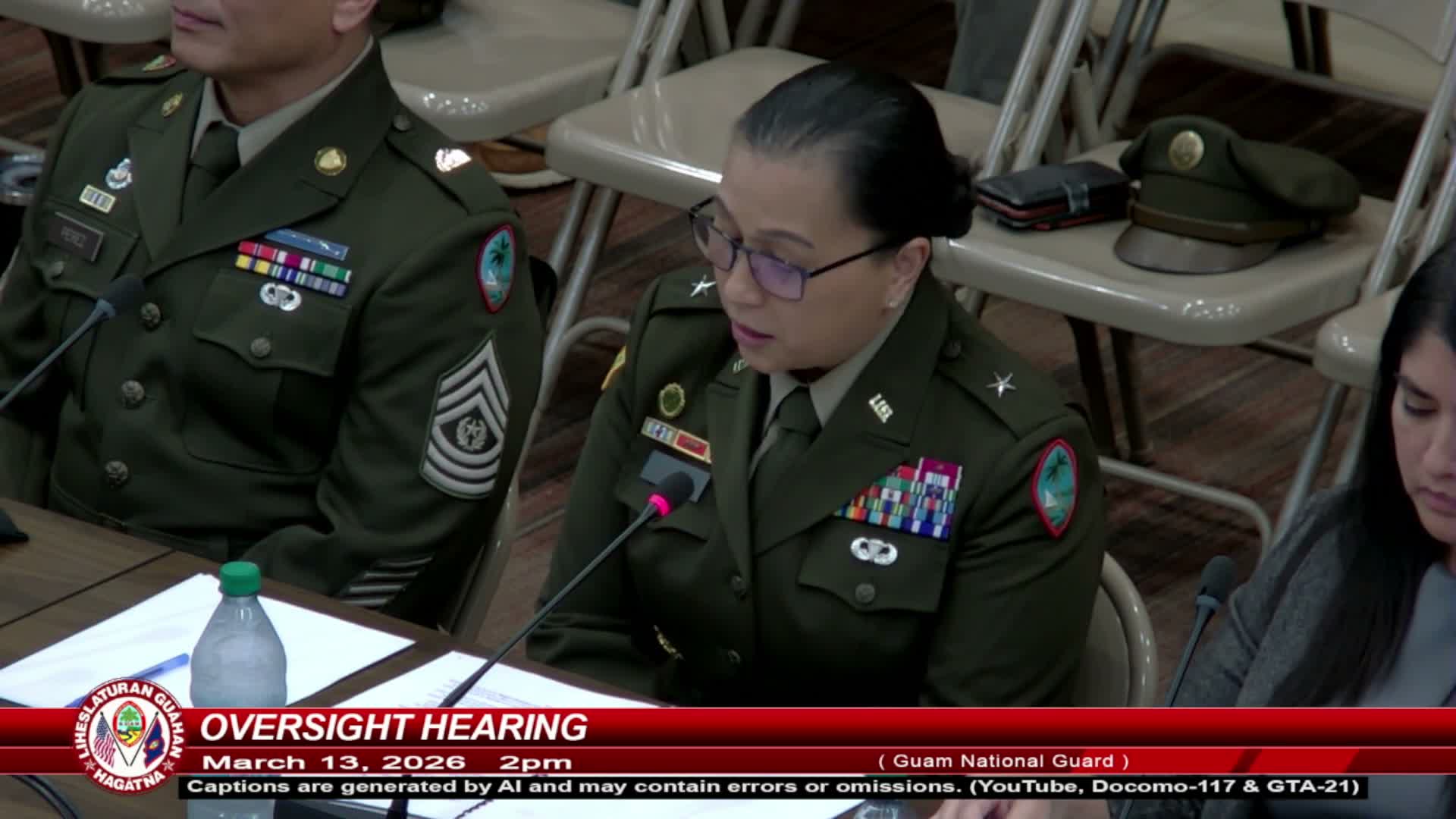
Department of Military Affairs leaders told the Guam Legislature on March 13 that they are moving toward performance-based budgeting but face recurring challenges meeting local matching obligations tied to the National Guard Bureau cooperative agreement.
Brigadier General Karen L. Watson described the PBB goal as "to shift the conversation from how much we spent to what did we achieve for the people of Guam," and said PBB would align cooperative-agreement funds with KPIs such as facility readiness and troop response times. Watson also noted that cooperative agreements must comply with federal regulations, including 2 CFR part 200.
Colonel Christian Cruz, the United States Property and Fiscal Officer (USPFO) for Guam, summarized the cooperative-agreement structure and its funding rules: "Of these 10, 8 are funded 100% by the federal government. Only 2 of the appendices requires 25% cost share from the government of Guam." He explained in-kind federal procurement and the annual verification and reimbursement process his office performs.
Officials and senators discussed budget numbers. The chair cited DMA's FY2026 general-fund appropriation of $1,197,710 and the governor's FY2027 request of $1,442,005.79. USPFO and DMA representatives said the FY2026 federal share was "around $11,400,000" on the continuing-resolution baseline. The briefing listed an FY2025 economic impact of roughly $146,100,000, while leaders variously cited force-size estimates of more than 1,200 and approximately 1,500 soldiers and airmen.
On grants, DMA said it currently oversees 10 active grants. The agency explained a FY2025 discrepancy between two federal totals ($10,571,313 vs. $17,100,000 reported by BBMR) as the mid-year addition of an "act of nature" grant for typhoon damages, which the USPFO described as 100% reimbursable and therefore not requiring the 25% local cost share tied to certain appendices. Nevertheless, DMA acknowledged it has not fully met the 75% federal/25% local match on some cooperative-agreement-funded items over the past three years and said reconciliation and corrective action remain ongoing.
DMA quartermaster Kathleen Paredo told senators that some prior-year obligations were carried over with USPFO approval and that construction projects and contracting timelines explain much of the unexpended balance; she also listed non-cooperative-agreement expenses such as internet and telephone services that DMA pays from local funds.
Senators urged DMA to be proactive in requesting matching funding and to coordinate with BBMR, DOA and USPFO to avoid losing federal opportunities. The committee asked for the Master Cooperative Agreement and status updates on corrective actions and audits. The hearing closed without votes; committee members said they would follow up during the fiscal cycle.
Brigadier General Karen L. Watson described the PBB goal as "to shift the conversation from how much we spent to what did we achieve for the people of Guam," and said PBB would align cooperative-agreement funds with KPIs such as facility readiness and troop response times. Watson also noted that cooperative agreements must comply with federal regulations, including 2 CFR part 200.
Colonel Christian Cruz, the United States Property and Fiscal Officer (USPFO) for Guam, summarized the cooperative-agreement structure and its funding rules: "Of these 10, 8 are funded 100% by the federal government. Only 2 of the appendices requires 25% cost share from the government of Guam." He explained in-kind federal procurement and the annual verification and reimbursement process his office performs.
Officials and senators discussed budget numbers. The chair cited DMA's FY2026 general-fund appropriation of $1,197,710 and the governor's FY2027 request of $1,442,005.79. USPFO and DMA representatives said the FY2026 federal share was "around $11,400,000" on the continuing-resolution baseline. The briefing listed an FY2025 economic impact of roughly $146,100,000, while leaders variously cited force-size estimates of more than 1,200 and approximately 1,500 soldiers and airmen.
On grants, DMA said it currently oversees 10 active grants. The agency explained a FY2025 discrepancy between two federal totals ($10,571,313 vs. $17,100,000 reported by BBMR) as the mid-year addition of an "act of nature" grant for typhoon damages, which the USPFO described as 100% reimbursable and therefore not requiring the 25% local cost share tied to certain appendices. Nevertheless, DMA acknowledged it has not fully met the 75% federal/25% local match on some cooperative-agreement-funded items over the past three years and said reconciliation and corrective action remain ongoing.
DMA quartermaster Kathleen Paredo told senators that some prior-year obligations were carried over with USPFO approval and that construction projects and contracting timelines explain much of the unexpended balance; she also listed non-cooperative-agreement expenses such as internet and telephone services that DMA pays from local funds.
Senators urged DMA to be proactive in requesting matching funding and to coordinate with BBMR, DOA and USPFO to avoid losing federal opportunities. The committee asked for the Master Cooperative Agreement and status updates on corrective actions and audits. The hearing closed without votes; committee members said they would follow up during the fiscal cycle.
Don't Miss a Word: See the Full Meeting!
Go beyond summaries. Unlock every video, transcript, and key insight with a Founder Membership.
✓
Get instant access to full meeting videos
✓
Search and clip any phrase from complete transcripts
✓
Receive AI-powered summaries & custom alerts
✓
Enjoy lifetime, unrestricted access to government data
30-day money-back guarantee
