Hanford reviews Brown Act update; council directs staff to add remote‑disruption policy, translation and outreach steps
May 05, 2026 | Hanford, Kings County, California
This article was created by AI summarizing key points discussed. AI makes mistakes, so for full details and context, please refer to the video of the full meeting. Please report any errors so we can fix them. Report an error »
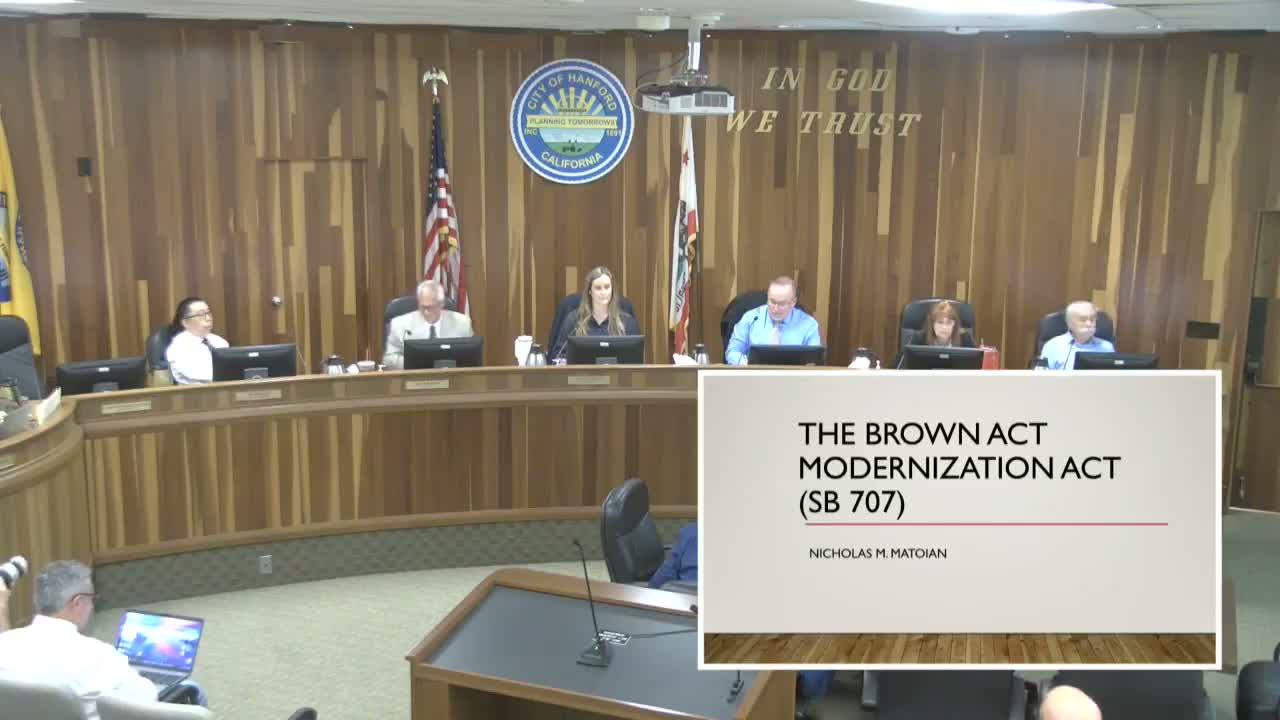
City Manager Nick Metoyan on Tuesday outlined the state’s 2025 Brown Act updates — Senate Bill 707 and the indefinite social‑media restrictions of Assembly Bill 992 — and recommended changes Hanford must make to meet the new requirements.
Metoyan told the City Council that SB 707 requires eligible legislative bodies to offer two‑way remote participation (audio and video when technology allows), adopt a policy to address disruptions to remote attendance, and make reasonable outreach and translation efforts. "SB 707 does make extensive updates to the Brown Act," Metoyan said, describing a required 60‑minute recess and an eventual roll‑call finding if a remote‑participation platform cannot be restored.
The law also requires eligible bodies to translate agendas and participation instructions into any language spoken by 20% or more of an applicable population that speaks English less than "very well" (measured by the American Community Survey). Metoyan said those requirements likely apply to Spanish‑speaking residents in Hanford. He added that teleconferencing provisions were expanded to include just‑cause exceptions and reasonable accommodations under laws such as the Americans with Disabilities Act.
Council members asked how the requirements would work in practice. One council member called the package an "unfunded mandate," and staff estimated initial implementation costs at roughly $10,000 for software and minor audio upgrades, while warning costs could rise over time. Metoyan and staff clarified that SB 707 requires translated agendas and a translated meeting‑information webpage but does not by itself mandate live simultaneous interpretation during meetings.
City staff recommended several handbook changes consistent with SB 707: add a disruption‑of‑remote‑participation policy, create a recommended public‑comment registration process for both in‑person and remote speakers (staff emphasized the registration would be recommended, not mandatory), maintain a dedicated webpage with translated instructions, and designate a physical location near the agenda posting site where translated materials can be accessed.
Council members signaled consensus to adopt the policy language into the handbook and directed staff to return a resolution for formal adoption no later than the next fiscal year and in advance of the July 1, 2026 compliance date. The council also asked staff to continue cost‑estimation work and to consult neighboring cities for implementation ideas.
What’s next: Staff will incorporate the recommended disruption and participation language into the council handbook and return a resolution for council adoption; implementation steps, estimated technology costs and outreach plans were flagged for future council review.
Metoyan told the City Council that SB 707 requires eligible legislative bodies to offer two‑way remote participation (audio and video when technology allows), adopt a policy to address disruptions to remote attendance, and make reasonable outreach and translation efforts. "SB 707 does make extensive updates to the Brown Act," Metoyan said, describing a required 60‑minute recess and an eventual roll‑call finding if a remote‑participation platform cannot be restored.
The law also requires eligible bodies to translate agendas and participation instructions into any language spoken by 20% or more of an applicable population that speaks English less than "very well" (measured by the American Community Survey). Metoyan said those requirements likely apply to Spanish‑speaking residents in Hanford. He added that teleconferencing provisions were expanded to include just‑cause exceptions and reasonable accommodations under laws such as the Americans with Disabilities Act.
Council members asked how the requirements would work in practice. One council member called the package an "unfunded mandate," and staff estimated initial implementation costs at roughly $10,000 for software and minor audio upgrades, while warning costs could rise over time. Metoyan and staff clarified that SB 707 requires translated agendas and a translated meeting‑information webpage but does not by itself mandate live simultaneous interpretation during meetings.
City staff recommended several handbook changes consistent with SB 707: add a disruption‑of‑remote‑participation policy, create a recommended public‑comment registration process for both in‑person and remote speakers (staff emphasized the registration would be recommended, not mandatory), maintain a dedicated webpage with translated instructions, and designate a physical location near the agenda posting site where translated materials can be accessed.
Council members signaled consensus to adopt the policy language into the handbook and directed staff to return a resolution for formal adoption no later than the next fiscal year and in advance of the July 1, 2026 compliance date. The council also asked staff to continue cost‑estimation work and to consult neighboring cities for implementation ideas.
What’s next: Staff will incorporate the recommended disruption and participation language into the council handbook and return a resolution for council adoption; implementation steps, estimated technology costs and outreach plans were flagged for future council review.
Don't Miss a Word: See the Full Meeting!
Go beyond summaries. Unlock every video, transcript, and key insight with a Founder Membership.
✓
Get instant access to full meeting videos
✓
Search and clip any phrase from complete transcripts
✓
Receive AI-powered summaries & custom alerts
✓
Enjoy lifetime, unrestricted access to government data
30-day money-back guarantee
