Gardner Institute: Arches timed-entry linked to lower park counts but county visitor spending rose
May 06, 2026 | Grand County Commission, Grand County Boards and Commissions, Grand County, Utah
This article was created by AI summarizing key points discussed. AI makes mistakes, so for full details and context, please refer to the video of the full meeting. Please report any errors so we can fix them. Report an error »
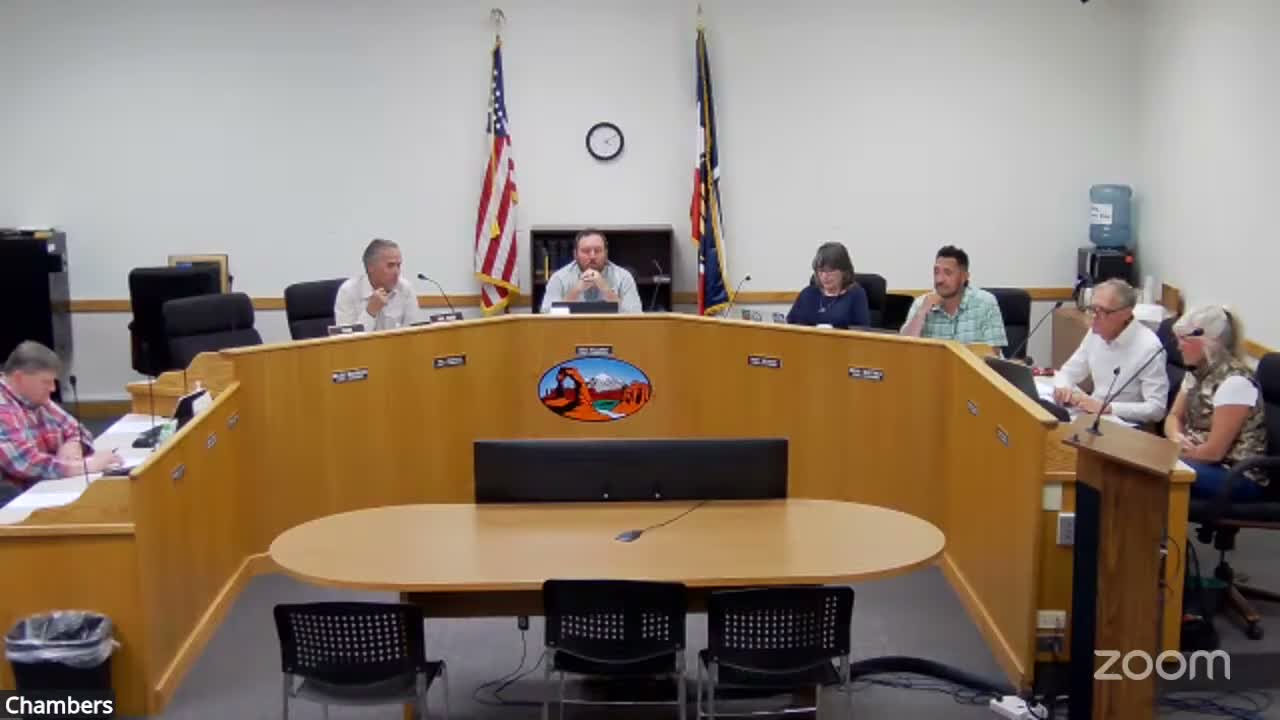
Phil Deal, research director and chief economist at the Kempe(y) Gardner Policy Institute, told the Grand County Commission on May 5 that the institute’s econometric analysis showed lower measured visitation at Arches National Park after a timed-entry system began, but higher overall visitor spending and private-sector job growth across Grand County during the same period.
Deal summarized the institute’s high-level findings, saying the report compares a 2017–2019 pre–timed-entry baseline with a 2022–2024 post–timed-entry period and uses counterfactual models to estimate what visitation would likely have been in the absence of timed entry. “We think there’s about a 14% difference between what we’re estimating would have happened in Arches otherwise versus what actually did happen,” Deal said during his presentation. He also said measured Arches visitation was roughly 9% lower in the 2022–24 window compared with the recent baseline, while countywide visitor spending and private-sector jobs rose on an inflation-adjusted basis.
Why it matters: Commissioners and residents have been debating whether a timed-entry system at Arches shifts visitors to other nearby recreation sites or reduces local tourism receipts. The Gardner Institute’s analysis attempts to separate the park-level effect from countywide outcomes, using actual data where available and several model variants to estimate counterfactuals.
Commissioners asked for the exact figures tied to the study’s memorandum of agreement (MOU). Commissioner Martinez requested the report section that provides a “detailed estimate of annual visitor spending in Grand County pre- and post-implementation” and the counterfactual comparisons called for in the MOU. Deal said the requested tables and appendices (identified in the presentation as appendix F and tables F3–F4) include the mappings required by the MOU and that the institute would provide the slide deck and a crosswalk to the commission by email.
Context and limits: Deal repeatedly emphasized that the econometric results are estimates and that the analysis combines direct data with modeled counterfactuals; he urged commissioners to consult the full 30+-page report for method and sensitivity tables. He described an interquartile band of alternative model specifications and cautioned that pandemic-era anomalies complicate direct comparisons.
At the public comment period before the presentation, resident Mary O’Brien criticized the county’s motivations for commissioning the study, urging transparency and wider public access to the report. O’Brien alleged that contracting for the report had been part of a broader set of political actions around park management; the county subsequently agreed to attach the report and related materials to the meeting agenda and post them on official social channels when the institute provided them.
Next steps: The institute offered to deliver the detailed appendices and a condensed slide deck to the county. The commission asked that follow-up technical questions be submitted in writing so the institute can involve coauthors or statisticians named in the report.
Deal summarized the institute’s high-level findings, saying the report compares a 2017–2019 pre–timed-entry baseline with a 2022–2024 post–timed-entry period and uses counterfactual models to estimate what visitation would likely have been in the absence of timed entry. “We think there’s about a 14% difference between what we’re estimating would have happened in Arches otherwise versus what actually did happen,” Deal said during his presentation. He also said measured Arches visitation was roughly 9% lower in the 2022–24 window compared with the recent baseline, while countywide visitor spending and private-sector jobs rose on an inflation-adjusted basis.
Why it matters: Commissioners and residents have been debating whether a timed-entry system at Arches shifts visitors to other nearby recreation sites or reduces local tourism receipts. The Gardner Institute’s analysis attempts to separate the park-level effect from countywide outcomes, using actual data where available and several model variants to estimate counterfactuals.
Commissioners asked for the exact figures tied to the study’s memorandum of agreement (MOU). Commissioner Martinez requested the report section that provides a “detailed estimate of annual visitor spending in Grand County pre- and post-implementation” and the counterfactual comparisons called for in the MOU. Deal said the requested tables and appendices (identified in the presentation as appendix F and tables F3–F4) include the mappings required by the MOU and that the institute would provide the slide deck and a crosswalk to the commission by email.
Context and limits: Deal repeatedly emphasized that the econometric results are estimates and that the analysis combines direct data with modeled counterfactuals; he urged commissioners to consult the full 30+-page report for method and sensitivity tables. He described an interquartile band of alternative model specifications and cautioned that pandemic-era anomalies complicate direct comparisons.
At the public comment period before the presentation, resident Mary O’Brien criticized the county’s motivations for commissioning the study, urging transparency and wider public access to the report. O’Brien alleged that contracting for the report had been part of a broader set of political actions around park management; the county subsequently agreed to attach the report and related materials to the meeting agenda and post them on official social channels when the institute provided them.
Next steps: The institute offered to deliver the detailed appendices and a condensed slide deck to the county. The commission asked that follow-up technical questions be submitted in writing so the institute can involve coauthors or statisticians named in the report.
View the Full Meeting & All Its Details
This article offers just a summary. Unlock complete video, transcripts, and insights as a Founder Member.
✓
Watch full, unedited meeting videos
✓
Search every word spoken in unlimited transcripts
✓
AI summaries & real-time alerts (all government levels)
✓
Permanent access to expanding government content
30-day money-back guarantee
