Austin Public Health IT demos internal AI-enabled services platform, asks commission to help move it into production
May 06, 2026 | Austin, Travis County, Texas
This article was created by AI summarizing key points discussed. AI makes mistakes, so for full details and context, please refer to the video of the full meeting. Please report any errors so we can fix them. Report an error »
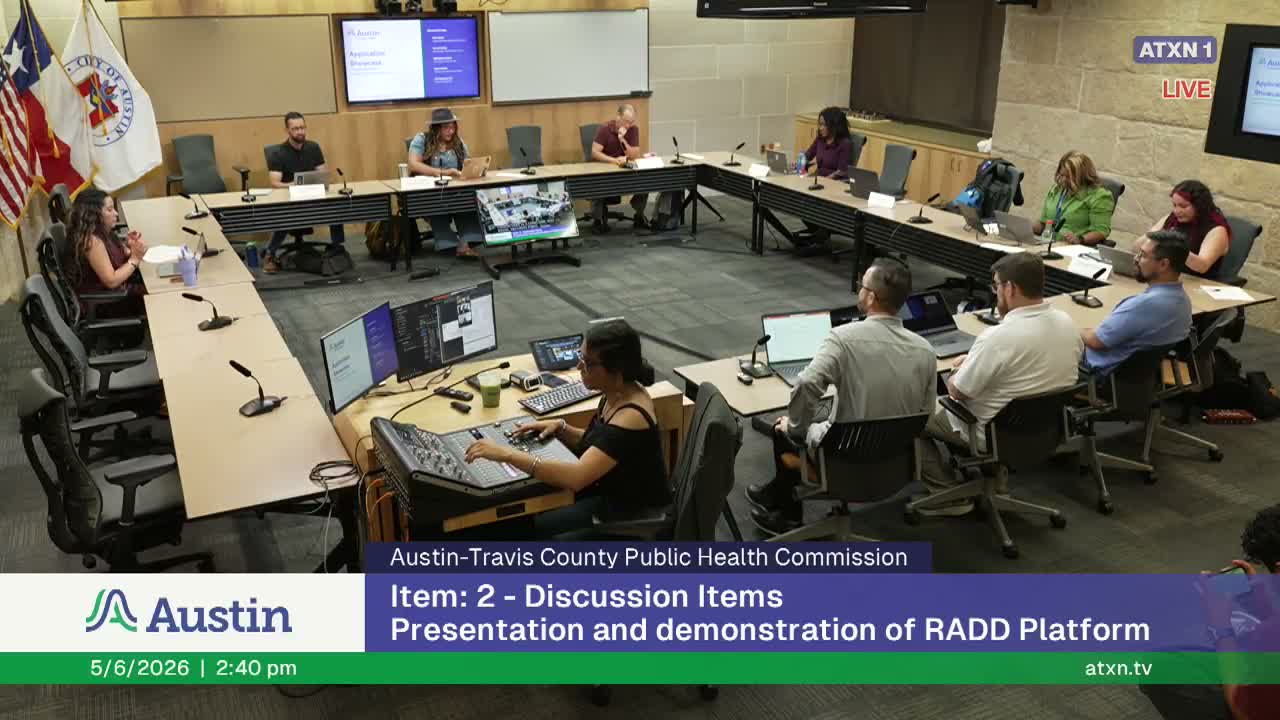
Austin Public Health IT staff demonstrated an internal rapid application development platform the department says can accelerate service delivery and program analytics without large vendor contracts. "We're not here to propose to build something new, asking for money, asking for headcount," said Philip Ayes, IT manager senior for Austin Public Health. He described a platform built on the city's Azure/ATS infrastructure that the team has developed over roughly three years and that already supports about 17 working applications.
Christopher Collins, introduced by Ayes as a scrum master and AI architect, showed a services catalog and an AI-powered conversational front end that can create a personalized "map" of city, county, state, federal and nonprofit programs for a resident in their native language. "A resident can sit down, describe what they're going through in any language, [and] walks out with a personalized map of the city ... for things they actually qualify for," Collins said. The backend admin dashboard, he said, surfaces demand by ZIP code, tracks completion rates and can generate equity flags and downloadable reports for program managers.
Brian Morris, introduced as an IT service owner and AI engineer, demonstrated a triage/chat proof of concept that performs first-level needs assessment and presents cases on a staff dashboard for follow-up. Presenters emphasized modular "code Legos" and a reusable services directory: "We designed it to be reusable across any use case ... we can go from an idea to a solution in about a week," Ayes said.
Commissioners asked about production barriers, costs and pilot options. Ayes said the platform currently sits in a development sandbox and needs a production environment and internal "Citi" dollars for server and storage to scale, but not headcount or external vendor buy-in. Commissioners recommended showing the tools to other city departments, selecting a low-risk "beachhead" pilot and considering derisking by initially deploying non-AI versions of some features. Several commissioners offered to help define pilot scope and to receive a live demonstration. A community health worker who spoke later urged that any referral system include reliable follow-up (citing prior referral systems where referrals were not picked up by agencies) and suggested partnering with 211/United Way or local nonprofits for outreach and follow-up.
The presenters left handouts and offered deeper demos; the commission said staff would follow up about scheduling departmental demos and compiling technical questions.
Christopher Collins, introduced by Ayes as a scrum master and AI architect, showed a services catalog and an AI-powered conversational front end that can create a personalized "map" of city, county, state, federal and nonprofit programs for a resident in their native language. "A resident can sit down, describe what they're going through in any language, [and] walks out with a personalized map of the city ... for things they actually qualify for," Collins said. The backend admin dashboard, he said, surfaces demand by ZIP code, tracks completion rates and can generate equity flags and downloadable reports for program managers.
Brian Morris, introduced as an IT service owner and AI engineer, demonstrated a triage/chat proof of concept that performs first-level needs assessment and presents cases on a staff dashboard for follow-up. Presenters emphasized modular "code Legos" and a reusable services directory: "We designed it to be reusable across any use case ... we can go from an idea to a solution in about a week," Ayes said.
Commissioners asked about production barriers, costs and pilot options. Ayes said the platform currently sits in a development sandbox and needs a production environment and internal "Citi" dollars for server and storage to scale, but not headcount or external vendor buy-in. Commissioners recommended showing the tools to other city departments, selecting a low-risk "beachhead" pilot and considering derisking by initially deploying non-AI versions of some features. Several commissioners offered to help define pilot scope and to receive a live demonstration. A community health worker who spoke later urged that any referral system include reliable follow-up (citing prior referral systems where referrals were not picked up by agencies) and suggested partnering with 211/United Way or local nonprofits for outreach and follow-up.
The presenters left handouts and offered deeper demos; the commission said staff would follow up about scheduling departmental demos and compiling technical questions.
View the Full Meeting & All Its Details
This article offers just a summary. Unlock complete video, transcripts, and insights as a Founder Member.
✓
Watch full, unedited meeting videos
✓
Search every word spoken in unlimited transcripts
✓
AI summaries & real-time alerts (all government levels)
✓
Permanent access to expanding government content
30-day money-back guarantee
