Public-health commissioners refine draft recommendations on HIV prevention funding, heat-illness protections and dedicated 'cap-and-stitch' revenue
May 06, 2026 | Austin, Travis County, Texas
This article was created by AI summarizing key points discussed. AI makes mistakes, so for full details and context, please refer to the video of the full meeting. Please report any errors so we can fix them. Report an error »
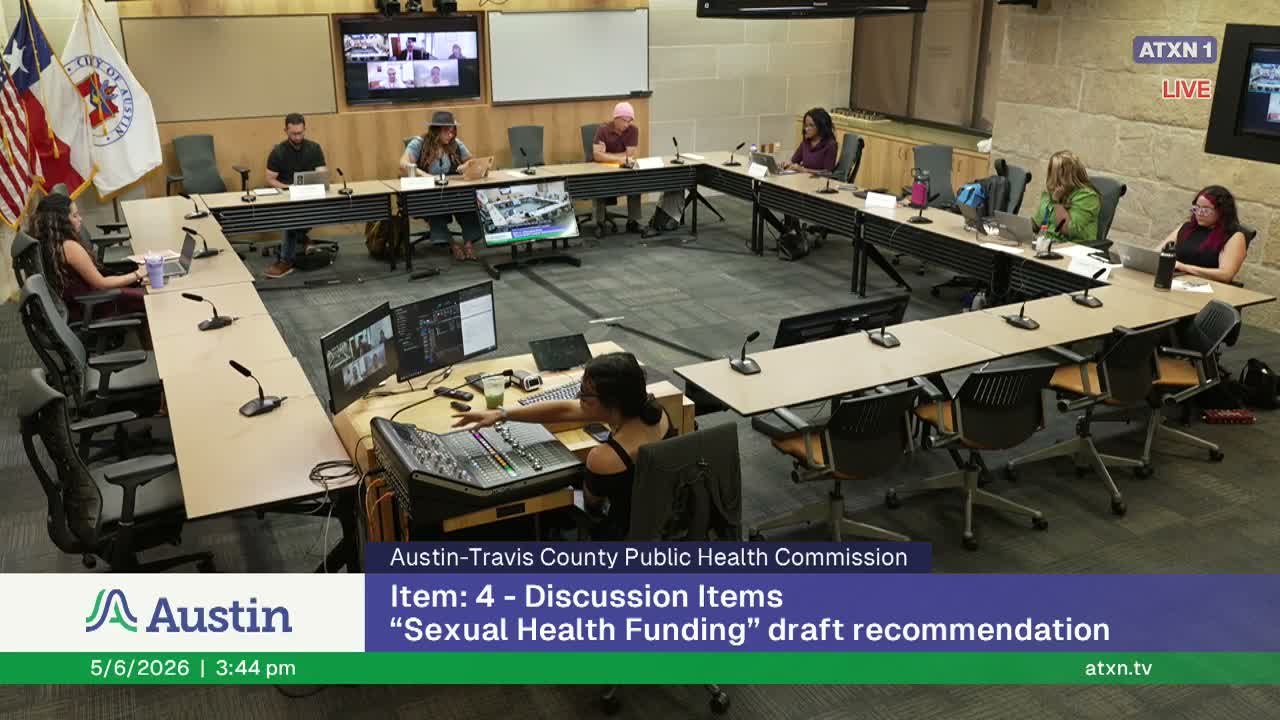
Commissioners used the meeting to update and coordinate several draft recommendations the commission may vote on at a future meeting.
Commissioner Jacob Whitty reported edits to a draft HIV-prevention funding recommendation that added a WHEREAS noting the cost-effectiveness of preventing HIV — "preventing 1 new HIV infection yields an estimated $300,000 plus costs saved for lifetime medical costs," he said — and removed an earlier explicit monetary attachment. Whitty also added language to recommend that disease-intervention specialists and public-health follow-up be included at the county level with Travis County Health and Human Services. He asked commissioners to email any editorial input so the commission can consider a final vote at the next meeting.
Vice Chair Dollhausen described progress on a draft recommendation addressing heat-related illness prevention for outdoor workers. She said she will circulate a revised draft plus supporting OSHA consultation materials by email and asked commissioners to confirm changes or provide written feedback within the commission’s 10-day review window rather than pursuing extended verbal edits during the meeting.
Commissioner Chris Crocombe presented a bridging-public-health-funding recommendation tied to development revenue from a project he referred to as the "cap and stitch." Citing a report, he said estimated annual property-tax revenue from developing soft sites and nearby value premiums could be between $12 million and nearly $40 million. Crocombe proposed dedicating 35% of that revenue to Austin Public Health, which he said would translate to roughly $4 million–$14 million annually. He said he removed a previously proposed fixed-dollar ask and intentionally left implementation details flexible — the funds could be distributed as grants, contracts or direct APH programming at APH’s discretion — and invited discussion about whether the dedication should be supplemental to APH’s existing budget.
Commissioner Leung raised concerns about whether funds distributed through grants might impose federal reporting requirements on nonprofits that could deter or jeopardize services for immigrants and refugees; Crocombe said the recommendation intentionally left uses flexible so APH could choose delivery mechanisms that protect clients and meet program needs. Commissioners agreed to circulate drafts and to bring finalized language for a vote at a future meeting.
Commissioner Jacob Whitty reported edits to a draft HIV-prevention funding recommendation that added a WHEREAS noting the cost-effectiveness of preventing HIV — "preventing 1 new HIV infection yields an estimated $300,000 plus costs saved for lifetime medical costs," he said — and removed an earlier explicit monetary attachment. Whitty also added language to recommend that disease-intervention specialists and public-health follow-up be included at the county level with Travis County Health and Human Services. He asked commissioners to email any editorial input so the commission can consider a final vote at the next meeting.
Vice Chair Dollhausen described progress on a draft recommendation addressing heat-related illness prevention for outdoor workers. She said she will circulate a revised draft plus supporting OSHA consultation materials by email and asked commissioners to confirm changes or provide written feedback within the commission’s 10-day review window rather than pursuing extended verbal edits during the meeting.
Commissioner Chris Crocombe presented a bridging-public-health-funding recommendation tied to development revenue from a project he referred to as the "cap and stitch." Citing a report, he said estimated annual property-tax revenue from developing soft sites and nearby value premiums could be between $12 million and nearly $40 million. Crocombe proposed dedicating 35% of that revenue to Austin Public Health, which he said would translate to roughly $4 million–$14 million annually. He said he removed a previously proposed fixed-dollar ask and intentionally left implementation details flexible — the funds could be distributed as grants, contracts or direct APH programming at APH’s discretion — and invited discussion about whether the dedication should be supplemental to APH’s existing budget.
Commissioner Leung raised concerns about whether funds distributed through grants might impose federal reporting requirements on nonprofits that could deter or jeopardize services for immigrants and refugees; Crocombe said the recommendation intentionally left uses flexible so APH could choose delivery mechanisms that protect clients and meet program needs. Commissioners agreed to circulate drafts and to bring finalized language for a vote at a future meeting.
View the Full Meeting & All Its Details
This article offers just a summary. Unlock complete video, transcripts, and insights as a Founder Member.
✓
Watch full, unedited meeting videos
✓
Search every word spoken in unlimited transcripts
✓
AI summaries & real-time alerts (all government levels)
✓
Permanent access to expanding government content
30-day money-back guarantee
