Hermosa Beach commissions warn of growing backlog, prioritize pier, city yard, windows and stormwater work
May 06, 2026 | Hermosa Beach City, Los Angeles County, California
This article was created by AI summarizing key points discussed. AI makes mistakes, so for full details and context, please refer to the video of the full meeting. Please report any errors so we can fix them. Report an error »
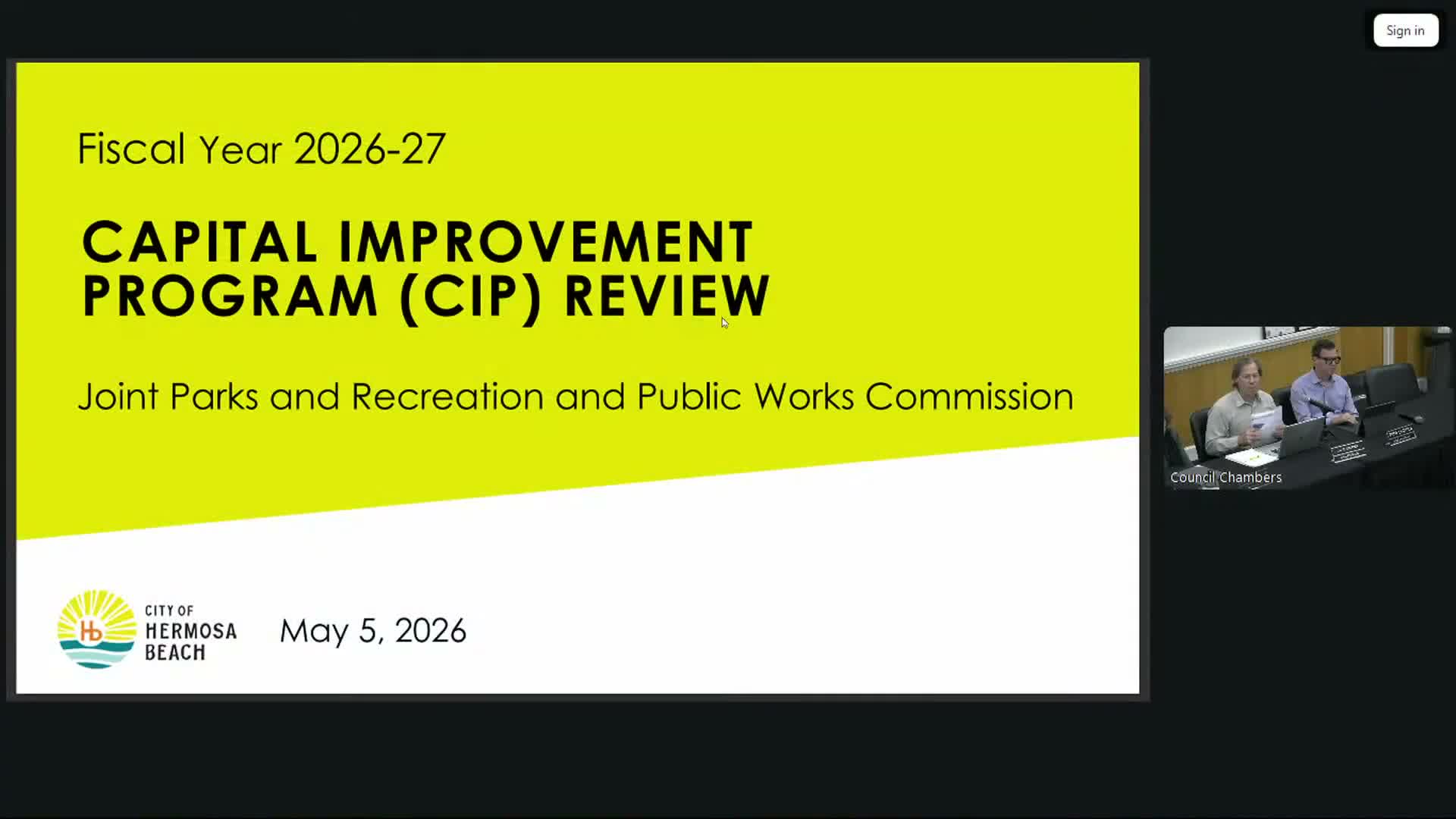
Hermosa Beach’s Public Works director told two advisory commissions on May 5 that the city’s capital improvement program (CIP) is at a critical inflection point: staff capacity and available funds, both strained, are forcing the city to prioritize safety and core infrastructure repairs over new enhancements.
"Staffing and funding remains very constrained," Public Works Director Joe San Clemente said as he opened a detailed review of the proposed FY 2026–27 CIP. He told the joint meeting of the Public Works and Parks & Recreation commissions that the department is at or over capacity for the next two fiscal years and that "deferring projects is no longer a sustainable strategy."
Why it matters: San Clemente’s presentation identified a short list of projects that must be advanced — the pier, the city yard, community center window replacement and critical pavement and sewer work — while flagging a much longer set of deferred and unfunded needs. Administrative Services Director Brandon Walker summarized the fiscal context, saying the city has been living off one‑time COVID and vacancy savings and now faces a structural gap in the CIP. Walker said the city typically needs on the order of $8 million to $12 million a year to maintain basic infrastructure but is replenishing at roughly $4 million to $6 million.
Key takeaways from staff:
- Staffing: San Clemente said the public works team is small (about 10 engineers) and that losing a single staffer can reduce capacity by roughly 10 percent.
- Funding: Walker said one‑time pandemic funds are exhausted and that most CIP funding sources are restricted by grant rules or state/county strings.
- Unfunded needs: staff reported roughly $59 million of near‑term unfunded project needs, with a broader deferred list that can exceed triple that depending on scope.
Projects and recommendations:
- High‑priority projects staff urged commissioners to support included near‑term structural repairs to the pier (work that staff said must be completed by 2027 to avoid closures), continued work on the city yard, design and permitting for community center window replacements, and expanded paving and sewer work.
- Staff recommended removing two items from the FY27 CIP and placing them on the deferred/unfunded list: a comprehensive downtown lighting project and a community‑center secondary tsunami siren project. In their place staff proposed two limited roofing projects (police building and the lawn bowling building) for this cycle.
What residents said: Dozens of public commenters urged action on a range of priorities. Tara, a resident who has petitioned for a pool, said the city must partner with residents and outside agencies to deliver a pool and noted "If you build it, they will come." Christine Schultz and others urged the commissions not to make residents shoulder implementation alone. Several speakers pressed staff about specific tradeoffs and urged more transparent tracking of project start/end dates and scope changes.
Contested details and community concerns: A number of public speakers criticized recent construction choices at Clark Field. Jackie Tagliaferro described a newly installed windscreen as "a solid ugly obtrusive black box," arguing it blocks sightlines and raises safety issues for parents and park users. Staff told commissioners they removed parts of the screen (east side) and would consider further changes while noting much of the current configuration followed contract plans and design submittals.
Numbers and fiscal framing: Tony Higgins, a virtual commenter, cited study figures in the meeting suggesting large program subsidies for parks and rec services; staff acknowledged the fee study and said fee recommendations will return to the commission before council action. Walker highlighted the city’s structural dilemma: without a new ongoing revenue stream, the pace of repairs and replacements will outstrip the city’s ability to replenish the CIP.
What the commissions did: After deliberation the Public Works and Parks & Recreation commissions separately moved to accept staff’s CIP recommendations and to receive and file the report; both motions passed by voice vote. The commissions will forward their feedback to City Council as the budget process continues.
Next steps: Staff said it will take commission feedback to the city council and continue refining scopes and schedules; several commissioners urged staff to publish clearer project tracking (start dates, scope changes, percent complete) and to keep the public better informed about trade‑offs and timelines.
"Staffing and funding remains very constrained," Public Works Director Joe San Clemente said as he opened a detailed review of the proposed FY 2026–27 CIP. He told the joint meeting of the Public Works and Parks & Recreation commissions that the department is at or over capacity for the next two fiscal years and that "deferring projects is no longer a sustainable strategy."
Why it matters: San Clemente’s presentation identified a short list of projects that must be advanced — the pier, the city yard, community center window replacement and critical pavement and sewer work — while flagging a much longer set of deferred and unfunded needs. Administrative Services Director Brandon Walker summarized the fiscal context, saying the city has been living off one‑time COVID and vacancy savings and now faces a structural gap in the CIP. Walker said the city typically needs on the order of $8 million to $12 million a year to maintain basic infrastructure but is replenishing at roughly $4 million to $6 million.
Key takeaways from staff:
- Staffing: San Clemente said the public works team is small (about 10 engineers) and that losing a single staffer can reduce capacity by roughly 10 percent.
- Funding: Walker said one‑time pandemic funds are exhausted and that most CIP funding sources are restricted by grant rules or state/county strings.
- Unfunded needs: staff reported roughly $59 million of near‑term unfunded project needs, with a broader deferred list that can exceed triple that depending on scope.
Projects and recommendations:
- High‑priority projects staff urged commissioners to support included near‑term structural repairs to the pier (work that staff said must be completed by 2027 to avoid closures), continued work on the city yard, design and permitting for community center window replacements, and expanded paving and sewer work.
- Staff recommended removing two items from the FY27 CIP and placing them on the deferred/unfunded list: a comprehensive downtown lighting project and a community‑center secondary tsunami siren project. In their place staff proposed two limited roofing projects (police building and the lawn bowling building) for this cycle.
What residents said: Dozens of public commenters urged action on a range of priorities. Tara, a resident who has petitioned for a pool, said the city must partner with residents and outside agencies to deliver a pool and noted "If you build it, they will come." Christine Schultz and others urged the commissions not to make residents shoulder implementation alone. Several speakers pressed staff about specific tradeoffs and urged more transparent tracking of project start/end dates and scope changes.
Contested details and community concerns: A number of public speakers criticized recent construction choices at Clark Field. Jackie Tagliaferro described a newly installed windscreen as "a solid ugly obtrusive black box," arguing it blocks sightlines and raises safety issues for parents and park users. Staff told commissioners they removed parts of the screen (east side) and would consider further changes while noting much of the current configuration followed contract plans and design submittals.
Numbers and fiscal framing: Tony Higgins, a virtual commenter, cited study figures in the meeting suggesting large program subsidies for parks and rec services; staff acknowledged the fee study and said fee recommendations will return to the commission before council action. Walker highlighted the city’s structural dilemma: without a new ongoing revenue stream, the pace of repairs and replacements will outstrip the city’s ability to replenish the CIP.
What the commissions did: After deliberation the Public Works and Parks & Recreation commissions separately moved to accept staff’s CIP recommendations and to receive and file the report; both motions passed by voice vote. The commissions will forward their feedback to City Council as the budget process continues.
Next steps: Staff said it will take commission feedback to the city council and continue refining scopes and schedules; several commissioners urged staff to publish clearer project tracking (start dates, scope changes, percent complete) and to keep the public better informed about trade‑offs and timelines.
Don't Miss a Word: See the Full Meeting!
Go beyond summaries. Unlock every video, transcript, and key insight with a Founder Membership.
✓
Get instant access to full meeting videos
✓
Search and clip any phrase from complete transcripts
✓
Receive AI-powered summaries & custom alerts
✓
Enjoy lifetime, unrestricted access to government data
30-day money-back guarantee
