West Bend committee recommends one‑year pilot of new online platform for alternative education
May 06, 2026 | West Bend School District, School Districts, Wisconsin
This article was created by AI summarizing key points discussed. AI makes mistakes, so for full details and context, please refer to the video of the full meeting. Please report any errors so we can fix them. Report an error »
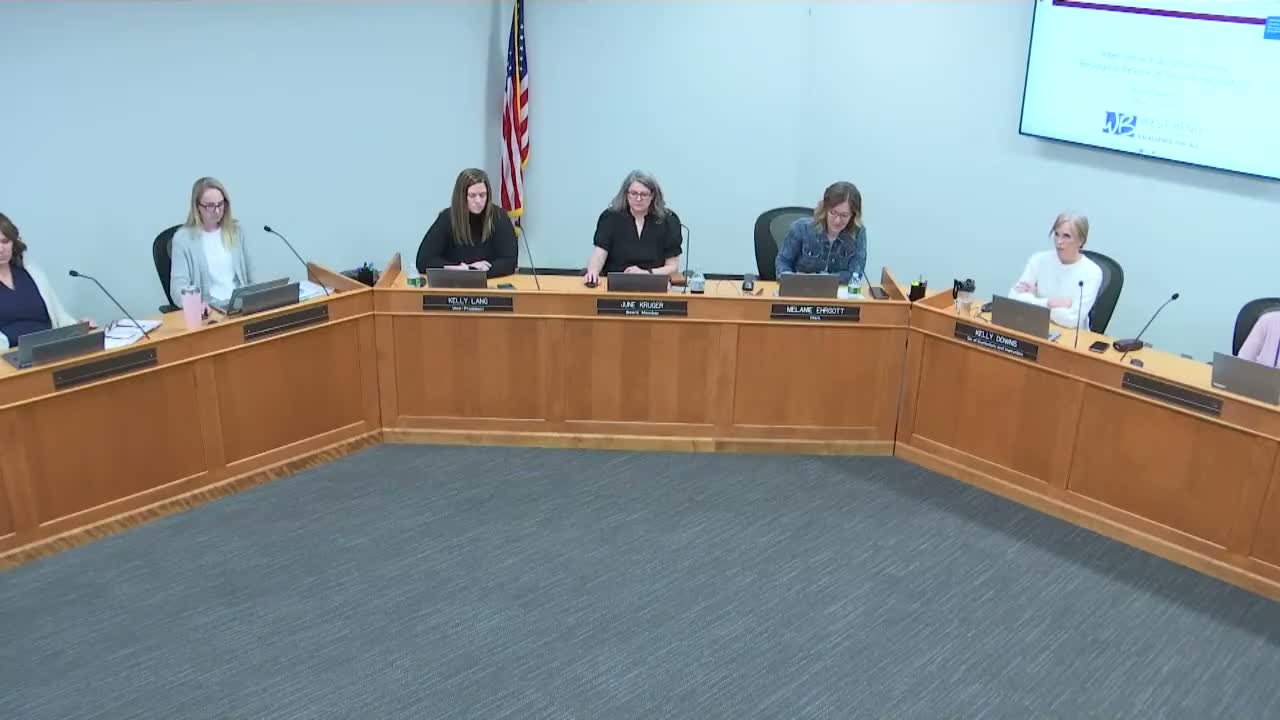
Jill Corbett, a presenter for the curriculum review team, recommended the district pilot a new online learning platform for alternative‑education students and credit‑recovery work, saying the platform produced higher engagement and tasks that require written reasoning rather than mainly multiple‑choice responses.
Corbett told the committee the district has relied on Imagine Edgenuity for roughly 15 years but found long, lecture‑style videos and mostly multiple‑choice assessments limit deeper learning. “We really believe this kind of is a superior solution for our students and staff,” Corbett said, summarizing teacher and student feedback from a recent pilot.
Why it matters: Committee members said the district uses online platforms for short‑term needs — for example, medical homebound instruction or credit recovery — and that the right tool must both support varied learners and connect to district systems. Corbett described the piloted platform as offering shorter videos (three to 15 minutes), interactive tasks, written‑response items that require explanation, multilingual supports and Skyward integration for grading visibility.
Costs and licensing: Corbett presented a preliminary cost comparison. The district’s current multi‑building Edgenuity setup was described as having an equivalent annualized district cost of about $43,568; the Subject site license quote was shown at about $47,600 per year with a concurrent‑user model (approximately 140 concurrent seats) and the ability to adjust counts midyear. Corbett recommended a one‑year district pilot to validate full implementation before a longer commitment.
Board questions and next steps: Board member Melanie Ergot asked whether the budgetary impacts had been vetted; Corbett said finance has been part of the discussion and staff believe the estimate fits within anticipated allocations. Tina Van Roo advised caution about “chasing another tool” and urged staff to be sure implementation and outcomes justify the transition. Committee staff noted the item will be forwarded to the Board of Education for either consent or discussion and approval.
What happens next: The committee voted to forward the recommendation to the Board for action at a future meeting; no final contract or multi‑year commitment was approved at the committee level.
Corbett told the committee the district has relied on Imagine Edgenuity for roughly 15 years but found long, lecture‑style videos and mostly multiple‑choice assessments limit deeper learning. “We really believe this kind of is a superior solution for our students and staff,” Corbett said, summarizing teacher and student feedback from a recent pilot.
Why it matters: Committee members said the district uses online platforms for short‑term needs — for example, medical homebound instruction or credit recovery — and that the right tool must both support varied learners and connect to district systems. Corbett described the piloted platform as offering shorter videos (three to 15 minutes), interactive tasks, written‑response items that require explanation, multilingual supports and Skyward integration for grading visibility.
Costs and licensing: Corbett presented a preliminary cost comparison. The district’s current multi‑building Edgenuity setup was described as having an equivalent annualized district cost of about $43,568; the Subject site license quote was shown at about $47,600 per year with a concurrent‑user model (approximately 140 concurrent seats) and the ability to adjust counts midyear. Corbett recommended a one‑year district pilot to validate full implementation before a longer commitment.
Board questions and next steps: Board member Melanie Ergot asked whether the budgetary impacts had been vetted; Corbett said finance has been part of the discussion and staff believe the estimate fits within anticipated allocations. Tina Van Roo advised caution about “chasing another tool” and urged staff to be sure implementation and outcomes justify the transition. Committee staff noted the item will be forwarded to the Board of Education for either consent or discussion and approval.
What happens next: The committee voted to forward the recommendation to the Board for action at a future meeting; no final contract or multi‑year commitment was approved at the committee level.
Don't Miss a Word: See the Full Meeting!
Go beyond summaries. Unlock every video, transcript, and key insight with a Founder Membership.
✓
Get instant access to full meeting videos
✓
Search and clip any phrase from complete transcripts
✓
Receive AI-powered summaries & custom alerts
✓
Enjoy lifetime, unrestricted access to government data
30-day money-back guarantee
