Tri County outlines $3 billion draft transportation plan; public comments due June 1
May 06, 2026 | Dauphin County, Pennsylvania
This article was created by AI summarizing key points discussed. AI makes mistakes, so for full details and context, please refer to the video of the full meeting. Please report any errors so we can fix them. Report an error »
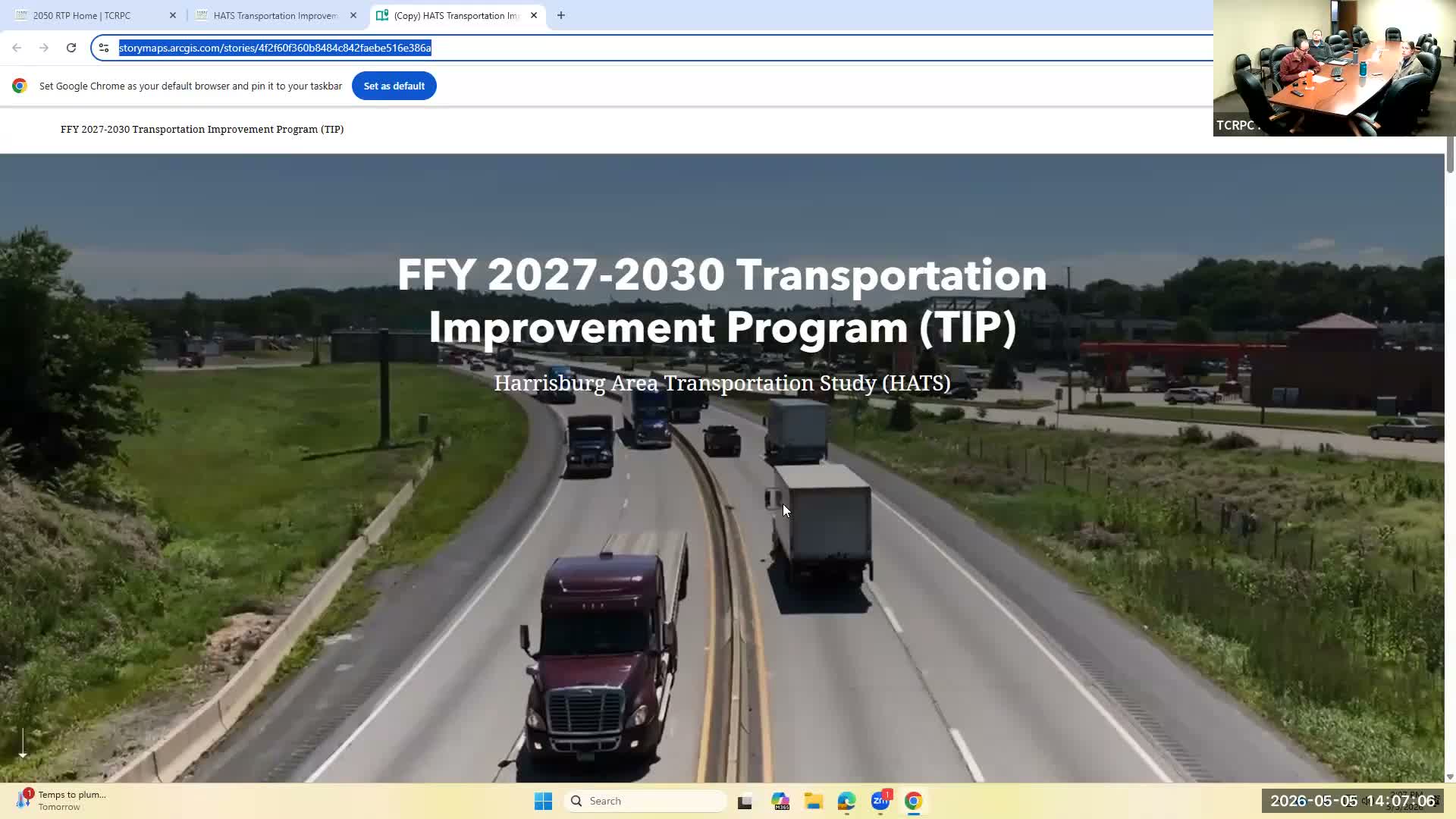
Andrew Bomburger, executive director of the Tri County Regional Planning Commission, on a virtual public meeting on May 1 presented the draft 2027–2030 Transportation Improvement Program (TIP) and told residents that official public comments must be submitted to Brian Snyder by 4 p.m. on June 1 to be included in the record. "Official comments need to be submitted to Brian by 4PM on June 1, to be kind of considered as part of the package," Bomburger said.
The draft TIP lists about 100 projects across Dauphin, Cumberland and Perry counties that, when fully built, represent roughly $3,000,000,000 of investment in transportation infrastructure, Bomburger said. "Once fully constructed, we'll see that it will represent about $3,000,000,000 in investment," he said. He noted that not all of that money will be spent in the TIP’s four-year window because many projects span multiple TIP cycles.
Bomburger described how projects are added to the TIP: some come from PennDOT-driven asset management (inspections and preservation needs) while others come from the regional RTP project pipeline, which accepts transportation-need forms from municipalities and stakeholders for prioritization. He said the HATS metropolitan planning organization covers the three counties and that Tri County serves as the planning staff.
Key program totals and categories the presentation listed include about 61 bridge projects (about $460 million), 19 roadway projects (about $156 million) and roughly 13 bicycle/pedestrian projects (a little over $19 million). Interstate projects — largely work on I‑83, the Eisenhower interchange reconstruction and Southbridge — account for a very large share of planned spending, about $2.5 billion across eight projects.
Bomburger highlighted several notable projects that are part of the TIP package, including the Lemoyne bottleneck improvements (a multimodal safety and access project), Sporting Hill turn-lane and parallel trail planning, intersection work at Center Street and 21st Street, Riverland safety improvements coordinated with Clarks Ferry bridge preservation, the Market Street East/West bridges (two structures to be delivered together with an estimated combined construction cost of roughly $140 million and a 14-foot separated bike/ped structure), McLeay Street bridge work adding bike/ped accommodations, and PA 34 corridor safety improvements and replacement of the PA 34 bridge over the Juniata River.
Bomburger said a county-specific bundle was created to address locally owned municipal bridges over 20 feet that are eligible for federal funding; Tri County worked with county bridge engineers to pick top candidates and programmed roughly $20 million across locally owned bridges in the three counties.
Funding context and near-term constraints were a focus of the briefing. Bomburger said the IIJA (the Infrastructure Investment and Jobs Act) boosted regional funding in prior TIP cycles, but projects funded then are now advancing into construction and, coupled with post-award inflation, have absorbed much of the available programming capacity. He warned that the current federal surface-transportation funding law expires Sept. 30 — the date this TIP would take effect — leaving reauthorization uncertainty until Congress acts.
Bomburger said Tri County completed required air-quality conformity work and that the conformity determination report is available on the TIP web page; he also described the public-facing TIP review documents and performance and demographic analyses available online. Public comments will be compiled and provided to the HATS technical committee and coordinating committee in June, with those committees expected to recommend and then adopt the TIP later in the month.
For those seeking more detail, Bomburger directed listeners to an interactive story map on Tri County’s TIP page and said physical copies of the TIP documents are available at each county planning commission office. He closed by thanking PennDOT staff on the call and municipal partners for participation.
Next steps: residents and stakeholders who want their remarks included in the record should submit written comments to Brian Snyder by 4 p.m. on June 1; Tri County will package comments for committee review in June and anticipates a committee recommendation and adoption later that month.
The draft TIP lists about 100 projects across Dauphin, Cumberland and Perry counties that, when fully built, represent roughly $3,000,000,000 of investment in transportation infrastructure, Bomburger said. "Once fully constructed, we'll see that it will represent about $3,000,000,000 in investment," he said. He noted that not all of that money will be spent in the TIP’s four-year window because many projects span multiple TIP cycles.
Bomburger described how projects are added to the TIP: some come from PennDOT-driven asset management (inspections and preservation needs) while others come from the regional RTP project pipeline, which accepts transportation-need forms from municipalities and stakeholders for prioritization. He said the HATS metropolitan planning organization covers the three counties and that Tri County serves as the planning staff.
Key program totals and categories the presentation listed include about 61 bridge projects (about $460 million), 19 roadway projects (about $156 million) and roughly 13 bicycle/pedestrian projects (a little over $19 million). Interstate projects — largely work on I‑83, the Eisenhower interchange reconstruction and Southbridge — account for a very large share of planned spending, about $2.5 billion across eight projects.
Bomburger highlighted several notable projects that are part of the TIP package, including the Lemoyne bottleneck improvements (a multimodal safety and access project), Sporting Hill turn-lane and parallel trail planning, intersection work at Center Street and 21st Street, Riverland safety improvements coordinated with Clarks Ferry bridge preservation, the Market Street East/West bridges (two structures to be delivered together with an estimated combined construction cost of roughly $140 million and a 14-foot separated bike/ped structure), McLeay Street bridge work adding bike/ped accommodations, and PA 34 corridor safety improvements and replacement of the PA 34 bridge over the Juniata River.
Bomburger said a county-specific bundle was created to address locally owned municipal bridges over 20 feet that are eligible for federal funding; Tri County worked with county bridge engineers to pick top candidates and programmed roughly $20 million across locally owned bridges in the three counties.
Funding context and near-term constraints were a focus of the briefing. Bomburger said the IIJA (the Infrastructure Investment and Jobs Act) boosted regional funding in prior TIP cycles, but projects funded then are now advancing into construction and, coupled with post-award inflation, have absorbed much of the available programming capacity. He warned that the current federal surface-transportation funding law expires Sept. 30 — the date this TIP would take effect — leaving reauthorization uncertainty until Congress acts.
Bomburger said Tri County completed required air-quality conformity work and that the conformity determination report is available on the TIP web page; he also described the public-facing TIP review documents and performance and demographic analyses available online. Public comments will be compiled and provided to the HATS technical committee and coordinating committee in June, with those committees expected to recommend and then adopt the TIP later in the month.
For those seeking more detail, Bomburger directed listeners to an interactive story map on Tri County’s TIP page and said physical copies of the TIP documents are available at each county planning commission office. He closed by thanking PennDOT staff on the call and municipal partners for participation.
Next steps: residents and stakeholders who want their remarks included in the record should submit written comments to Brian Snyder by 4 p.m. on June 1; Tri County will package comments for committee review in June and anticipates a committee recommendation and adoption later that month.
View the Full Meeting & All Its Details
This article offers just a summary. Unlock complete video, transcripts, and insights as a Founder Member.
✓
Watch full, unedited meeting videos
✓
Search every word spoken in unlimited transcripts
✓
AI summaries & real-time alerts (all government levels)
✓
Permanent access to expanding government content
30-day money-back guarantee
