Marlboro County presents $17 million draft budget, leans on reassessment and limited fund balance
May 06, 2026 | Marlboro County, South Carolina
This article was created by AI summarizing key points discussed. AI makes mistakes, so for full details and context, please refer to the video of the full meeting. Please report any errors so we can fix them. Report an error »
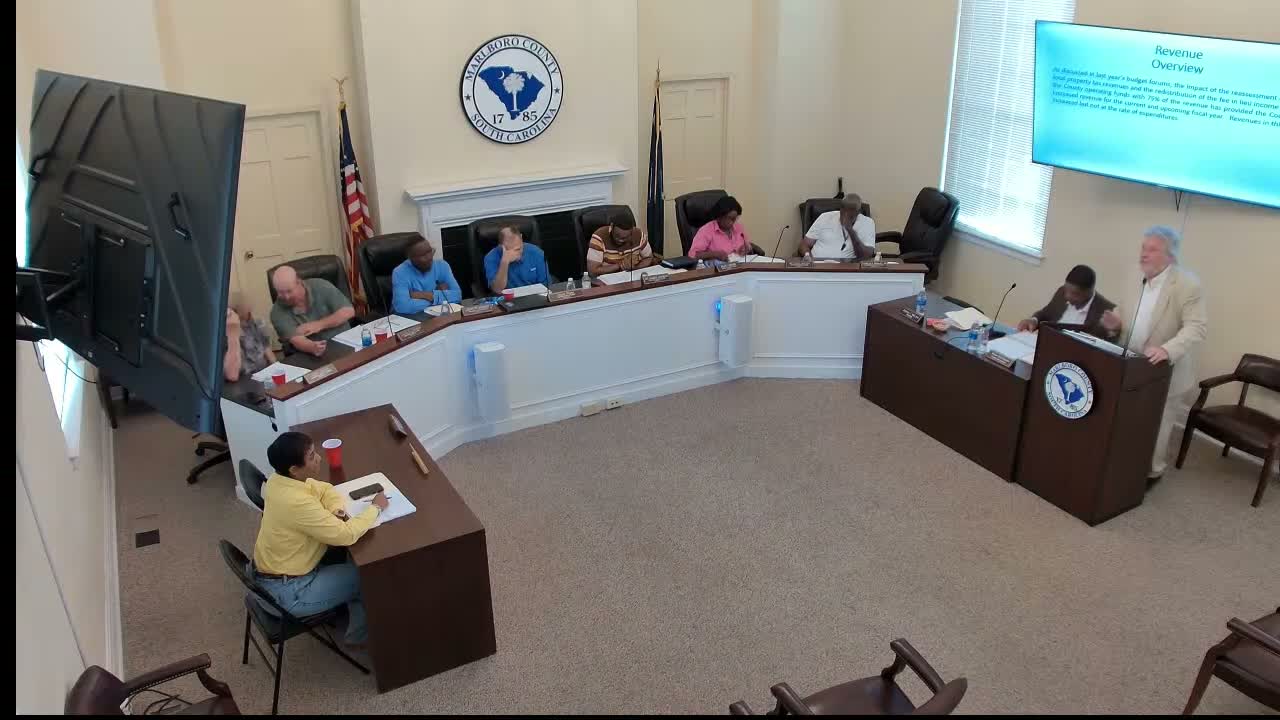
Wes Parks, the county’s presenting staff member, outlined a draft general‑fund budget that totals about $17,000,001.82 for FY 2026–27, saying recent reassessment and a redistribution of fee‑in‑lieu revenue have raised county receipts but not enough to match rising expenditures. “Revenues in this budget have increased, but not at the rate of the expenditures,” Parks told council members.
Parks said the draft assumes a 2% cost‑of‑living increase for employees, funded in part through nondepartmental allocations. “No provision outside of a 2% cost of living increase is incorporated in the budget request for increased salary,” he said. The proposed budget uses $262,000 of fund balance; if $200,000 in sheriff vehicle needs is offset by bond proceeds, the net use of fund balance falls to roughly $62,000.
The presentation walked members through revenue lines: about $140,000 in increased property‑tax receipts, roughly $55,000 in intergovernmental revenue, $205,000 in fee‑in‑lieu receipts and an additional $50,000 in state library funding, adding up to an overall revenue increase of $427,106. Parks said roughly half of county revenues still come from general taxes and that the draft retains the county’s operating millage at 98 mills.
Council members pressed for context on the millage and long‑term purchasing power. Parks cited inflation and reassessment timing, saying the county is “10.6 mills behind” an inflation‑adjusted benchmark and illustrating the effect by estimating a mill’s notional value at about $75,000. That shortfall, he said, would be roughly $800,000 in foregone capacity compared with a program of incremental millage adjustments.
Department‑level changes in the draft include increases in retirement and fringe costs, higher information‑technology and security subscriptions tied to law‑enforcement requirements, and targeted salary adjustments in select offices; Parks highlighted a $50,000 increase in library state aid and said the HR‑related nondepartmental package includes $205,000 for the 2% COLA.
Parks recommended that the aquatic center’s operating costs be kept in a proprietary fund so they won’t flow through the general fund; council members asked for operational estimates and fee projections before the facility opens. He also suggested funding sheriff vehicle needs through general‑obligation bond proceeds rather than the general fund.
What’s next: council members agreed the draft was a reasonable starting point and asked staff to present further departmental details, solid‑waste fee justifications and estimates for aquatic‑center operations in a subsequent workshop. Council discussed moving to a second reading with additional follow‑up before a public hearing and third reading.
Parks said the draft assumes a 2% cost‑of‑living increase for employees, funded in part through nondepartmental allocations. “No provision outside of a 2% cost of living increase is incorporated in the budget request for increased salary,” he said. The proposed budget uses $262,000 of fund balance; if $200,000 in sheriff vehicle needs is offset by bond proceeds, the net use of fund balance falls to roughly $62,000.
The presentation walked members through revenue lines: about $140,000 in increased property‑tax receipts, roughly $55,000 in intergovernmental revenue, $205,000 in fee‑in‑lieu receipts and an additional $50,000 in state library funding, adding up to an overall revenue increase of $427,106. Parks said roughly half of county revenues still come from general taxes and that the draft retains the county’s operating millage at 98 mills.
Council members pressed for context on the millage and long‑term purchasing power. Parks cited inflation and reassessment timing, saying the county is “10.6 mills behind” an inflation‑adjusted benchmark and illustrating the effect by estimating a mill’s notional value at about $75,000. That shortfall, he said, would be roughly $800,000 in foregone capacity compared with a program of incremental millage adjustments.
Department‑level changes in the draft include increases in retirement and fringe costs, higher information‑technology and security subscriptions tied to law‑enforcement requirements, and targeted salary adjustments in select offices; Parks highlighted a $50,000 increase in library state aid and said the HR‑related nondepartmental package includes $205,000 for the 2% COLA.
Parks recommended that the aquatic center’s operating costs be kept in a proprietary fund so they won’t flow through the general fund; council members asked for operational estimates and fee projections before the facility opens. He also suggested funding sheriff vehicle needs through general‑obligation bond proceeds rather than the general fund.
What’s next: council members agreed the draft was a reasonable starting point and asked staff to present further departmental details, solid‑waste fee justifications and estimates for aquatic‑center operations in a subsequent workshop. Council discussed moving to a second reading with additional follow‑up before a public hearing and third reading.
Don't Miss a Word: See the Full Meeting!
Go beyond summaries. Unlock every video, transcript, and key insight with a Founder Membership.
✓
Get instant access to full meeting videos
✓
Search and clip any phrase from complete transcripts
✓
Receive AI-powered summaries & custom alerts
✓
Enjoy lifetime, unrestricted access to government data
30-day money-back guarantee
