City administrator says FY26 budget balanced with cuts and one-time funding; previewing FY27 millage options
May 05, 2026 | West Palm Beach, Palm Beach County, Florida
This article was created by AI summarizing key points discussed. AI makes mistakes, so for full details and context, please refer to the video of the full meeting. Please report any errors so we can fix them. Report an error »
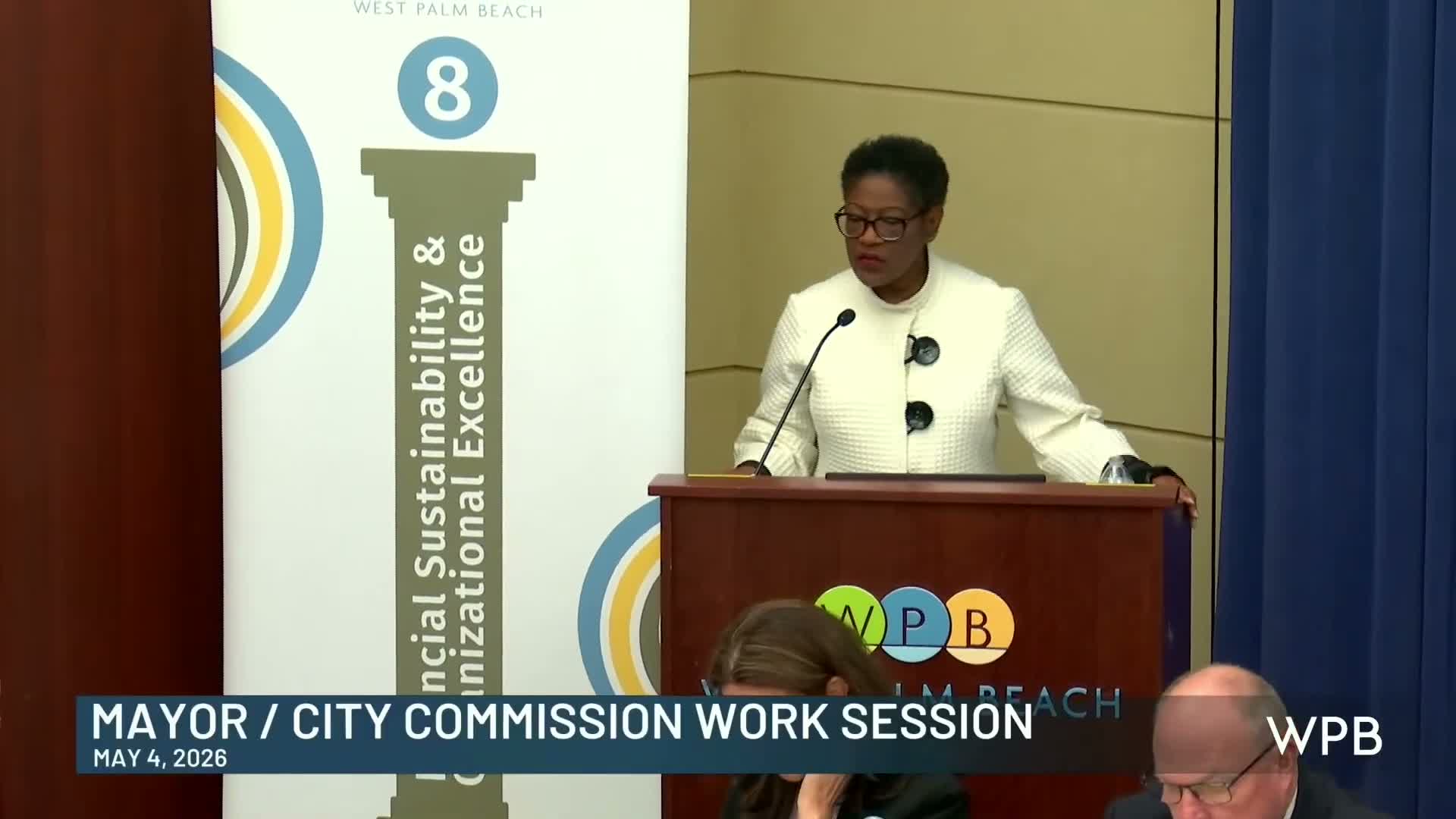
Faye Johnson, city administrator, told the City Commission during a work session that administration balanced the FY26 general fund after identifying a $4.2 million budget gap and making targeted operational reductions and one-time funding allocations.
Johnson said the FY25 general fund revenue base was $264,000,000 and that the city brought $19,000,000 of new general-fund revenue into FY26. At the same time, she said obligated expenses and critical needs for the year totaled $23,200,000, creating a $4,200,000 shortfall that the city closed with a mix of cuts and temporary funding. "We took $1,000,000 out of the general fund that we had started two prior years for road paving," she said, and added that $1.2 million for police contractual obligations was funded with one-time sources. She also described a $2,000,000 reduction to the police overtime budget conditional on bringing 27 police officers on staff.
The administration emphasized that maintaining public-safety staffing was the board’s top priority. Johnson said FY26 added roughly 43 public-safety positions in total — 27 new police officers and seven fire positions, and that 15 firefighters previously funded by a SAFER grant were incorporated into the general fund. "We were able to then put a lion’s share of the additional revenue towards the board's number 1 priority, and that's public safety," she said.
Johnson acknowledged commissioners' desire that the budget include a millage reduction. She described why the timing of prior FY26 decisions — including the inclusion of new sworn positions and the one-time funding that covered certain costs — made a millage cut infeasible in the FY26 cycle. To address that, administration proposed a front-loaded FY27 planning process that gives commissioners earlier engagement so a millage preference can be set before the tentative budget is finalized.
Looking ahead, Johnson said she was "cautiously optimistic" that because some one‑time FY26 costs will not reappear in FY27, the city could absorb a modest millage reduction without programmatic cuts. She stressed, however, that final decisions will depend on FY27 revenue estimates and outcomes of labor negotiations that will affect mandatory costs. The city administrator outlined a calendar that includes department budget reviews in June, a June 22 not-to-exceed millage discussion, and statutorily required public hearings in September ahead of the Oct. 1 fiscal-year start.
The commission did not take any formal votes during the session; Johnson said the purpose of the meeting was informational and to shape deliberations at upcoming work sessions.
Johnson said the FY25 general fund revenue base was $264,000,000 and that the city brought $19,000,000 of new general-fund revenue into FY26. At the same time, she said obligated expenses and critical needs for the year totaled $23,200,000, creating a $4,200,000 shortfall that the city closed with a mix of cuts and temporary funding. "We took $1,000,000 out of the general fund that we had started two prior years for road paving," she said, and added that $1.2 million for police contractual obligations was funded with one-time sources. She also described a $2,000,000 reduction to the police overtime budget conditional on bringing 27 police officers on staff.
The administration emphasized that maintaining public-safety staffing was the board’s top priority. Johnson said FY26 added roughly 43 public-safety positions in total — 27 new police officers and seven fire positions, and that 15 firefighters previously funded by a SAFER grant were incorporated into the general fund. "We were able to then put a lion’s share of the additional revenue towards the board's number 1 priority, and that's public safety," she said.
Johnson acknowledged commissioners' desire that the budget include a millage reduction. She described why the timing of prior FY26 decisions — including the inclusion of new sworn positions and the one-time funding that covered certain costs — made a millage cut infeasible in the FY26 cycle. To address that, administration proposed a front-loaded FY27 planning process that gives commissioners earlier engagement so a millage preference can be set before the tentative budget is finalized.
Looking ahead, Johnson said she was "cautiously optimistic" that because some one‑time FY26 costs will not reappear in FY27, the city could absorb a modest millage reduction without programmatic cuts. She stressed, however, that final decisions will depend on FY27 revenue estimates and outcomes of labor negotiations that will affect mandatory costs. The city administrator outlined a calendar that includes department budget reviews in June, a June 22 not-to-exceed millage discussion, and statutorily required public hearings in September ahead of the Oct. 1 fiscal-year start.
The commission did not take any formal votes during the session; Johnson said the purpose of the meeting was informational and to shape deliberations at upcoming work sessions.
View the Full Meeting & All Its Details
This article offers just a summary. Unlock complete video, transcripts, and insights as a Founder Member.
✓
Watch full, unedited meeting videos
✓
Search every word spoken in unlimited transcripts
✓
AI summaries & real-time alerts (all government levels)
✓
Permanent access to expanding government content
30-day money-back guarantee
