Board continues Paso Robles subdivision appeal to May 25, orders environmental study
May 05, 2026 | San Luis Obispo County, California
This article was created by AI summarizing key points discussed. AI makes mistakes, so for full details and context, please refer to the video of the full meeting. Please report any errors so we can fix them. Report an error »
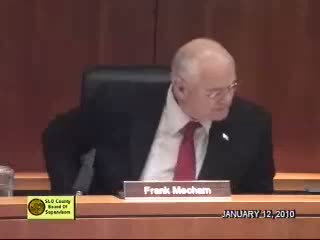
The Board of Supervisors on Jan. 12 continued an appeal by Richard Smith of a Subdivision Review Board decision that had disapproved a proposed vesting parcel map to split a roughly 15‑acre property near Paso Robles into 10‑ and 5‑acre parcels.
Planning staff and CAL FIRE told the board the SRB's disapproval rested on fire and public safety requirements: "The maximum length for a dead‑end road shall not exceed 0.5 miles for parcels of 5 acres or larger," planning staff said, and Cal Fire Deputy Rick Swan testified the dead‑end road condition was non‑mitigatable without a secondary access. "That's the main issue," Swan said, citing state code and post‑fire regulatory changes.
Appellant Richard Smith described long personal investment in the property and said the site already has two legal residences and a 5,000‑gallon water storage tank. He asked the board to allow the split and offered to accept deed restrictions prohibiting new secondary residences if that would satisfy safety concerns: "We would agree to no additional structures," Smith told the board.
After extended questioning about existing permits, the potential for deed restrictions, whether a Transfer of Development Credit (TDC) would be required to meet minimum parcel size, and water supply and fire suppression capacity, supervisors voted to continue the matter to May 25 so staff can complete an initial study and consult with CAL FIRE. Staff advised the applicant that remaining initial application fees could be used for environmental review and that additional costs might be required if deeper studies prove necessary.
Why it matters: The Subdivision Review Board found the site does not meet current fire safety/dead‑end road standards and that there is no available mitigation without a secondary access. The continuation lets staff check whether a narrowly drawn deed restriction or other site improvements could allow CAL FIRE to recommend an exception, and it preserves procedural safeguards including CEQA review.
What happens next: Planning staff will prepare an initial environmental study within the agreed time frame (staff estimated four months) and work with CAL FIRE and the applicant on possible deed restrictions, water/turnaround verification and other mitigation. The appeal will return to the Board May 25; the applicant may withdraw if proposed conditions are not acceptable.
Provenance: topicintro SEG 2281; topfinish SEG 3608.
Planning staff and CAL FIRE told the board the SRB's disapproval rested on fire and public safety requirements: "The maximum length for a dead‑end road shall not exceed 0.5 miles for parcels of 5 acres or larger," planning staff said, and Cal Fire Deputy Rick Swan testified the dead‑end road condition was non‑mitigatable without a secondary access. "That's the main issue," Swan said, citing state code and post‑fire regulatory changes.
Appellant Richard Smith described long personal investment in the property and said the site already has two legal residences and a 5,000‑gallon water storage tank. He asked the board to allow the split and offered to accept deed restrictions prohibiting new secondary residences if that would satisfy safety concerns: "We would agree to no additional structures," Smith told the board.
After extended questioning about existing permits, the potential for deed restrictions, whether a Transfer of Development Credit (TDC) would be required to meet minimum parcel size, and water supply and fire suppression capacity, supervisors voted to continue the matter to May 25 so staff can complete an initial study and consult with CAL FIRE. Staff advised the applicant that remaining initial application fees could be used for environmental review and that additional costs might be required if deeper studies prove necessary.
Why it matters: The Subdivision Review Board found the site does not meet current fire safety/dead‑end road standards and that there is no available mitigation without a secondary access. The continuation lets staff check whether a narrowly drawn deed restriction or other site improvements could allow CAL FIRE to recommend an exception, and it preserves procedural safeguards including CEQA review.
What happens next: Planning staff will prepare an initial environmental study within the agreed time frame (staff estimated four months) and work with CAL FIRE and the applicant on possible deed restrictions, water/turnaround verification and other mitigation. The appeal will return to the Board May 25; the applicant may withdraw if proposed conditions are not acceptable.
Provenance: topicintro SEG 2281; topfinish SEG 3608.
Don't Miss a Word: See the Full Meeting!
Go beyond summaries. Unlock every video, transcript, and key insight with a Founder Membership.
✓
Get instant access to full meeting videos
✓
Search and clip any phrase from complete transcripts
✓
Receive AI-powered summaries & custom alerts
✓
Enjoy lifetime, unrestricted access to government data
30-day money-back guarantee
