Supervisors ask staff to draft ministerial permit for small agricultural event venues, seek broader review of ag‑tourism rules
May 05, 2026 | San Luis Obispo County, California
This article was created by AI summarizing key points discussed. AI makes mistakes, so for full details and context, please refer to the video of the full meeting. Please report any errors so we can fix them. Report an error »
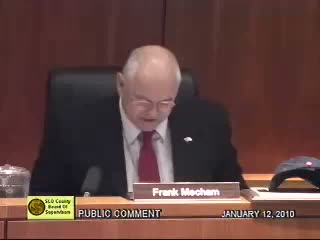
The Board of Supervisors devoted the afternoon of its Jan. 12 meeting to a lengthy public and staff conversation about proposed ordinance changes to regulate temporary events on agricultural and rural lands.
Planning staff framed the choice around two competing general plan policies and implementation options. "Today, we are before you at the request of the Planning Commission," Cammy Griffin told the board as she summarized a multi‑year effort to reconcile agricultural policy with visitor‑serving uses. "There was no consensus in the commission; they asked us to seek guidance from the Board."
Public testimony included farmers and ranchers, the Ag Tourism Coalition, the Farm Bureau, the Chamber of Commerce, event‑industry representatives and numerous residents. Testimony illustrated the range of concerns: event professionals emphasized operational tools (decibel meters, professional DJs and checklists) and warned that an expensive Minor Use Permit (MUP) process drives venues underground; neighbors pressed for stronger limits on size, frequency and enforcement, and urged protection of water, roads and rural character.
Key direction from the board:
- Staff should prepare a proposed tiered system that includes a ministerial (over‑the‑counter) permit for small, well‑defined venues (staff to draft objective criteria such as attendee caps and annual frequency limits; supervisors suggested examples such as up to 10 events per year and roughly 150 attendees as an example range for discussion).
- Ministerial permits should require clear operational standards (on‑site parking, access, fire and sanitation checks, a 24‑hour contact, and documented noise controls); any site failing those checkboxes would be routed to discretionary review (MUP/CUP).
- Nonprofit fundraisers should not be left as an unlimited exemption; staff should define nonprofit events, require documentation of proceeds and apply reasonable size/frequency limits.
- Staff should return with a draft ordinance, a user guide for applicants, enforcement proposals and comparative analysis of Napa and Sonoma approaches.
As event professional Andy Morris put it, practical tools exist: "Decibel levels at the speakers and at the property line can be managed and can be monitored that way," he said, urging objective sound limits combined with responsible industry practice.
Why it matters: The county's farm economy and tourist draw have led to a surge of destination weddings and small on‑farm events that generate income for landowners but raise neighborhood complaints about noise, traffic, dust and trash. Supervisors said they wanted a pragmatic path that brings small venues into compliance without imposing unaffordable fees, while preserving tools to prevent proliferation or nuisance impacts.
What happens next: Staff will draft concrete ministerial permit criteria (checklists and objective thresholds), integrate them into a proposed ordinance, and return with public outreach and comparisons to other counties. The board asked staff to prepare a clear user guide so small operators can apply at the counter; staff will also identify enforcement resources and a renewal/revocation framework.
Provenance: topicintro SEG 3946; topfinish SEG 9220.
Planning staff framed the choice around two competing general plan policies and implementation options. "Today, we are before you at the request of the Planning Commission," Cammy Griffin told the board as she summarized a multi‑year effort to reconcile agricultural policy with visitor‑serving uses. "There was no consensus in the commission; they asked us to seek guidance from the Board."
Public testimony included farmers and ranchers, the Ag Tourism Coalition, the Farm Bureau, the Chamber of Commerce, event‑industry representatives and numerous residents. Testimony illustrated the range of concerns: event professionals emphasized operational tools (decibel meters, professional DJs and checklists) and warned that an expensive Minor Use Permit (MUP) process drives venues underground; neighbors pressed for stronger limits on size, frequency and enforcement, and urged protection of water, roads and rural character.
Key direction from the board:
- Staff should prepare a proposed tiered system that includes a ministerial (over‑the‑counter) permit for small, well‑defined venues (staff to draft objective criteria such as attendee caps and annual frequency limits; supervisors suggested examples such as up to 10 events per year and roughly 150 attendees as an example range for discussion).
- Ministerial permits should require clear operational standards (on‑site parking, access, fire and sanitation checks, a 24‑hour contact, and documented noise controls); any site failing those checkboxes would be routed to discretionary review (MUP/CUP).
- Nonprofit fundraisers should not be left as an unlimited exemption; staff should define nonprofit events, require documentation of proceeds and apply reasonable size/frequency limits.
- Staff should return with a draft ordinance, a user guide for applicants, enforcement proposals and comparative analysis of Napa and Sonoma approaches.
As event professional Andy Morris put it, practical tools exist: "Decibel levels at the speakers and at the property line can be managed and can be monitored that way," he said, urging objective sound limits combined with responsible industry practice.
Why it matters: The county's farm economy and tourist draw have led to a surge of destination weddings and small on‑farm events that generate income for landowners but raise neighborhood complaints about noise, traffic, dust and trash. Supervisors said they wanted a pragmatic path that brings small venues into compliance without imposing unaffordable fees, while preserving tools to prevent proliferation or nuisance impacts.
What happens next: Staff will draft concrete ministerial permit criteria (checklists and objective thresholds), integrate them into a proposed ordinance, and return with public outreach and comparisons to other counties. The board asked staff to prepare a clear user guide so small operators can apply at the counter; staff will also identify enforcement resources and a renewal/revocation framework.
Provenance: topicintro SEG 3946; topfinish SEG 9220.
Don't Miss a Word: See the Full Meeting!
Go beyond summaries. Unlock every video, transcript, and key insight with a Founder Membership.
✓
Get instant access to full meeting videos
✓
Search and clip any phrase from complete transcripts
✓
Receive AI-powered summaries & custom alerts
✓
Enjoy lifetime, unrestricted access to government data
30-day money-back guarantee
