Guam senators hear competing views on bills to let acupuncturists perform dry needling and to create ACOM assistants
May 06, 2026 | General Government Operations and Appropriations , Legislative, Guam, International
This article was created by AI summarizing key points discussed. AI makes mistakes, so for full details and context, please refer to the video of the full meeting. Please report any errors so we can fix them. Report an error »
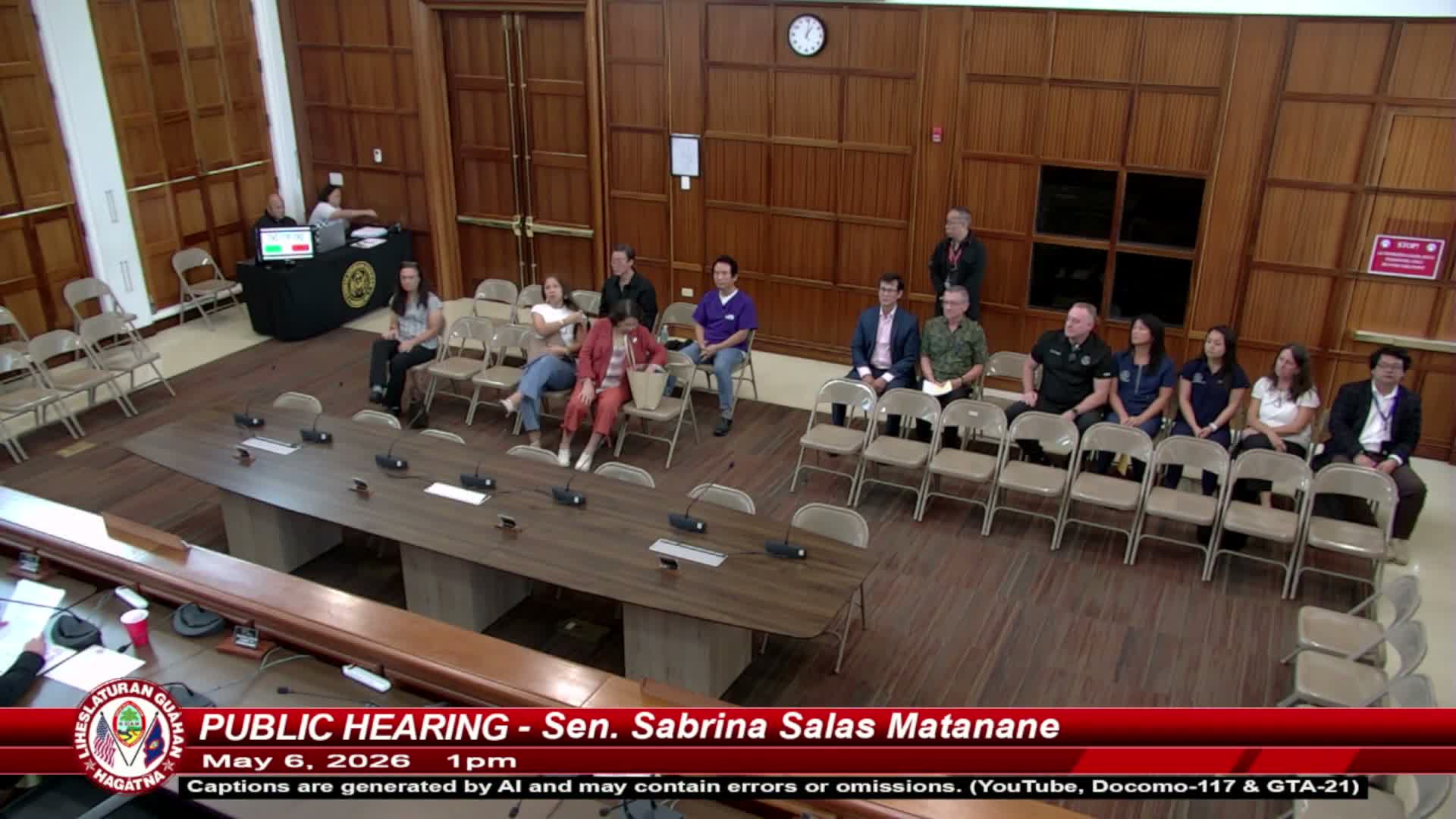
The Guam Legislature’s Committee on Health and Veterans Affairs heard public testimony May 6 on two measures that would change how acupuncture and oriental medicine (ACOM) are regulated on the island. Bill 276‑38 would add “dry needling” and certain spinal/manual therapies to the explicit scope of practice for licensed ACOM practitioners; Bill 277‑38 would create a new certification and role for ACOM assistants.
Ranking Member Senator Tina Rose Munoz Barnes, who introduced both measures, said the bills are intended to “align Guam law with real world competencies while strengthening regulatory clarity” and to expand access to integrative care without compromising patient safety. “This bill does not introduce a new practice,” she said in closing remarks, adding that boards would retain authority to set standards.
Public health staff and clinicians pressed for details. Brianna Sablan, acting administrator for the Health Professional Licensing Office, reading testimony from the Department of Public Health and Social Services, said the department “lacks the necessary data to evaluate how these standards will interact with existing public health safety codes,” noting the bills do not set baseline curricular hours or identify accrediting organizations for the proposed certifications. Sablan told senators the department cannot yet determine the fiscal or inspector staffing impact of enforcing the bills’ provisions.
Practitioners differed sharply in their assessments. Chang Wen Chung, an acupuncturist who said ACOM training includes multi‑year degree programs and thousands of clinical hours, argued that needling and manual therapies (including Tuina) are part of Oriental medicine’s traditions and training and therefore should be clearly recognized in statute. “Dry needling and acupuncture, they’re the same,” Chung said, describing trigger‑point work as part of acupuncture practice.
Chiropractors and some physical therapists urged caution. A chiropractor testifying as Dr. Miller said spinal manipulative therapy is a specialized competency taught and regulated within chiropractic education and licensing: “None of them have specific courses or syllabuses in spinal manipulative therapy,” he said, arguing the bill would risk “watering down” the safety and identity of that specialty. Dr. Jordan Singson, a physical therapist, said dry needling requires differential diagnostic skills and red‑flag recognition and that any cross‑practice authorization would need consistent, enforceable training standards: “It is a high‑level skill…additional training may be required,” he said.
Senators focused questions on the bills’ vagueness. Lawmakers asked whether existing ACOM degree programs and national accrediting bodies include the specific competencies cited in the bills, whether the proposed 40 hours of assistant safety training and supervision periods cited in Bill 277‑38 are sufficient, and how many licensed ACOM practitioners on Guam already have training in spinal/manual therapy. DPHSS told the committee it would research accreditation standards, complaint history and inspector capacity and provide a fiscal impact estimate.
No formal votes were taken. Several senators signaled they would seek written curricula from the Guam Board of Allied Health Examiners, comparative standards from other U.S. jurisdictions, and a DPHSS briefing before advancing either bill. The committee then moved on to confirmation hearings for health‑sector appointees.
The committee’s next procedural step, based on comments during the hearing, is to request additional documentation from DPHSS and the allied health board on curricula, accreditation and enforcement capacity; senators indicated those materials would be necessary before the bills move to the session floor.
Ranking Member Senator Tina Rose Munoz Barnes, who introduced both measures, said the bills are intended to “align Guam law with real world competencies while strengthening regulatory clarity” and to expand access to integrative care without compromising patient safety. “This bill does not introduce a new practice,” she said in closing remarks, adding that boards would retain authority to set standards.
Public health staff and clinicians pressed for details. Brianna Sablan, acting administrator for the Health Professional Licensing Office, reading testimony from the Department of Public Health and Social Services, said the department “lacks the necessary data to evaluate how these standards will interact with existing public health safety codes,” noting the bills do not set baseline curricular hours or identify accrediting organizations for the proposed certifications. Sablan told senators the department cannot yet determine the fiscal or inspector staffing impact of enforcing the bills’ provisions.
Practitioners differed sharply in their assessments. Chang Wen Chung, an acupuncturist who said ACOM training includes multi‑year degree programs and thousands of clinical hours, argued that needling and manual therapies (including Tuina) are part of Oriental medicine’s traditions and training and therefore should be clearly recognized in statute. “Dry needling and acupuncture, they’re the same,” Chung said, describing trigger‑point work as part of acupuncture practice.
Chiropractors and some physical therapists urged caution. A chiropractor testifying as Dr. Miller said spinal manipulative therapy is a specialized competency taught and regulated within chiropractic education and licensing: “None of them have specific courses or syllabuses in spinal manipulative therapy,” he said, arguing the bill would risk “watering down” the safety and identity of that specialty. Dr. Jordan Singson, a physical therapist, said dry needling requires differential diagnostic skills and red‑flag recognition and that any cross‑practice authorization would need consistent, enforceable training standards: “It is a high‑level skill…additional training may be required,” he said.
Senators focused questions on the bills’ vagueness. Lawmakers asked whether existing ACOM degree programs and national accrediting bodies include the specific competencies cited in the bills, whether the proposed 40 hours of assistant safety training and supervision periods cited in Bill 277‑38 are sufficient, and how many licensed ACOM practitioners on Guam already have training in spinal/manual therapy. DPHSS told the committee it would research accreditation standards, complaint history and inspector capacity and provide a fiscal impact estimate.
No formal votes were taken. Several senators signaled they would seek written curricula from the Guam Board of Allied Health Examiners, comparative standards from other U.S. jurisdictions, and a DPHSS briefing before advancing either bill. The committee then moved on to confirmation hearings for health‑sector appointees.
The committee’s next procedural step, based on comments during the hearing, is to request additional documentation from DPHSS and the allied health board on curricula, accreditation and enforcement capacity; senators indicated those materials would be necessary before the bills move to the session floor.
Don't Miss a Word: See the Full Meeting!
Go beyond summaries. Unlock every video, transcript, and key insight with a Founder Membership.
✓
Get instant access to full meeting videos
✓
Search and clip any phrase from complete transcripts
✓
Receive AI-powered summaries & custom alerts
✓
Enjoy lifetime, unrestricted access to government data
30-day money-back guarantee
