Policy workshop narrows board values to equity, collaboration, growth and accountability
May 06, 2026 | Portland SD 1J, School Districts, Oregon
This article was created by AI summarizing key points discussed. AI makes mistakes, so for full details and context, please refer to the video of the full meeting. Please report any errors so we can fix them. Report an error »
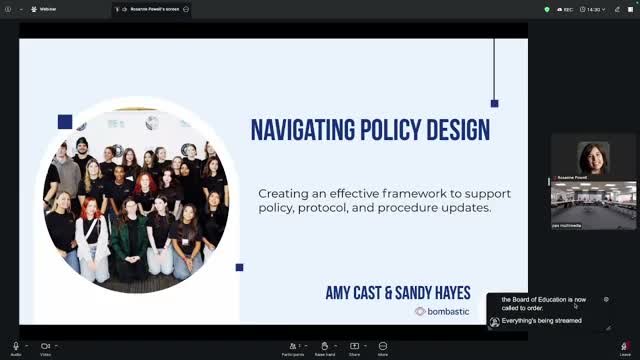
Facilitators led Portland SD 1J trustees and members of the policy committee through a daylong workshop to surface shared values and decide how those values should shape Section 1 of the district’s policy manual.
The session, framed as a practice in policy design rather than a drafting meeting, moved from an opening reflective exercise into definitions of what belongs in a policy versus a procedure or guideline. Facilitator (Presenter, S4) summarized the distinction: "So a policy is what establishes the standard." The group then applied that framework to real examples — curriculum pilots, budget cuts and a forthcoming vote on a school resource officer (SRO) contract — to surface implicit assumptions and guardrails that should guide future decisions.
Why this matters: Board-level policy sets districtwide standards that influence budgets, contracts, and everyday practice in schools. By agreeing a small set of guiding values, the board aims to reduce ad-hoc decision-making and give the policy subcommittee a clear lens for revising the role-of-the-board resolution and related section 1 language.
Presenters introduced the University of Wisconsin–Madison tool as an example of how to classify a statement as policy, procedure (administrative directive), or guideline; participants used that model to critique several paragraphs of the current role-of-the-board language. Several members raised specific, operational examples: one board member noted an upcoming vote on whether to renew "a contract with a vendor" that "is one of our city's police department, and it's for the SRO on campus," and asked whether that procurement properly fits under current policy and state law (Presenter, S2).
Trustee versus representative role: A lengthy exchange considered whether board members should act primarily as trustees making districtwide choices or as direct representatives of particular community constituencies. One participant (Board member Virginia, S7) said, "I believe that we are trustees because we are chosen by voters, and we are accountable to the public, and we're expected to listen to their concerns." Others argued the role is often hybrid in practice and flagged how local elections and turnout shape who runs for board seats.
Values selection and next steps: Using a columns-of-words exercise, the group circled and discussed individual values, then synthesized them into a short list that multiple participants supported: justice/equity/inclusion; collaboration/teamwork; growth (applied both to students and to organizational learning); accountability/ethics; and resilience/sustainability. Facilitators and board members debated whether the word "growth" adequately captured both student progress and organizational improvement; several members preferred one term that would apply across audiences rather than separate entries.
Implementation and process decisions: Rather than rewriting policy text in the workshop, the board agreed to send the prioritized values and annotated feedback to the policy subcommittee for legal crosswalks and drafting. Facilitators recommended the subcommittee cross-reference finance, contracting and civic-use policies to avoid gaps when language is moved or removed. Attendees also requested a menu of options for ongoing facilitation and professional development so the board can sustain the work and check progress after initial drafts are produced.
Representative quotes:
"So a policy is what establishes the standard," Presenter (S4) said when distinguishing policy from procedures and guidelines.
"We have a vote on Monday on whether to renew a contract with a vendor ... the vendor is one of our city's police department, and it's for the SRO on campus," Presenter (S2) said, urging attention to how policy and procedure intersect with procurement and state law.
"I believe that we are trustees because we are chosen by voters," Board member Virginia (S7) said during a discussion about trusteeship versus direct representation.
The meeting ended with clear, nonbinding next steps: the policy subcommittee will redraft the role-of-the-board resolution to reflect the group's chosen values and to crosswalk any operational language with existing finance and contract policies; staff and board leadership will compile options for follow-up facilitation and training; and the subcommittee will present revised language for discussion at a future meeting.
The session, framed as a practice in policy design rather than a drafting meeting, moved from an opening reflective exercise into definitions of what belongs in a policy versus a procedure or guideline. Facilitator (Presenter, S4) summarized the distinction: "So a policy is what establishes the standard." The group then applied that framework to real examples — curriculum pilots, budget cuts and a forthcoming vote on a school resource officer (SRO) contract — to surface implicit assumptions and guardrails that should guide future decisions.
Why this matters: Board-level policy sets districtwide standards that influence budgets, contracts, and everyday practice in schools. By agreeing a small set of guiding values, the board aims to reduce ad-hoc decision-making and give the policy subcommittee a clear lens for revising the role-of-the-board resolution and related section 1 language.
Presenters introduced the University of Wisconsin–Madison tool as an example of how to classify a statement as policy, procedure (administrative directive), or guideline; participants used that model to critique several paragraphs of the current role-of-the-board language. Several members raised specific, operational examples: one board member noted an upcoming vote on whether to renew "a contract with a vendor" that "is one of our city's police department, and it's for the SRO on campus," and asked whether that procurement properly fits under current policy and state law (Presenter, S2).
Trustee versus representative role: A lengthy exchange considered whether board members should act primarily as trustees making districtwide choices or as direct representatives of particular community constituencies. One participant (Board member Virginia, S7) said, "I believe that we are trustees because we are chosen by voters, and we are accountable to the public, and we're expected to listen to their concerns." Others argued the role is often hybrid in practice and flagged how local elections and turnout shape who runs for board seats.
Values selection and next steps: Using a columns-of-words exercise, the group circled and discussed individual values, then synthesized them into a short list that multiple participants supported: justice/equity/inclusion; collaboration/teamwork; growth (applied both to students and to organizational learning); accountability/ethics; and resilience/sustainability. Facilitators and board members debated whether the word "growth" adequately captured both student progress and organizational improvement; several members preferred one term that would apply across audiences rather than separate entries.
Implementation and process decisions: Rather than rewriting policy text in the workshop, the board agreed to send the prioritized values and annotated feedback to the policy subcommittee for legal crosswalks and drafting. Facilitators recommended the subcommittee cross-reference finance, contracting and civic-use policies to avoid gaps when language is moved or removed. Attendees also requested a menu of options for ongoing facilitation and professional development so the board can sustain the work and check progress after initial drafts are produced.
Representative quotes:
"So a policy is what establishes the standard," Presenter (S4) said when distinguishing policy from procedures and guidelines.
"We have a vote on Monday on whether to renew a contract with a vendor ... the vendor is one of our city's police department, and it's for the SRO on campus," Presenter (S2) said, urging attention to how policy and procedure intersect with procurement and state law.
"I believe that we are trustees because we are chosen by voters," Board member Virginia (S7) said during a discussion about trusteeship versus direct representation.
The meeting ended with clear, nonbinding next steps: the policy subcommittee will redraft the role-of-the-board resolution to reflect the group's chosen values and to crosswalk any operational language with existing finance and contract policies; staff and board leadership will compile options for follow-up facilitation and training; and the subcommittee will present revised language for discussion at a future meeting.
Don't Miss a Word: See the Full Meeting!
Go beyond summaries. Unlock every video, transcript, and key insight with a Founder Membership.
✓
Get instant access to full meeting videos
✓
Search and clip any phrase from complete transcripts
✓
Receive AI-powered summaries & custom alerts
✓
Enjoy lifetime, unrestricted access to government data
30-day money-back guarantee
