Connetquot board presents roughly $230 million budget with 2.12% tax-levy increase; public voices concern over cuts and class sizes
May 06, 2026 | CONNETQUOT CENTRAL SCHOOL DISTRICT, School Districts, New York
This article was created by AI summarizing key points discussed. AI makes mistakes, so for full details and context, please refer to the video of the full meeting. Please report any errors so we can fix them. Report an error »
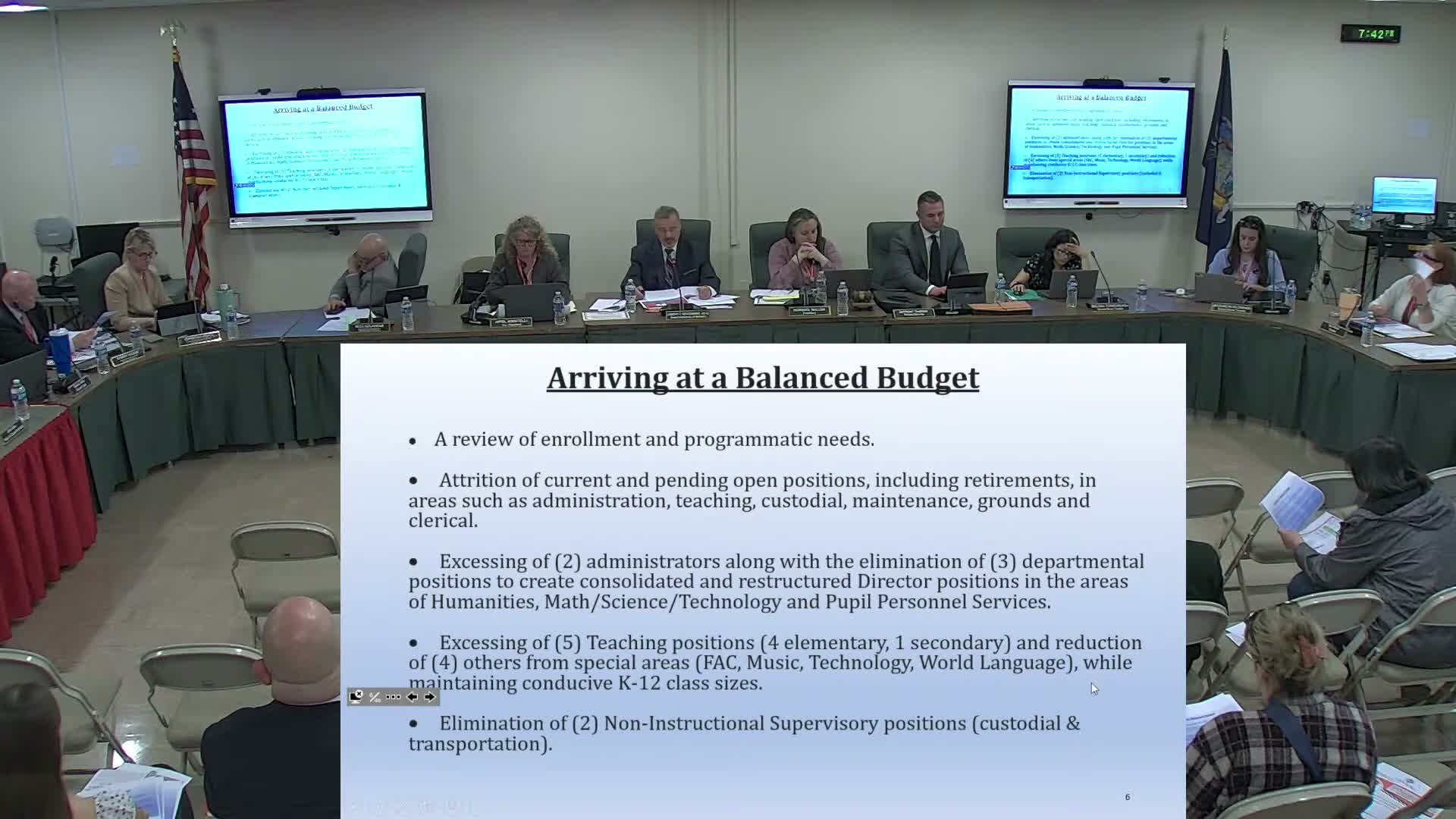
The Connetquot Central School District presented its proposed 2026–27 expenditure budget — about $230.0 million — at a public hearing Tuesday evening, with a proposed tax-levy increase of 2.12%, the administration said. The district will hold the budget vote and board election on May 19.
The district’s superintendent, Joseph Semmoor, told attendees the budget emphasizes “student learning and the programs that promote it,” while also addressing mental-health supports, college- and career-readiness programs, the arts and STEM partnerships. Hauser, who presented the budget detail slides, said the district is working under state-budget uncertainty and is projecting a modest 1% increase in foundation aid in a best-case scenario (presenter cited roughly $363,914). Hauser described a contingency scenario that would freeze the levy and require about $3.08 million in cuts.
Why it matters: the proposed budget would keep the district within the New York State tax-cap rules and, if adopted, would fund instructional programs that make up roughly half of the district’s spending. Voters decide on May 19 whether to approve the proposal; if it fails the district would operate under a contingency budget that freezes the levy and forces additional cuts.
In the presentation, the administration broke the budget into major categories: instruction (about 51.5%, cited as approximately $118 million), transportation (about $11.9 million), employee benefits and debt service (undistributed expenses), and interfund transfers to special-aid and capital funds. The presenter pointed to the consumer price index (about 2.63%) to illustrate cost pressures that outpace the budget increase.
Public concern and administration response: several community members urged voters to pass the budget to avoid deeper reductions. Commenters repeatedly raised two specific concerns: the sudden removal of a district scholarship/fellowship program and proposed increases in elementary-class sizes. One resident warned of potential job losses and “no accountability” for cuts; another asked how the district would restore smaller class sizes if student outcomes declined.
Superintendent Semmoor and executive staff responded that class sizes remain within the district’s established guidelines and that the budget includes teaching-assistant support where needed, particularly at the primary level when a class is one or two students over a guideline. The administration said some programs and software that “weren’t functioning to full capacity” were under review and that replacements or internal alternatives were being explored rather than an automatic continuation of outside contracts.
Other questions during the hearing covered practical issues such as where district residents should vote (three polling sites, divided by address) and a pilot technology upgrade — a cellular booster in one building to test improved connectivity as part of a broader network-switch replacement project.
Next steps: the district will publish the legally required notices (the 6‑day budget notice was discussed) and hold the budget vote and board election on May 19. If the budget fails, the board and administration said they will reconvene to prioritize cuts and discuss restoring programs when additional revenue is confirmed.
Provenance: presentation and numeric details drawn from the budget presentation (SEG 151–SEG 241, SEG 241–SEG 320); public comments and administration responses (SEG 353–SEG 407, SEG 445–SEG 476).
The district’s superintendent, Joseph Semmoor, told attendees the budget emphasizes “student learning and the programs that promote it,” while also addressing mental-health supports, college- and career-readiness programs, the arts and STEM partnerships. Hauser, who presented the budget detail slides, said the district is working under state-budget uncertainty and is projecting a modest 1% increase in foundation aid in a best-case scenario (presenter cited roughly $363,914). Hauser described a contingency scenario that would freeze the levy and require about $3.08 million in cuts.
Why it matters: the proposed budget would keep the district within the New York State tax-cap rules and, if adopted, would fund instructional programs that make up roughly half of the district’s spending. Voters decide on May 19 whether to approve the proposal; if it fails the district would operate under a contingency budget that freezes the levy and forces additional cuts.
In the presentation, the administration broke the budget into major categories: instruction (about 51.5%, cited as approximately $118 million), transportation (about $11.9 million), employee benefits and debt service (undistributed expenses), and interfund transfers to special-aid and capital funds. The presenter pointed to the consumer price index (about 2.63%) to illustrate cost pressures that outpace the budget increase.
Public concern and administration response: several community members urged voters to pass the budget to avoid deeper reductions. Commenters repeatedly raised two specific concerns: the sudden removal of a district scholarship/fellowship program and proposed increases in elementary-class sizes. One resident warned of potential job losses and “no accountability” for cuts; another asked how the district would restore smaller class sizes if student outcomes declined.
Superintendent Semmoor and executive staff responded that class sizes remain within the district’s established guidelines and that the budget includes teaching-assistant support where needed, particularly at the primary level when a class is one or two students over a guideline. The administration said some programs and software that “weren’t functioning to full capacity” were under review and that replacements or internal alternatives were being explored rather than an automatic continuation of outside contracts.
Other questions during the hearing covered practical issues such as where district residents should vote (three polling sites, divided by address) and a pilot technology upgrade — a cellular booster in one building to test improved connectivity as part of a broader network-switch replacement project.
Next steps: the district will publish the legally required notices (the 6‑day budget notice was discussed) and hold the budget vote and board election on May 19. If the budget fails, the board and administration said they will reconvene to prioritize cuts and discuss restoring programs when additional revenue is confirmed.
Provenance: presentation and numeric details drawn from the budget presentation (SEG 151–SEG 241, SEG 241–SEG 320); public comments and administration responses (SEG 353–SEG 407, SEG 445–SEG 476).
Don't Miss a Word: See the Full Meeting!
Go beyond summaries. Unlock every video, transcript, and key insight with a Founder Membership.
✓
Get instant access to full meeting videos
✓
Search and clip any phrase from complete transcripts
✓
Receive AI-powered summaries & custom alerts
✓
Enjoy lifetime, unrestricted access to government data
30-day money-back guarantee
