Planning staff seeks favorably recommendation to allow 10,000- and 20,000-square-foot lots in rural residential zone
May 06, 2026 | Dorchester County, Maryland
This article was created by AI summarizing key points discussed. AI makes mistakes, so for full details and context, please refer to the video of the full meeting. Please report any errors so we can fix them. Report an error »
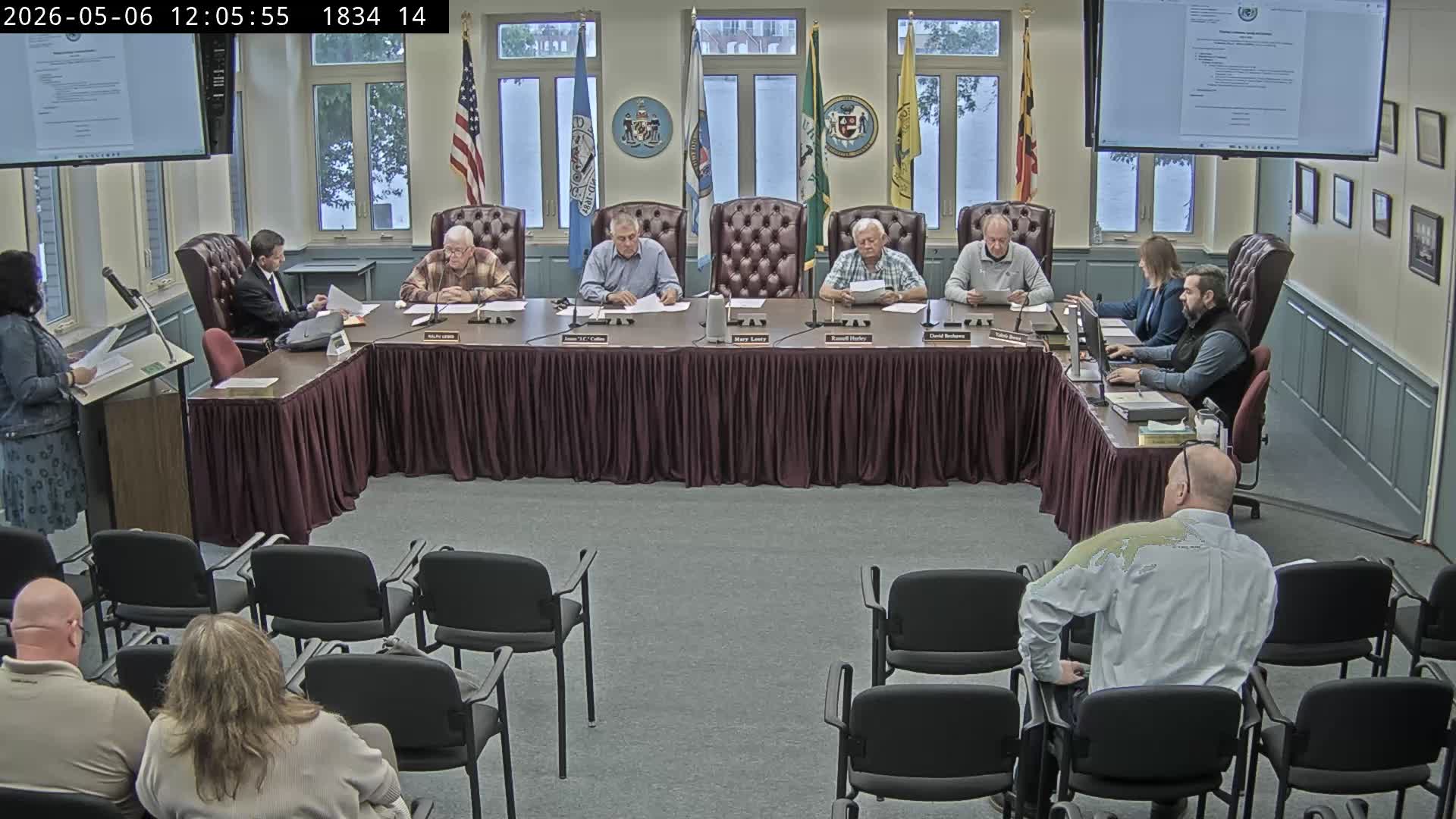
Susan Webb, a planning staff presenter, told the Dorchester County Planning Commission that a proposed text amendment would change minimum lot sizes in the Rural Residential (RR) district to better align development with available infrastructure. "It allows smaller lots, 10,000 square feet, where public water and sewer are available and requires larger lots, 20,000 square feet, where development relies on well and septic," Webb said.
The amendment’s goal, Webb said, is to direct growth into areas that can support it and to make more efficient use of existing infrastructure while protecting agricultural lands. Webb told commissioners the change would bring the county code in line with modern planning practices and the county’s comprehensive plan.
Commission members asked how the lot-size rules intersect with health-department standards for wells and septic and how many properties would be affected. Webb said the county contains about 10,000 acres zoned RR and that agricultural land totals roughly 175,000 acres; she did not provide a parcel-level count of properties that would be affected. Webb noted that health-department approvals remain necessary for on‑site sewage and well systems and that the planning code’s minimums are separate from those technical approvals.
During discussion, commissioners also contrasted the proposed 10,000- and 20,000-square-foot thresholds with the current RR minimum, which staff said is 40,000 square feet. Webb said the proposal is intended as a minimum floor rather than a requirement that every lot be the same size. "All the lots are not gonna be cookie cutter 20 or 10," she said, adding that the amendment merely prevents lots from being subdivided below the new thresholds.
A commissioner moved for a favorable recommendation to the county council; another commissioner seconded the motion and the body indicated assent. The commission did not record a roll-call tally in the transcript; staff will forward the commission’s recommendation to the county council for consideration.
The planning staff noted the county is monitoring possible state-level legislation that could further change local minimums and said the commission’s action is intended to modernize code ahead of future shifts in statewide guidance.
Next steps: The commission gave a favorable recommendation to forward the text amendment to the Dorchester County Council; the council will consider the ordinance during its legislative process.
The amendment’s goal, Webb said, is to direct growth into areas that can support it and to make more efficient use of existing infrastructure while protecting agricultural lands. Webb told commissioners the change would bring the county code in line with modern planning practices and the county’s comprehensive plan.
Commission members asked how the lot-size rules intersect with health-department standards for wells and septic and how many properties would be affected. Webb said the county contains about 10,000 acres zoned RR and that agricultural land totals roughly 175,000 acres; she did not provide a parcel-level count of properties that would be affected. Webb noted that health-department approvals remain necessary for on‑site sewage and well systems and that the planning code’s minimums are separate from those technical approvals.
During discussion, commissioners also contrasted the proposed 10,000- and 20,000-square-foot thresholds with the current RR minimum, which staff said is 40,000 square feet. Webb said the proposal is intended as a minimum floor rather than a requirement that every lot be the same size. "All the lots are not gonna be cookie cutter 20 or 10," she said, adding that the amendment merely prevents lots from being subdivided below the new thresholds.
A commissioner moved for a favorable recommendation to the county council; another commissioner seconded the motion and the body indicated assent. The commission did not record a roll-call tally in the transcript; staff will forward the commission’s recommendation to the county council for consideration.
The planning staff noted the county is monitoring possible state-level legislation that could further change local minimums and said the commission’s action is intended to modernize code ahead of future shifts in statewide guidance.
Next steps: The commission gave a favorable recommendation to forward the text amendment to the Dorchester County Council; the council will consider the ordinance during its legislative process.
Don't Miss a Word: See the Full Meeting!
Go beyond summaries. Unlock every video, transcript, and key insight with a Founder Membership.
✓
Get instant access to full meeting videos
✓
Search and clip any phrase from complete transcripts
✓
Receive AI-powered summaries & custom alerts
✓
Enjoy lifetime, unrestricted access to government data
30-day money-back guarantee
