Guam Department of Education requests $307 million for FY2027 as lawmakers press on staffing, maintenance and procurement
May 06, 2026 | General Government Operations and Appropriations , Legislative, Guam, International
This article was created by AI summarizing key points discussed. AI makes mistakes, so for full details and context, please refer to the video of the full meeting. Please report any errors so we can fix them. Report an error »
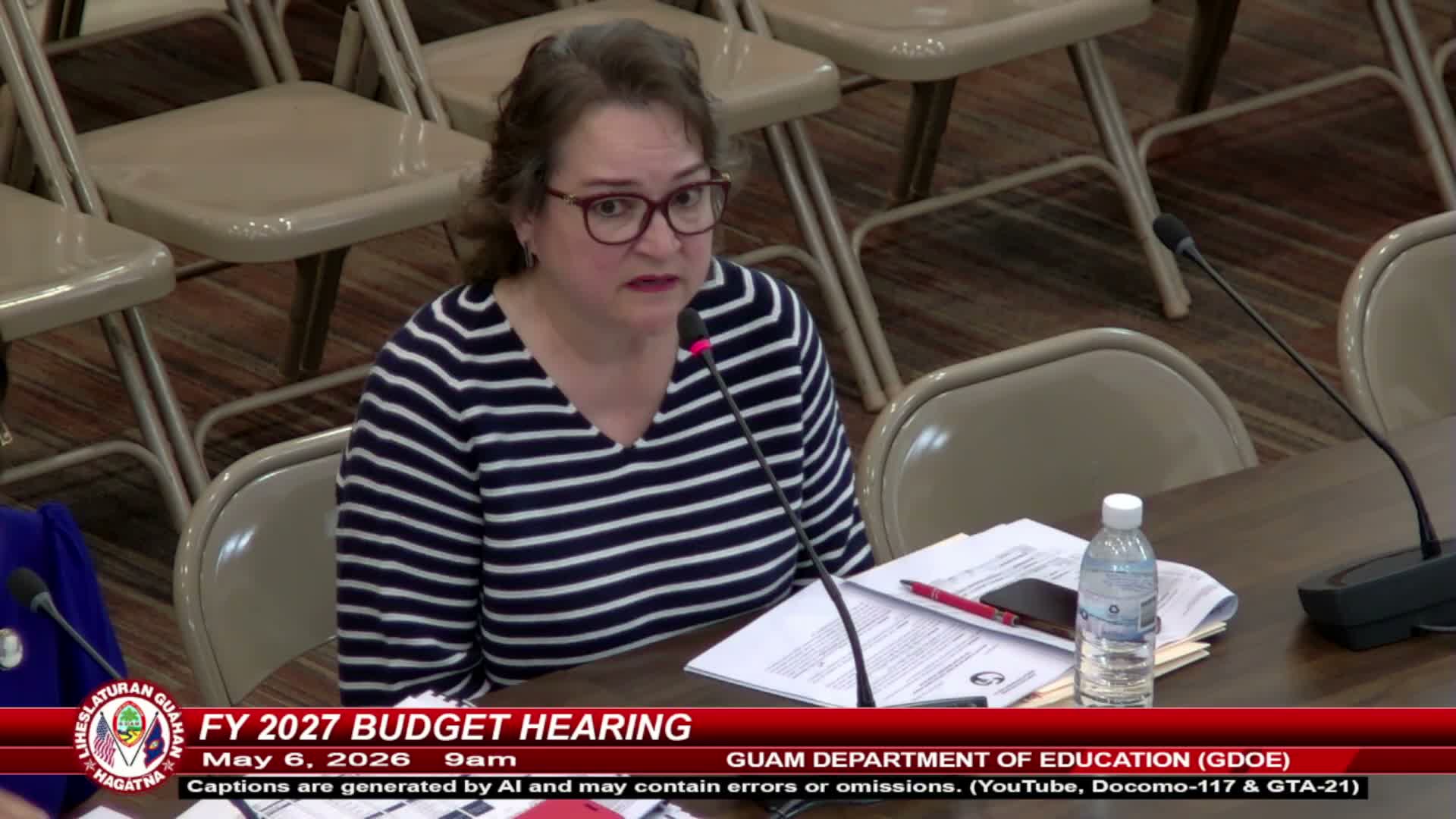
Gwenison Halfade, the superintendent of education, told the Committee on Finance and Government Operations on May 6 that the Guam Department of Education (GDOE) is requesting $307,027,565 for fiscal 2027 to cover operations across 39 schools serving 23,121 students.
Halfade said personnel costs make up the largest share of the request—about 86.5%—driven largely by collective bargaining agreement (CBA) positions and previously implemented pay plans. "There are increases in salaries in 2021, '22, '23 and '24," she said, explaining those adjustments account for much of the higher personnel line.
The superintendent and board members listed unmet facility and compliance needs totaling $23,500,000 that were not included in the operating request: $12,000,000 for ADA compliance, $10,000,000 for deferred maintenance and capital improvements, and $1,500,000 for security enhancements. "These unmet needs present ongoing risk to safety, accessibility, and infrastructure integrity," Halfade said.
Senators questioned how the department could seek a roughly $41 million increase over the governor's proposal while enrollment has fallen roughly 26% (from its prior high) and DOE's reported first-quarter execution rate was low. One senator noted per-student costs now exceed $13,000 and asked how the budget links to measurable educational outcomes. Halfade said assessment work and student-performance initiatives are funded through the consolidated federal grant and that the department is revamping testing and strategic planning work to address numeracy and literacy.
On staffing, DOE confirmed it included requests for roughly 442 additional FTEs for FY27: 334 CBA positions for school-level roles (including paraeducators, library technicians, licensed practical nurses and counselors) and roughly 30 central-office positions (auditors, carpenters, maintenance workers, payroll clerk, personnel specialist and others). The department told senators principals reported about 116 current vacancies across elementary, middle and high schools; HR has hired 41 teachers year-to-date but retirements and transfers have offset those gains.
Procurement and grant execution emerged as a recurring concern. Committee members flagged audit findings and questioned roughly $29 million in procurement costs identified by the public auditor and additional "questionable" costs—citing textbooks, laptops and air conditioners—totaling about $63 million. DOE and its DFAS, Franklin Leon Guerrero, said a backlog of requisitions (366 in the financial system) and limited procurement staff have slowed obligation of federal funds. The department noted it has about $81 million in federal funds that must be encumbered by Dec. 31, 2026, and warned some ARP funds (about $3,000,000) were returned because projects missed deadlines.
DFAS described steps to increase in-house capacity and process RFPs and said some procurements were on hold because legal and procurement processes were not followed; a large refurbishment contract for 12 schools was estimated at $20–30 million but is being held pending legal review. "We have to improve procurement staff skills and pay them enough to retain them," DFAS said.
On facilities, officials described savings from decommissioning two schools (LBJ and Chief Bridal): power and water bills declined substantially after closure, and DOE reported an in-house demolition that avoided a $120,000 low bid. Siemens completed an ADA assessment that DOE says breaks down required changes by school and estimates $12,000,000 to meet ADA requirements; deferred maintenance was estimated at $10,000,000 but is not part of the $307 million operating request.
Lawmakers pressed DOE on unspent appropriations for the School Resource Officer program (about $1,042,577 unspent of $1.5 million appropriated as of Sept. 30) and on the limited gaming fund, which DOE said it plans to use for field and gym repairs where possible. Committee members also urged statutory changes to allow greater flexibility (for leasing unused school space and using prevailing rates) and discussed proposals to allow retired college faculty and professors to teach without repeating full certification requirements.
The committee did not take a vote. The hearing continued as senators requested additional program-level breakdowns, procurement follow-up, and documentation on vacancies and spending plans for further oversight.
Halfade said personnel costs make up the largest share of the request—about 86.5%—driven largely by collective bargaining agreement (CBA) positions and previously implemented pay plans. "There are increases in salaries in 2021, '22, '23 and '24," she said, explaining those adjustments account for much of the higher personnel line.
The superintendent and board members listed unmet facility and compliance needs totaling $23,500,000 that were not included in the operating request: $12,000,000 for ADA compliance, $10,000,000 for deferred maintenance and capital improvements, and $1,500,000 for security enhancements. "These unmet needs present ongoing risk to safety, accessibility, and infrastructure integrity," Halfade said.
Senators questioned how the department could seek a roughly $41 million increase over the governor's proposal while enrollment has fallen roughly 26% (from its prior high) and DOE's reported first-quarter execution rate was low. One senator noted per-student costs now exceed $13,000 and asked how the budget links to measurable educational outcomes. Halfade said assessment work and student-performance initiatives are funded through the consolidated federal grant and that the department is revamping testing and strategic planning work to address numeracy and literacy.
On staffing, DOE confirmed it included requests for roughly 442 additional FTEs for FY27: 334 CBA positions for school-level roles (including paraeducators, library technicians, licensed practical nurses and counselors) and roughly 30 central-office positions (auditors, carpenters, maintenance workers, payroll clerk, personnel specialist and others). The department told senators principals reported about 116 current vacancies across elementary, middle and high schools; HR has hired 41 teachers year-to-date but retirements and transfers have offset those gains.
Procurement and grant execution emerged as a recurring concern. Committee members flagged audit findings and questioned roughly $29 million in procurement costs identified by the public auditor and additional "questionable" costs—citing textbooks, laptops and air conditioners—totaling about $63 million. DOE and its DFAS, Franklin Leon Guerrero, said a backlog of requisitions (366 in the financial system) and limited procurement staff have slowed obligation of federal funds. The department noted it has about $81 million in federal funds that must be encumbered by Dec. 31, 2026, and warned some ARP funds (about $3,000,000) were returned because projects missed deadlines.
DFAS described steps to increase in-house capacity and process RFPs and said some procurements were on hold because legal and procurement processes were not followed; a large refurbishment contract for 12 schools was estimated at $20–30 million but is being held pending legal review. "We have to improve procurement staff skills and pay them enough to retain them," DFAS said.
On facilities, officials described savings from decommissioning two schools (LBJ and Chief Bridal): power and water bills declined substantially after closure, and DOE reported an in-house demolition that avoided a $120,000 low bid. Siemens completed an ADA assessment that DOE says breaks down required changes by school and estimates $12,000,000 to meet ADA requirements; deferred maintenance was estimated at $10,000,000 but is not part of the $307 million operating request.
Lawmakers pressed DOE on unspent appropriations for the School Resource Officer program (about $1,042,577 unspent of $1.5 million appropriated as of Sept. 30) and on the limited gaming fund, which DOE said it plans to use for field and gym repairs where possible. Committee members also urged statutory changes to allow greater flexibility (for leasing unused school space and using prevailing rates) and discussed proposals to allow retired college faculty and professors to teach without repeating full certification requirements.
The committee did not take a vote. The hearing continued as senators requested additional program-level breakdowns, procurement follow-up, and documentation on vacancies and spending plans for further oversight.
Don't Miss a Word: See the Full Meeting!
Go beyond summaries. Unlock every video, transcript, and key insight with a Founder Membership.
✓
Get instant access to full meeting videos
✓
Search and clip any phrase from complete transcripts
✓
Receive AI-powered summaries & custom alerts
✓
Enjoy lifetime, unrestricted access to government data
30-day money-back guarantee
