Douglas County weighs stormwater utility, proposes tiered fees and capital surcharge after public debate
May 06, 2026 | Douglas County, Nevada
This article was created by AI summarizing key points discussed. AI makes mistakes, so for full details and context, please refer to the video of the full meeting. Please report any errors so we can fix them. Report an error »
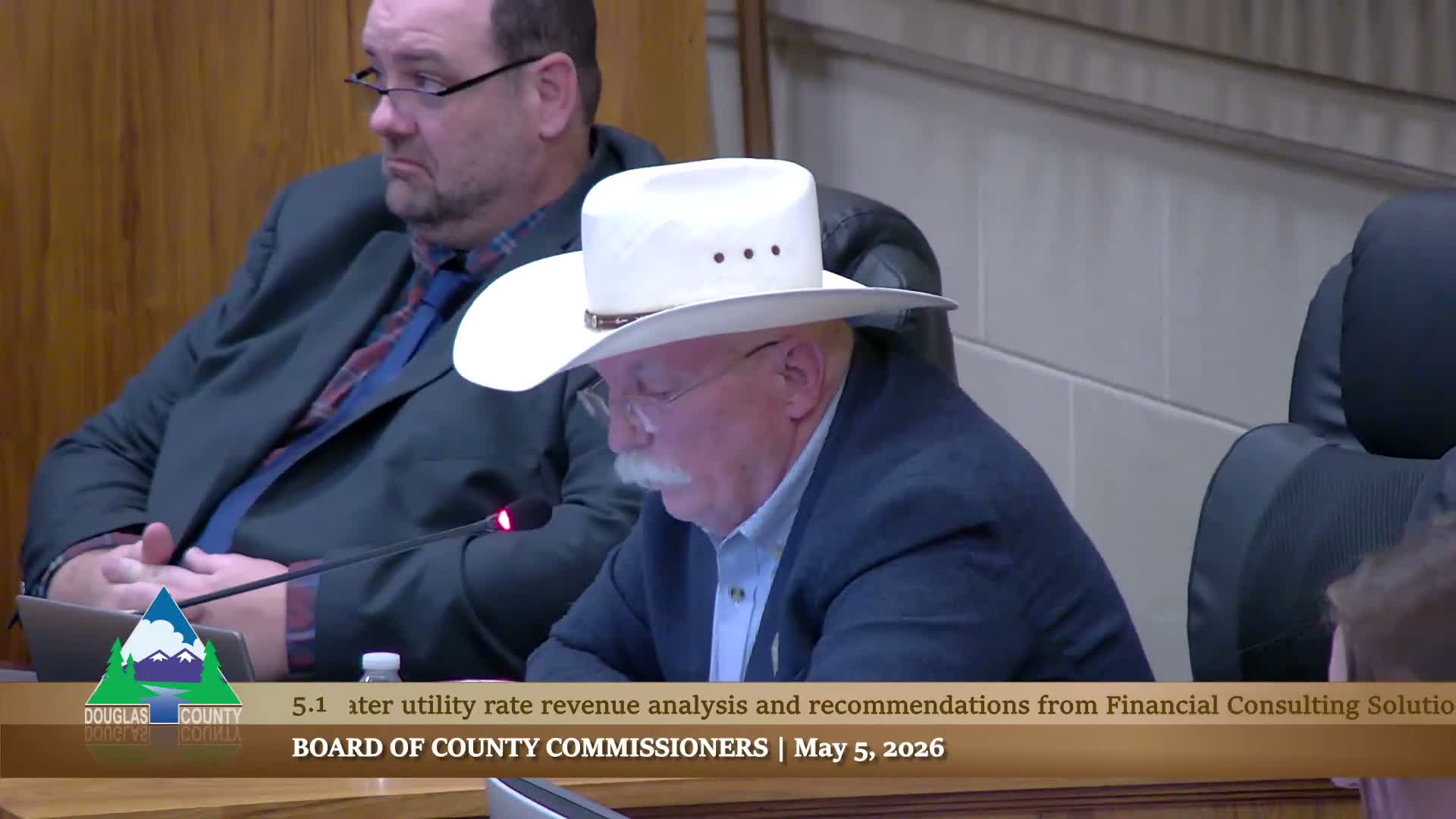
Douglas County officials on May 5 laid out a detailed plan to create a countywide stormwater utility funded by property-based service fees, while hearing hours of public comment both supporting and opposing the measure.
At a special meeting, Assistant County Manager Wendy Lang described the ordinance introduced for first reading — Ordinance 2026-1670 — which would add Appendix G (Stormwater Utility Service) to Title 20 of the county code and establish a dedicated enterprise fund for planning, constructing, operating and maintaining regional stormwater infrastructure. "Ordinance 2026-1670, an ordinance establishing a countywide stormwater utility by adding Appendix G stormwater utility service to Title 20 of the Douglas County code," Lang told the board during the presentation.
Why it matters: County staff and consultants said the stormwater division, created in 2018 and recently formalized in a 2024 master plan, lacks a sustainable funding source; continued reliance on general-fund transfers has left operations vulnerable and could force cuts to road maintenance. County Manager Jennifer Davidson pressed that the utility is meant to sustain day-to-day operations and required drainage assets, not to prevent every flood event. "A lot of the infrastructure that is installed to handle just day to day stormwater, snow melt... is still required in order for us to function properly," Davidson said, adding that the program’s objective is maintenance and regulatory compliance rather than flood insurance.
What staff proposed: Financial Consulting Solutions (FCS) modeled three cost scenarios and a revised rate design. The consultants said they begin with the revenue requirement (costs) and translate that into charges per Equivalent Service Unit (ESU). Updated data puts the ESU at about 6,100 square feet of impervious surface. Under the revised approach shown to the board, the base monthly rate would be roughly $5.80 per ESU, a local-service-area maintenance component would remain about $4.10 per ESU where applicable, and a new capital surcharge (about $5.10 per ESU) would recover capital costs from areas that benefit most from priority projects. FCS described single-family residential tiers — small (<5,000 sq ft = 0.5 ESU), medium (5,000–15,000 = 1 ESU), large (up to 25,000 = 1.5 ESU) — and a 50-ESU cap for nonresidential parcels.
Staff framed the program’s scale and priorities: one scenario funds about $1.5 million per year in operating costs, $1.5 million in capital to fund a portion of the highest-priority projects, and a $1 million allocation for "critical land management" such as conservation easements in flood-prone areas. Consultants said Scenario 1 would fund about $15 million of an identified list of $50 million in top priorities over 10 years while preserving day-to-day maintenance at current levels.
Questions and guardrails: Commissioners repeatedly questioned equity, caps on future increases, exemptions and hardship provisions, and whether revenue could be diverted. Deputy District Attorney Doug Ritchie explained the procedural safeguards for utility-rate setting under state law, noting the rate-setting process includes public hearings and mailed notices and that challenges to rates are reviewed under an abuse-of-discretion standard. Jennifer Davidson said the enterprise fund structure legally restricts use of collected fees to stormwater purposes, and staff pledged annual budget hearings, external audits and a proposed "rate window" (staff suggested three years) to provide predictability.
Public response: Public comment was deeply split. Supporters — including the Tahoe Regional Planning Agency’s watersheds program manager and longtime local residents — said a dedicated fund is necessary to meet TMDL obligations at Lake Tahoe, maintain drainage assets and leverage grant funding. "We are in support of a stormwater utility," Megan Kelly of the Nevada Tahoe Conservation District told commissioners, citing the ability to leverage federal and state funds for lake-clarity projects.
Opponents cited equity and past obligations. Several residents asked why property owners who receive little or no direct service would pay the same base fee; others urged a ballot vote instead of a fee. Rachel Christiansen said residents were told maintenance responsibility had shifted after last year’s flood and argued the county should honor prior Emergency Watershed Protection agreements: "The county is stepping away from its historical role, denying prior commitments, shifting its responsibilities onto residents," she said. Other commenters asked for clearer maps of service boundaries, strict definitions of "impervious surface," and firm limits on the proposed $1 million critical-land fund to avoid misuse.
Actions and next steps: The board approved the meeting agenda earlier in the session by a 5–0 vote. Staff said the business impact hearing will be held at the regular board meeting on May 7; the board may consider adoption and a rate resolution during the final budget hearing on May 28, when staff will also present a line-item budget for the proposed utility.
What remains unresolved: Commissioners and members of the public want more detail about maintenance boundaries, the appeals and credit process for property owners who dispute their ESU assignment, explicit hardship discount criteria for fixed-income residents, and clearer guardrails for capital-land acquisitions and future rate increases. Staff agreed to return with those details and to recommend a rate window and annual budget/audit checkpoints before adoption.
The board took no final vote on the ordinance at the May 5 special meeting; the ordinance was introduced for first reading and will return to the board in subsequent hearings.
At a special meeting, Assistant County Manager Wendy Lang described the ordinance introduced for first reading — Ordinance 2026-1670 — which would add Appendix G (Stormwater Utility Service) to Title 20 of the county code and establish a dedicated enterprise fund for planning, constructing, operating and maintaining regional stormwater infrastructure. "Ordinance 2026-1670, an ordinance establishing a countywide stormwater utility by adding Appendix G stormwater utility service to Title 20 of the Douglas County code," Lang told the board during the presentation.
Why it matters: County staff and consultants said the stormwater division, created in 2018 and recently formalized in a 2024 master plan, lacks a sustainable funding source; continued reliance on general-fund transfers has left operations vulnerable and could force cuts to road maintenance. County Manager Jennifer Davidson pressed that the utility is meant to sustain day-to-day operations and required drainage assets, not to prevent every flood event. "A lot of the infrastructure that is installed to handle just day to day stormwater, snow melt... is still required in order for us to function properly," Davidson said, adding that the program’s objective is maintenance and regulatory compliance rather than flood insurance.
What staff proposed: Financial Consulting Solutions (FCS) modeled three cost scenarios and a revised rate design. The consultants said they begin with the revenue requirement (costs) and translate that into charges per Equivalent Service Unit (ESU). Updated data puts the ESU at about 6,100 square feet of impervious surface. Under the revised approach shown to the board, the base monthly rate would be roughly $5.80 per ESU, a local-service-area maintenance component would remain about $4.10 per ESU where applicable, and a new capital surcharge (about $5.10 per ESU) would recover capital costs from areas that benefit most from priority projects. FCS described single-family residential tiers — small (<5,000 sq ft = 0.5 ESU), medium (5,000–15,000 = 1 ESU), large (up to 25,000 = 1.5 ESU) — and a 50-ESU cap for nonresidential parcels.
Staff framed the program’s scale and priorities: one scenario funds about $1.5 million per year in operating costs, $1.5 million in capital to fund a portion of the highest-priority projects, and a $1 million allocation for "critical land management" such as conservation easements in flood-prone areas. Consultants said Scenario 1 would fund about $15 million of an identified list of $50 million in top priorities over 10 years while preserving day-to-day maintenance at current levels.
Questions and guardrails: Commissioners repeatedly questioned equity, caps on future increases, exemptions and hardship provisions, and whether revenue could be diverted. Deputy District Attorney Doug Ritchie explained the procedural safeguards for utility-rate setting under state law, noting the rate-setting process includes public hearings and mailed notices and that challenges to rates are reviewed under an abuse-of-discretion standard. Jennifer Davidson said the enterprise fund structure legally restricts use of collected fees to stormwater purposes, and staff pledged annual budget hearings, external audits and a proposed "rate window" (staff suggested three years) to provide predictability.
Public response: Public comment was deeply split. Supporters — including the Tahoe Regional Planning Agency’s watersheds program manager and longtime local residents — said a dedicated fund is necessary to meet TMDL obligations at Lake Tahoe, maintain drainage assets and leverage grant funding. "We are in support of a stormwater utility," Megan Kelly of the Nevada Tahoe Conservation District told commissioners, citing the ability to leverage federal and state funds for lake-clarity projects.
Opponents cited equity and past obligations. Several residents asked why property owners who receive little or no direct service would pay the same base fee; others urged a ballot vote instead of a fee. Rachel Christiansen said residents were told maintenance responsibility had shifted after last year’s flood and argued the county should honor prior Emergency Watershed Protection agreements: "The county is stepping away from its historical role, denying prior commitments, shifting its responsibilities onto residents," she said. Other commenters asked for clearer maps of service boundaries, strict definitions of "impervious surface," and firm limits on the proposed $1 million critical-land fund to avoid misuse.
Actions and next steps: The board approved the meeting agenda earlier in the session by a 5–0 vote. Staff said the business impact hearing will be held at the regular board meeting on May 7; the board may consider adoption and a rate resolution during the final budget hearing on May 28, when staff will also present a line-item budget for the proposed utility.
What remains unresolved: Commissioners and members of the public want more detail about maintenance boundaries, the appeals and credit process for property owners who dispute their ESU assignment, explicit hardship discount criteria for fixed-income residents, and clearer guardrails for capital-land acquisitions and future rate increases. Staff agreed to return with those details and to recommend a rate window and annual budget/audit checkpoints before adoption.
The board took no final vote on the ordinance at the May 5 special meeting; the ordinance was introduced for first reading and will return to the board in subsequent hearings.
Don't Miss a Word: See the Full Meeting!
Go beyond summaries. Unlock every video, transcript, and key insight with a Founder Membership.
✓
Get instant access to full meeting videos
✓
Search and clip any phrase from complete transcripts
✓
Receive AI-powered summaries & custom alerts
✓
Enjoy lifetime, unrestricted access to government data
30-day money-back guarantee
