House debates and temporarily passes measure to expand parole review for people who offended before 26
May 05, 2026 | 2026 Legislature CT, Connecticut
This article was created by AI summarizing key points discussed. AI makes mistakes, so for full details and context, please refer to the video of the full meeting. Please report any errors so we can fix them. Report an error »
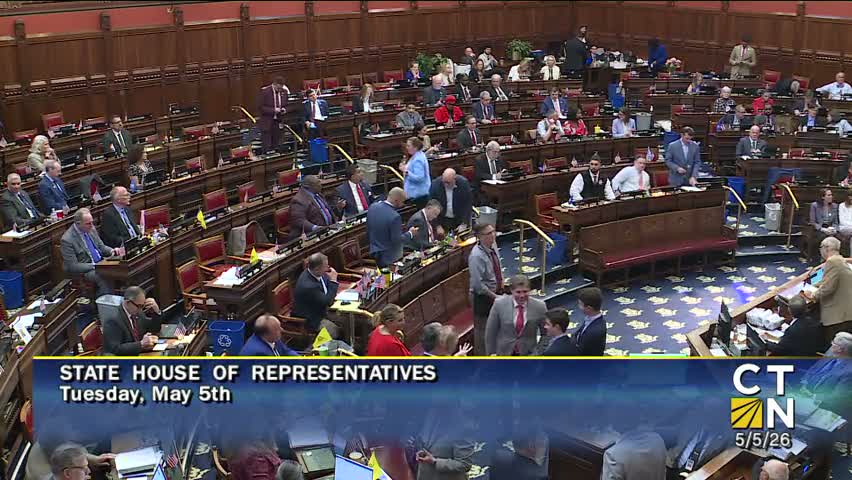
A lengthy floor debate in the Connecticut House on May 5 focused on SB 503, legislation that would expand parole eligibility for people whose offenses were committed before age 26.
Representative Stasstrom, the bill’s proponent, said the measure would ‘‘create a path for certain incarcerated individuals who committed an offense at a young age to be considered for parole after serving substantial time’’ and framed the change as grounded in scientific research about brain development. He described the bill’s mechanics: in many cases the proposal would make people eligible to apply to the parole board after serving 60% of their sentence (with fixed minimums for very long terms), not an automatic release but an opportunity for review. ‘‘This is not a guaranteed release,’’ he said, ‘‘it is a chance to demonstrate growth before the board.’’
Opponents on the floor pushed back, stressing victims’ perspectives and the emotional stakes of reopening sentences. Representative Fishbein argued the bill ‘‘unpacks’’ sentencing expectations and could be painful for families whose loved ones died. ‘‘There is a sense of closure when a sentence is imposed,’’ he said, and faulted language that would place a rebuttable presumption on aspects of parole eligibility, saying that shift in burden was a serious policy change.
Several members gave deeply personal testimony on opposite sides of the question. Representative Butler, whose brother was murdered, described enduring family trauma and urged colleagues to consider the continuing harm to victims’ families. Other members recounted stories of people who committed serious crimes as young adults and later became mentors, degree-holders and contributors upon release; Representative Nolan urged the chamber to ‘‘pay attention to the science’’ and said the parole review process is rigorous and victim-centered.
Supporters emphasized limits baked into the bill: lengthy minimum-served requirements for the gravest sentences, a full parole application process that includes victim and prosecutor input, the possibility of denial, and the prospect that a person on parole can be returned to custody if they violate conditions.
The House did not adopt a final, binding change to state law on the floor that day. Members voted to pass the bill temporarily (PT), a procedural move that allows the legislature to revisit or carry the measure forward during subsequent consideration. That action keeps the measure alive for further conference or amendment rather than enacting immediate law.
Next steps: with the passage PT, sponsors said the bill will be reworked and will return for further consideration; any future change would have to be reconciled between chambers and signed by the governor before becoming law.
Representative Stasstrom, the bill’s proponent, said the measure would ‘‘create a path for certain incarcerated individuals who committed an offense at a young age to be considered for parole after serving substantial time’’ and framed the change as grounded in scientific research about brain development. He described the bill’s mechanics: in many cases the proposal would make people eligible to apply to the parole board after serving 60% of their sentence (with fixed minimums for very long terms), not an automatic release but an opportunity for review. ‘‘This is not a guaranteed release,’’ he said, ‘‘it is a chance to demonstrate growth before the board.’’
Opponents on the floor pushed back, stressing victims’ perspectives and the emotional stakes of reopening sentences. Representative Fishbein argued the bill ‘‘unpacks’’ sentencing expectations and could be painful for families whose loved ones died. ‘‘There is a sense of closure when a sentence is imposed,’’ he said, and faulted language that would place a rebuttable presumption on aspects of parole eligibility, saying that shift in burden was a serious policy change.
Several members gave deeply personal testimony on opposite sides of the question. Representative Butler, whose brother was murdered, described enduring family trauma and urged colleagues to consider the continuing harm to victims’ families. Other members recounted stories of people who committed serious crimes as young adults and later became mentors, degree-holders and contributors upon release; Representative Nolan urged the chamber to ‘‘pay attention to the science’’ and said the parole review process is rigorous and victim-centered.
Supporters emphasized limits baked into the bill: lengthy minimum-served requirements for the gravest sentences, a full parole application process that includes victim and prosecutor input, the possibility of denial, and the prospect that a person on parole can be returned to custody if they violate conditions.
The House did not adopt a final, binding change to state law on the floor that day. Members voted to pass the bill temporarily (PT), a procedural move that allows the legislature to revisit or carry the measure forward during subsequent consideration. That action keeps the measure alive for further conference or amendment rather than enacting immediate law.
Next steps: with the passage PT, sponsors said the bill will be reworked and will return for further consideration; any future change would have to be reconciled between chambers and signed by the governor before becoming law.
View the Full Meeting & All Its Details
This article offers just a summary. Unlock complete video, transcripts, and insights as a Founder Member.
✓
Watch full, unedited meeting videos
✓
Search every word spoken in unlimited transcripts
✓
AI summaries & real-time alerts (all government levels)
✓
Permanent access to expanding government content
30-day money-back guarantee
