Richland County weighs countywide EMS levy and multiple service models as ambulance fund runs deficit
May 06, 2026 | Richland County, Wisconsin
This article was created by AI summarizing key points discussed. AI makes mistakes, so for full details and context, please refer to the video of the full meeting. Please report any errors so we can fix them. Report an error »
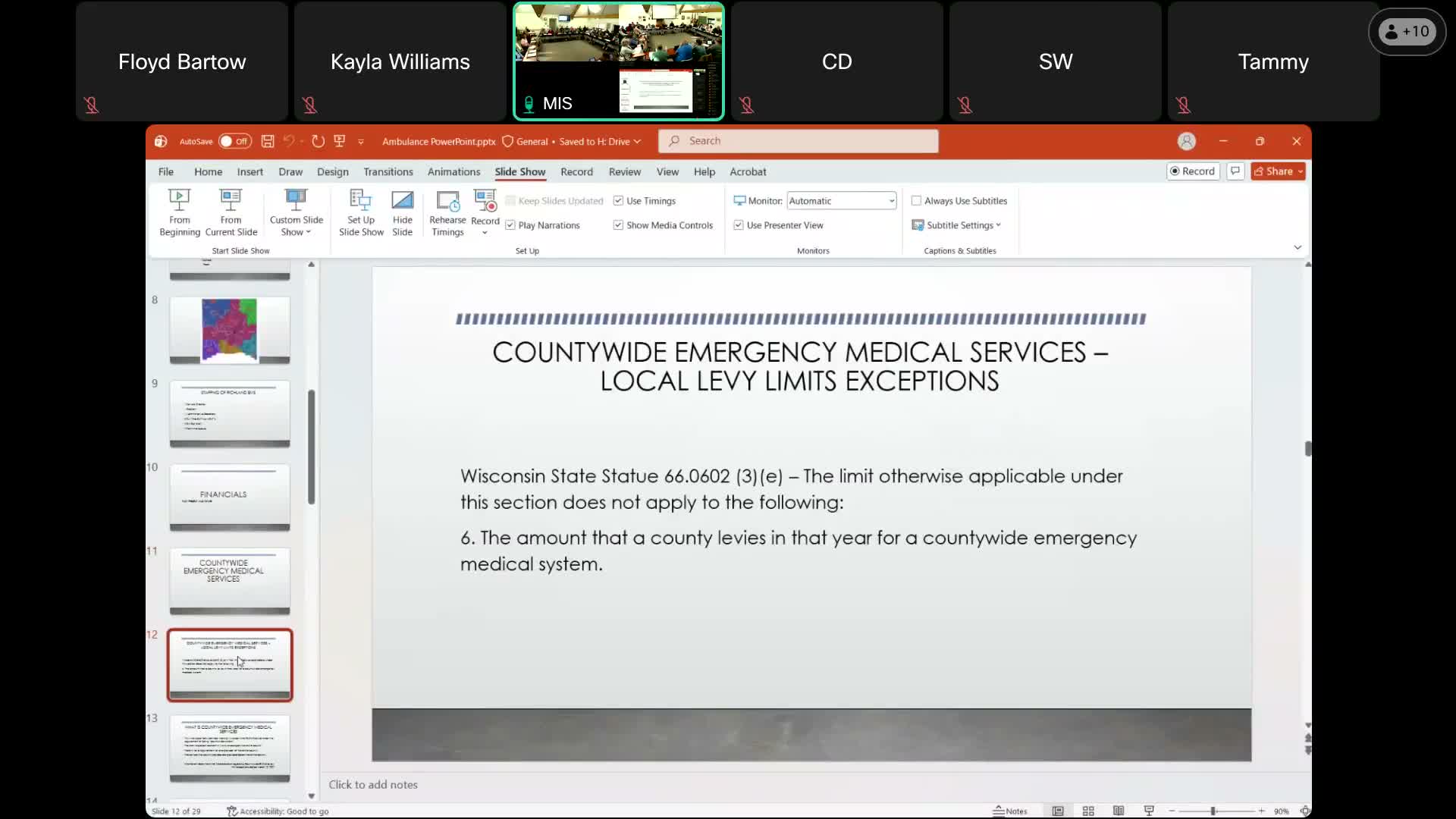
Richland County officials, consultants and local emergency responders spent much of the May 5 county board meeting reviewing the finances and options for the county ambulance service and a possible countywide emergency medical services (EMS) levy that would exceed statutory levy limits.
The board heard a presentation from the county’s finance director and outside consultants showing that the ambulance fund is operating in the red. Finance Director Leanna Pick told supervisors the service owed roughly $297,000 to the county operating account and that auditors may increase the year‑end write‑off estimates, possibly flipping the ambulance fund balance negative after the 2025 audit. Year‑to‑date (Jan–Apr 2026) revenue of about $296,000 was contrasted with $423,000 in expenses, producing a roughly $127,000 deficit through April.
The financial picture was coupled with operational facts: Richland County EMS covers portions of multiple towns and the city of Richland Center and serves an estimated 10,000 residents in its service footprint. Call volumes reported in the packet were roughly 1,228 calls in 2023, 1,131 in 2024 and 1,386 in 2025; 2026 year‑to‑date calls were incomplete in the presentation.
Consultants and county counsel framed the legal options. County attorneys and outside advisers reviewed Wisconsin statutes that govern municipal responsibility for EMS — noting that towns have a statutory obligation under Wis. Stat. 60.565 while cities, villages and counties generally have broader discretion (citing Wis. Stat. 59.54). A separate statute (Wis. Stat. 66.0602) permits counties to levy outside levy limits for a countywide EMS system, but presenters warned the statute contains no clear statutory definition of “countywide,” creating legal and administrative ambiguity that must be resolved in program design.
The board reviewed four primary models compiled in the consultant report: (1) municipalities form and operate an EMS district; (2) municipalities create a district and hire a third party to run operations; (3) the county consolidates responsibility and becomes the direct provider and owner of assets; and (4) a distributed/administrator approach in which the county administers funding and contracts while local municipalities or other providers continue operating day‑to‑day response. Consultants said option 4 — a county administrator role with contracted operations — would preserve existing local providers while allowing centralized accountability and was the recommended, most immediately viable approach.
Presenters discussed grant opportunities as partial mitigation. A state “innovation grant” program that requires a transfer or re‑organization of service can provide multi‑year transition funding; consultants estimated a conservative Richland County award of roughly $139,000 in certain configurations, but cautioned the grant is time limited and that maintaining the status quo under county operation likely disqualifies the county from the program.
Board members and outside counsel probed revenue‑side and collection issues. The presenters said a large portion of ambulance billing is Medicare/Medicaid, which accepts assignment and typically reimburses far below billed charges; combined payer mix and high deductibles make private‑pay receivables difficult to collect. The county recently switched billing companies; staff warned that reports and payments can lag months after a billing vendor change. Supervisors asked about more aggressive collections tools such as the state tax intercept program (TRIP), and county counsel and a collections‑experienced attorney said many recipients of public assistance or those without liens are effectively uncollectible.
Capital needs and mill‑rate impacts were central to the discussion. The county’s analysis model included scenarios to purchase two new ambulances at roughly $500,000 each in year one and smaller recurring capital allocations thereafter, or to lease vehicles to reduce upfront costs. Depending on the scenario, presenters provided sample tax impacts (examples in the packet produced an estimated increase of roughly $120–$270 annually on a $250,000 home under some scenarios), but stressed the numbers depend heavily on assumptions about fleet replacement cadence, salary growth and whether nonparticipating municipalities would be reimbursed under a countywide levy.
Public commenters and municipal leaders urged care in design. Several municipal officials and volunteer fire/EMS leaders told the board they wanted local control preserved and cautioned that a county takeover that displaces local volunteer capacity could reduce available surge manpower in disasters and discourage volunteer recruitment. The board also received a statement from a town representative who said their township had been incorrectly included on a prior letter of support for a countywide levy and asked that be corrected in the record.
Next steps: staff said an RFP for third‑party providers had been issued, and bids were due soon; executive/finance will open proposals in a public meeting and return cost details to the board. The board was reminded that at its May 19 meeting it will take two specific votes: whether Richland County should continue to operate the ambulance service and whether to pursue a countywide levy exemption to fund EMS outside current levy limits. No final vote on those specific items was taken on May 5. The meeting adjourned after public comment.
What’s next: The board will receive procurement bids and additional financial detail before the May 19 vote, at which supervisors could approve continuing county operation, pursue a county levy exemption, adopt a different service model, or direct further negotiation with municipalities and RFP respondents.
The board heard a presentation from the county’s finance director and outside consultants showing that the ambulance fund is operating in the red. Finance Director Leanna Pick told supervisors the service owed roughly $297,000 to the county operating account and that auditors may increase the year‑end write‑off estimates, possibly flipping the ambulance fund balance negative after the 2025 audit. Year‑to‑date (Jan–Apr 2026) revenue of about $296,000 was contrasted with $423,000 in expenses, producing a roughly $127,000 deficit through April.
The financial picture was coupled with operational facts: Richland County EMS covers portions of multiple towns and the city of Richland Center and serves an estimated 10,000 residents in its service footprint. Call volumes reported in the packet were roughly 1,228 calls in 2023, 1,131 in 2024 and 1,386 in 2025; 2026 year‑to‑date calls were incomplete in the presentation.
Consultants and county counsel framed the legal options. County attorneys and outside advisers reviewed Wisconsin statutes that govern municipal responsibility for EMS — noting that towns have a statutory obligation under Wis. Stat. 60.565 while cities, villages and counties generally have broader discretion (citing Wis. Stat. 59.54). A separate statute (Wis. Stat. 66.0602) permits counties to levy outside levy limits for a countywide EMS system, but presenters warned the statute contains no clear statutory definition of “countywide,” creating legal and administrative ambiguity that must be resolved in program design.
The board reviewed four primary models compiled in the consultant report: (1) municipalities form and operate an EMS district; (2) municipalities create a district and hire a third party to run operations; (3) the county consolidates responsibility and becomes the direct provider and owner of assets; and (4) a distributed/administrator approach in which the county administers funding and contracts while local municipalities or other providers continue operating day‑to‑day response. Consultants said option 4 — a county administrator role with contracted operations — would preserve existing local providers while allowing centralized accountability and was the recommended, most immediately viable approach.
Presenters discussed grant opportunities as partial mitigation. A state “innovation grant” program that requires a transfer or re‑organization of service can provide multi‑year transition funding; consultants estimated a conservative Richland County award of roughly $139,000 in certain configurations, but cautioned the grant is time limited and that maintaining the status quo under county operation likely disqualifies the county from the program.
Board members and outside counsel probed revenue‑side and collection issues. The presenters said a large portion of ambulance billing is Medicare/Medicaid, which accepts assignment and typically reimburses far below billed charges; combined payer mix and high deductibles make private‑pay receivables difficult to collect. The county recently switched billing companies; staff warned that reports and payments can lag months after a billing vendor change. Supervisors asked about more aggressive collections tools such as the state tax intercept program (TRIP), and county counsel and a collections‑experienced attorney said many recipients of public assistance or those without liens are effectively uncollectible.
Capital needs and mill‑rate impacts were central to the discussion. The county’s analysis model included scenarios to purchase two new ambulances at roughly $500,000 each in year one and smaller recurring capital allocations thereafter, or to lease vehicles to reduce upfront costs. Depending on the scenario, presenters provided sample tax impacts (examples in the packet produced an estimated increase of roughly $120–$270 annually on a $250,000 home under some scenarios), but stressed the numbers depend heavily on assumptions about fleet replacement cadence, salary growth and whether nonparticipating municipalities would be reimbursed under a countywide levy.
Public commenters and municipal leaders urged care in design. Several municipal officials and volunteer fire/EMS leaders told the board they wanted local control preserved and cautioned that a county takeover that displaces local volunteer capacity could reduce available surge manpower in disasters and discourage volunteer recruitment. The board also received a statement from a town representative who said their township had been incorrectly included on a prior letter of support for a countywide levy and asked that be corrected in the record.
Next steps: staff said an RFP for third‑party providers had been issued, and bids were due soon; executive/finance will open proposals in a public meeting and return cost details to the board. The board was reminded that at its May 19 meeting it will take two specific votes: whether Richland County should continue to operate the ambulance service and whether to pursue a countywide levy exemption to fund EMS outside current levy limits. No final vote on those specific items was taken on May 5. The meeting adjourned after public comment.
What’s next: The board will receive procurement bids and additional financial detail before the May 19 vote, at which supervisors could approve continuing county operation, pursue a county levy exemption, adopt a different service model, or direct further negotiation with municipalities and RFP respondents.
Don't Miss a Word: See the Full Meeting!
Go beyond summaries. Unlock every video, transcript, and key insight with a Founder Membership.
✓
Get instant access to full meeting videos
✓
Search and clip any phrase from complete transcripts
✓
Receive AI-powered summaries & custom alerts
✓
Enjoy lifetime, unrestricted access to government data
30-day money-back guarantee
