Senate Resources Committee presses AGDC and Glenfarn over costs and tax plan for SB 280
May 05, 2026 | 2026 Legislature Alaska, Alaska
This article was created by AI summarizing key points discussed. AI makes mistakes, so for full details and context, please refer to the video of the full meeting. Please report any errors so we can fix them. Report an error »
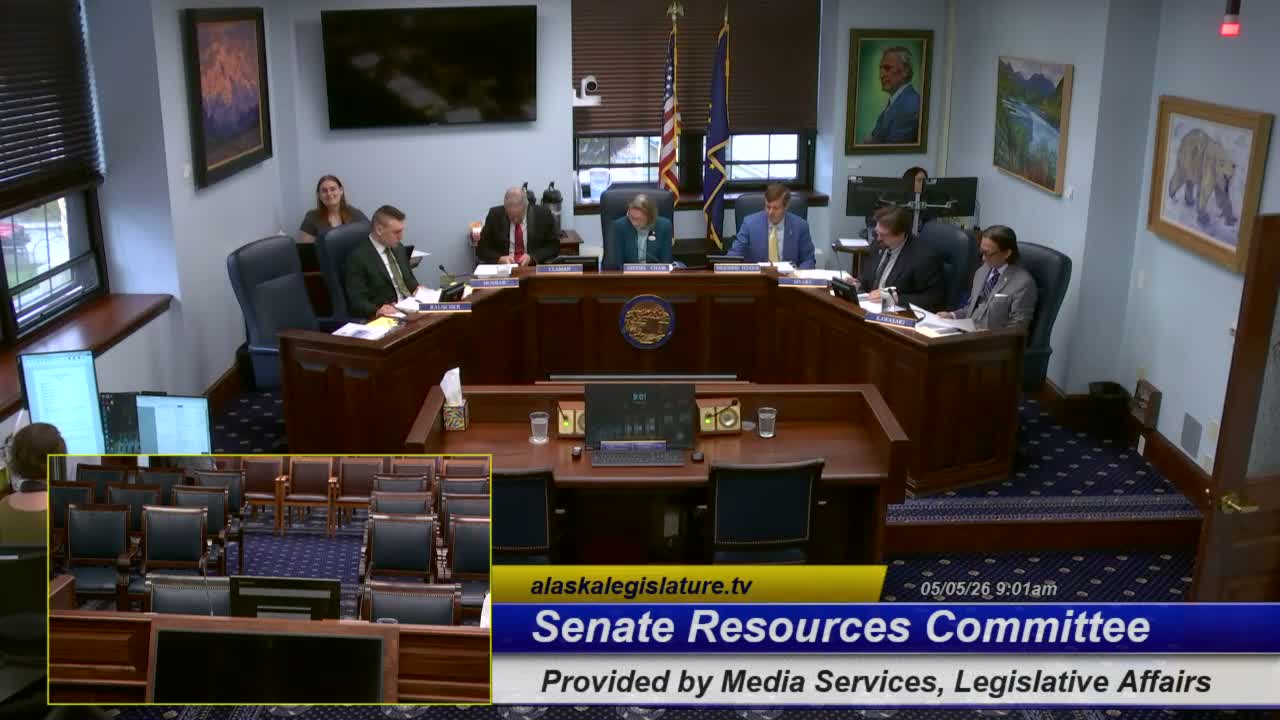
The Senate Resources Committee on May 5 heard extended testimony from the Alaska Gas Line Development Corporation (AGDC) and Glenfarn on the Supporting a Gas Line for Alaskans Act (Senate Bill 280), centered on proposed alternative volumetric tax (AVT) rates, project cost estimates and the confidentiality of commercial negotiations.
At the hearing, committee members focused first on the bill's tax structure. The H-version on the table would apply 15¢ per MCF to the gas treatment plant, 15¢ per MCF to the pipeline and 25¢ per MCF to the LNG plant. "If you tally up the stack tariffs... you end up with a 55¢ per MCF tax," Adam Prestige, a Glenfarn representative, told the committee, calling that level "very burdensome, for the project and potentially, prohibitively" so for a timely final investment decision.
Why it matters: Senators said they need firm numbers to weigh long-term tradeoffs between state and local revenue and near-term consumer prices. "I am not gonna vote on a bill without numbers," Vice Chair Senator Wilkowski said, pressing presenters for model inputs and projected fiscal impacts.
Project costs and component estimates were another focal point. Witnesses and Department of Revenue (DOR) material cited an updated, industry-derived total in the mid-$40 billion range. Frank Richards, president of AGDC, described earlier and Department of Revenue'aligned estimates placing the gas treatment plant at roughly $10'$11 billion, the pipeline at about $16 billion, and the liquefaction facility north of $20 billion, producing an aggregate near the $44'$46 billion figures being circulated for modeling purposes.
The committee sought clarity on how the AVT would affect consumers. Mark Begich, appearing for the governor's office, told senators the AVT is treated as an operational pass-through: "It goes to the consumer... It just goes away," he said, explaining that the tax is embedded in the delivered price and not retained as profit by the project sponsor. Begich and others warned that higher per-unit charges could weaken export competitiveness and reduce volume, a result that could ultimately raise the per-unit cost for Alaskans rather than lower it.
Transportation and local impacts came up in follow-up questioning. Senators asked whether the project would pay for road upgrades beyond immediate access work. AGDC and Glenfarn said pipeline contractors would include repair and maintenance in bids and the project plans to use highway-use agreements with the Department of Transportation for larger upgrades. AGDC cited a prior class-estimate near $40 million to relocate a highway segment around a proposed LNG plant site in the Kenai area.
On transparency and confidentiality, Glenfarn and AGDC said commercially sensitive costs and negotiated commercial terms remain under private negotiation and that public disclosure could compromise competitive negotiations with lenders, contractors and buyers. "Disclosing... our cost estimates and what we have on our side of the model puts the project at a competitive disadvantage," Prestige said, adding Glenfarn is open to NDAs or executive-session briefings as ways to provide the committee with more detailed information while protecting commercial leverage. Several senators objected that confidential briefings complicate public-law crafting if the committee cannot disclose the basis for legislative decisions.
Federal support and timing: Senators asked how federal tools such as the Defense Production Act (DPA) might be applied. Witnesses said no concrete White House implementation plan had been communicated to them; Begich noted the DPA could be used in various ways (bureaucratic acceleration or financing) if the administration chose to act.
What was not decided: No motion or vote occurred. Committee members repeatedly emphasized they need firmer numbers on construction costs, tariff impacts and consumer price projections before advancing the bill. Several senators explored compromises, including time-limited provisions or additional consumer protections, and asked staff to pursue more detailed modeling and confidential briefings where appropriate.
Next steps: Chair Senator Giesel closed the hearing and announced the committee will reconvene tomorrow afternoon at 3:30 p.m. for other business; the SB 280 discussion will continue in subsequent meetings as members press for the specific fiscal details they say are necessary to weigh the trade-offs.
Representative attributions used in this report come from the hearing transcript and are limited to speakers who self-identified or were introduced on the record.
At the hearing, committee members focused first on the bill's tax structure. The H-version on the table would apply 15¢ per MCF to the gas treatment plant, 15¢ per MCF to the pipeline and 25¢ per MCF to the LNG plant. "If you tally up the stack tariffs... you end up with a 55¢ per MCF tax," Adam Prestige, a Glenfarn representative, told the committee, calling that level "very burdensome, for the project and potentially, prohibitively" so for a timely final investment decision.
Why it matters: Senators said they need firm numbers to weigh long-term tradeoffs between state and local revenue and near-term consumer prices. "I am not gonna vote on a bill without numbers," Vice Chair Senator Wilkowski said, pressing presenters for model inputs and projected fiscal impacts.
Project costs and component estimates were another focal point. Witnesses and Department of Revenue (DOR) material cited an updated, industry-derived total in the mid-$40 billion range. Frank Richards, president of AGDC, described earlier and Department of Revenue'aligned estimates placing the gas treatment plant at roughly $10'$11 billion, the pipeline at about $16 billion, and the liquefaction facility north of $20 billion, producing an aggregate near the $44'$46 billion figures being circulated for modeling purposes.
The committee sought clarity on how the AVT would affect consumers. Mark Begich, appearing for the governor's office, told senators the AVT is treated as an operational pass-through: "It goes to the consumer... It just goes away," he said, explaining that the tax is embedded in the delivered price and not retained as profit by the project sponsor. Begich and others warned that higher per-unit charges could weaken export competitiveness and reduce volume, a result that could ultimately raise the per-unit cost for Alaskans rather than lower it.
Transportation and local impacts came up in follow-up questioning. Senators asked whether the project would pay for road upgrades beyond immediate access work. AGDC and Glenfarn said pipeline contractors would include repair and maintenance in bids and the project plans to use highway-use agreements with the Department of Transportation for larger upgrades. AGDC cited a prior class-estimate near $40 million to relocate a highway segment around a proposed LNG plant site in the Kenai area.
On transparency and confidentiality, Glenfarn and AGDC said commercially sensitive costs and negotiated commercial terms remain under private negotiation and that public disclosure could compromise competitive negotiations with lenders, contractors and buyers. "Disclosing... our cost estimates and what we have on our side of the model puts the project at a competitive disadvantage," Prestige said, adding Glenfarn is open to NDAs or executive-session briefings as ways to provide the committee with more detailed information while protecting commercial leverage. Several senators objected that confidential briefings complicate public-law crafting if the committee cannot disclose the basis for legislative decisions.
Federal support and timing: Senators asked how federal tools such as the Defense Production Act (DPA) might be applied. Witnesses said no concrete White House implementation plan had been communicated to them; Begich noted the DPA could be used in various ways (bureaucratic acceleration or financing) if the administration chose to act.
What was not decided: No motion or vote occurred. Committee members repeatedly emphasized they need firmer numbers on construction costs, tariff impacts and consumer price projections before advancing the bill. Several senators explored compromises, including time-limited provisions or additional consumer protections, and asked staff to pursue more detailed modeling and confidential briefings where appropriate.
Next steps: Chair Senator Giesel closed the hearing and announced the committee will reconvene tomorrow afternoon at 3:30 p.m. for other business; the SB 280 discussion will continue in subsequent meetings as members press for the specific fiscal details they say are necessary to weigh the trade-offs.
Representative attributions used in this report come from the hearing transcript and are limited to speakers who self-identified or were introduced on the record.
Don't Miss a Word: See the Full Meeting!
Go beyond summaries. Unlock every video, transcript, and key insight with a Founder Membership.
✓
Get instant access to full meeting videos
✓
Search and clip any phrase from complete transcripts
✓
Receive AI-powered summaries & custom alerts
✓
Enjoy lifetime, unrestricted access to government data
30-day money-back guarantee
