Fairfax County outlines plan to replace aging Jones Point pump station; construction targeted Jan. 2027
May 06, 2026 | Fairfax County, Virginia
This article was created by AI summarizing key points discussed. AI makes mistakes, so for full details and context, please refer to the video of the full meeting. Please report any errors so we can fix them. Report an error »
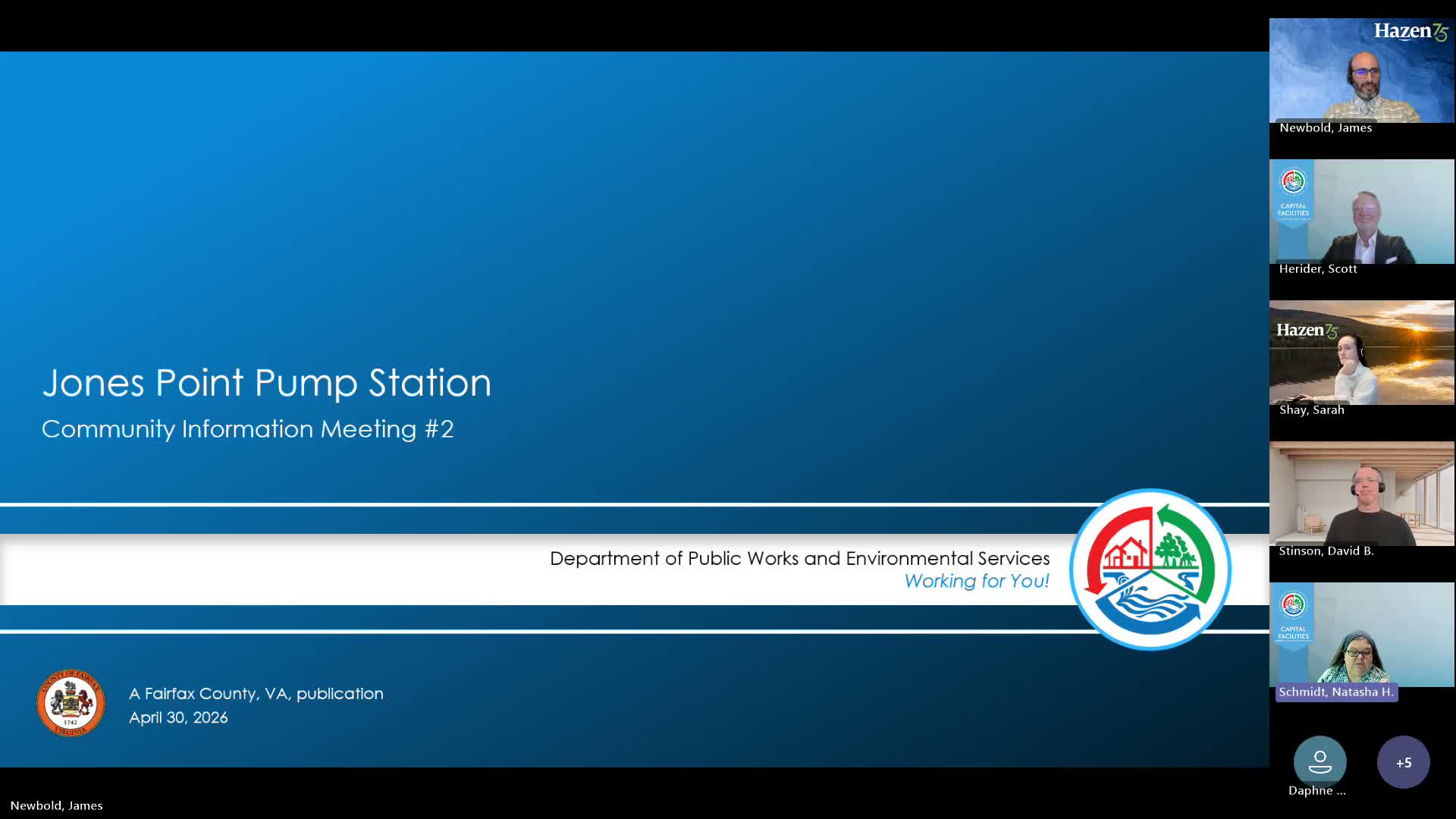
Natasha Schmidt, project manager for Fairfax County Department of Public Works and Environmental Services, said the county is moving forward with a replacement for the aging Jones Point pump station to ensure reliable wastewater conveyance and prepare for projected flow increases.
The county and its design consultant Hazen and Sawyer presented maps, renderings and a condition assessment showing the existing station is “beyond the point of rehabilitation,” a point Hazen engineer Jim Newbold emphasized as the basis for replacement. Sarah Shay, a Hazen project engineer, said the new station is intended to “reduce the risk of basement backups in our residential areas nearby,” lower future maintenance costs and accommodate growth through 2045.
County staff and consultants said most infrastructure will be underground; the only above-ground elements will be a small control building and an emergency generator. To minimize neighborhood and park impact, the team proposed a 6-foot black chain-link fence with privacy slats, native-tree landscaping coordinated with the Fairfax County Park Authority, and lighting designed to reduce light pollution. Project staff estimated the emergency generator will run about 50 to 60 hours per year and that it will be enclosed in a noise-rated enclosure designed to limit sound to approximately 55 decibels at full load.
The design includes an influent manhole, grinder vault, wet well and pumps that will discharge through a force main to the ALEX Renew Enterprise treatment plant, officials said. Staff described options for connecting existing apartment-side sewer lines to the new station, including open-cut trenching or trenchless methods such as microtunneling to limit surface disturbance.
On access and operations, the team said the contractor laydown area will be fenced, and that most construction traffic will use Mainstay Drive and the apartment parking lot for staging. After construction, the project will provide gated vehicle access for authorized maintenance staff and a widened, paved pedestrian path where a worn informal path currently exists; staff said park trails themselves will not be impacted and pedestrians and bicyclists will be able to pass the gate on a paved route.
Natasha Schmidt outlined the schedule and procurement plan: the team expects bid-ready documents in July, to advertise for bids shortly thereafter, to award the construction contract in December, and to issue a notice to proceed in January 2027. She said construction is expected to last about 18 months, with substantial completion in July 2028 and a one-year warranty period thereafter; the schedule remains contingent on permit approvals and easement acquisitions from the Park Authority and adjacent property owners.
In the meeting’s public Q&A, resident Maddie Debru asked whether the access road would provide a path to the levee; staff replied pedestrians will still be able to use the levee walkway, the worn apartment-side path will be paved and widened to accommodate pedestrians and bicyclists, and gates will restrict vehicle access to authorized users. Another attendee raised concerns about historic flooding in the area; staff responded that backups are more often caused by gravity-sewer failures and that the station’s design—including elevating electrical equipment and providing a generator—aims to mitigate those risks. Staff added that pump-and-haul procedures exist as an emergency contingency.
Project staff invited residents with additional questions to email the project team and noted contact information and a project website (Jones Pointe facilities rehabilitation) and QR code would be posted with the meeting materials. The meeting ended with staff thanking attendees and confirming materials and the recording would be posted for later review.
The county and its design consultant Hazen and Sawyer presented maps, renderings and a condition assessment showing the existing station is “beyond the point of rehabilitation,” a point Hazen engineer Jim Newbold emphasized as the basis for replacement. Sarah Shay, a Hazen project engineer, said the new station is intended to “reduce the risk of basement backups in our residential areas nearby,” lower future maintenance costs and accommodate growth through 2045.
County staff and consultants said most infrastructure will be underground; the only above-ground elements will be a small control building and an emergency generator. To minimize neighborhood and park impact, the team proposed a 6-foot black chain-link fence with privacy slats, native-tree landscaping coordinated with the Fairfax County Park Authority, and lighting designed to reduce light pollution. Project staff estimated the emergency generator will run about 50 to 60 hours per year and that it will be enclosed in a noise-rated enclosure designed to limit sound to approximately 55 decibels at full load.
The design includes an influent manhole, grinder vault, wet well and pumps that will discharge through a force main to the ALEX Renew Enterprise treatment plant, officials said. Staff described options for connecting existing apartment-side sewer lines to the new station, including open-cut trenching or trenchless methods such as microtunneling to limit surface disturbance.
On access and operations, the team said the contractor laydown area will be fenced, and that most construction traffic will use Mainstay Drive and the apartment parking lot for staging. After construction, the project will provide gated vehicle access for authorized maintenance staff and a widened, paved pedestrian path where a worn informal path currently exists; staff said park trails themselves will not be impacted and pedestrians and bicyclists will be able to pass the gate on a paved route.
Natasha Schmidt outlined the schedule and procurement plan: the team expects bid-ready documents in July, to advertise for bids shortly thereafter, to award the construction contract in December, and to issue a notice to proceed in January 2027. She said construction is expected to last about 18 months, with substantial completion in July 2028 and a one-year warranty period thereafter; the schedule remains contingent on permit approvals and easement acquisitions from the Park Authority and adjacent property owners.
In the meeting’s public Q&A, resident Maddie Debru asked whether the access road would provide a path to the levee; staff replied pedestrians will still be able to use the levee walkway, the worn apartment-side path will be paved and widened to accommodate pedestrians and bicyclists, and gates will restrict vehicle access to authorized users. Another attendee raised concerns about historic flooding in the area; staff responded that backups are more often caused by gravity-sewer failures and that the station’s design—including elevating electrical equipment and providing a generator—aims to mitigate those risks. Staff added that pump-and-haul procedures exist as an emergency contingency.
Project staff invited residents with additional questions to email the project team and noted contact information and a project website (Jones Pointe facilities rehabilitation) and QR code would be posted with the meeting materials. The meeting ended with staff thanking attendees and confirming materials and the recording would be posted for later review.
View the Full Meeting & All Its Details
This article offers just a summary. Unlock complete video, transcripts, and insights as a Founder Member.
✓
Watch full, unedited meeting videos
✓
Search every word spoken in unlimited transcripts
✓
AI summaries & real-time alerts (all government levels)
✓
Permanent access to expanding government content
30-day money-back guarantee
