Northern Lebanon SD committee reviews proposed $55M budget that includes 4.2% tax increase
May 06, 2026 | Northern Lebanon SD, School Districts, Pennsylvania
This article was created by AI summarizing key points discussed. AI makes mistakes, so for full details and context, please refer to the video of the full meeting. Please report any errors so we can fix them. Report an error »
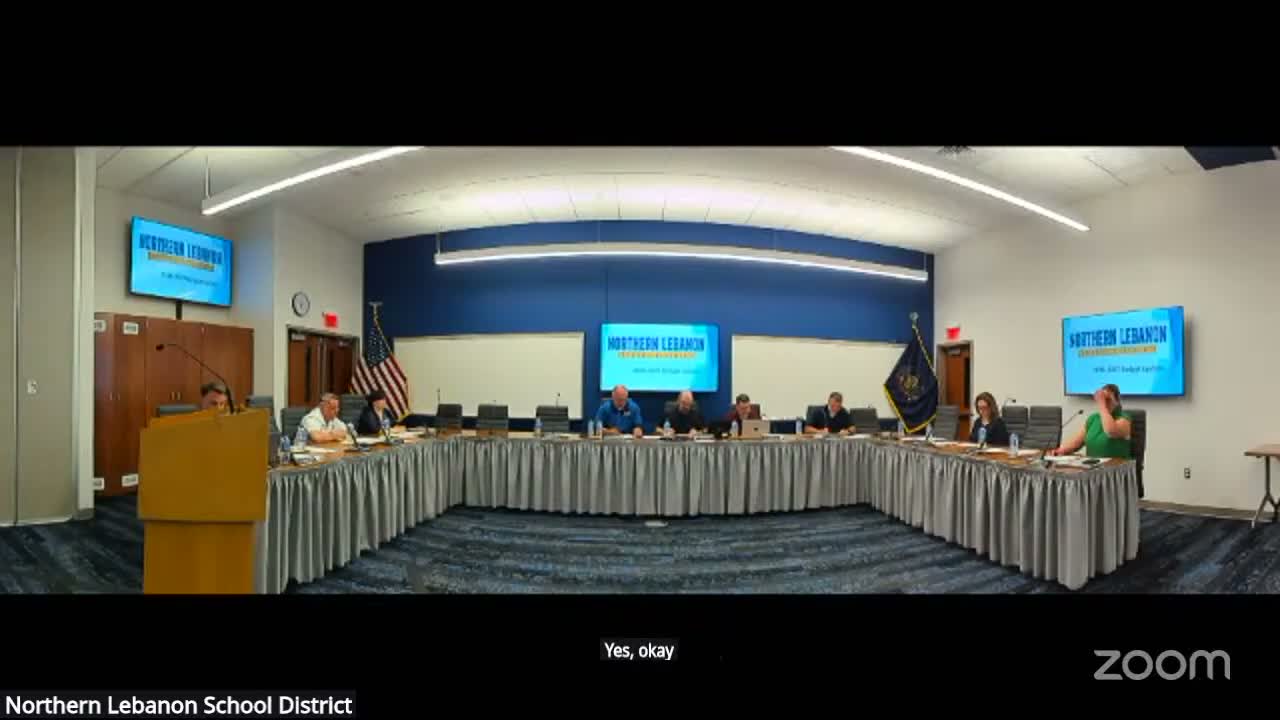
The Northern Lebanon School District committee on May 5 reviewed a proposed 2026–27 budget that uses a 4.2% real-estate tax increase to balance total revenues and expenses "right under $55,000,000," district business official Leanne Martin said.
Martin told directors the district projects roughly $27.8 million from real-estate taxes — about 51% of total revenue — with state funding near 38% and declining federal funds. "At 4.2%, it's a $139 for the year to the average homeowner," Martin said, describing the average assessed value used in the slide deck. She said the proposed final budget will be adopted by the board next week and made available for public inspection before the district adopts a final budget in June and files required documents with the Pennsylvania Department of Education.
Why it matters: the committee’s proposed budget frames next week’s board action. Martin highlighted that salary, benefits, debt payments and transportation together account for the largest share of expenses — roughly 77–78% — and that the district faces higher debt-service costs as bond payments from recent construction come due.
Martin reviewed several specifics directors asked about, including a proposed $300,000 placeholder transfer into a reopened capital reserve fund to begin accounting for future career-technical-center (CTC) bond payments. On long-term debt, she said annual debt service has risen from about $1.9 million in 2021–22 to an estimated $6.5 million for 2026–27. "So we are building $300,000 into this budget for 26–27 to go towards that CTC bond payment when it comes," Martin said.
Board members asked for additional detail on the CTC renovation scenarios and transportation reimbursements. Martin said the district had received two cost scenarios for the CTC renovation and would supply more precise district-by-district numbers at the next meeting. On transportation, she said the district bears fuel costs and expects a CPI-linked contract increase next year; state reimbursement lags and typically does not fully cover higher costs.
Martin also noted health-care costs were budgeted conservatively this year: the consultant returned a smaller-than-expected increase and the draft includes a $65,000 line-item increase; she proposed moving an additional $200,000 into committed health-care funds in June to manage risk.
What’s next: the committee left the proposed final budget on next week’s discussion agenda for formal adoption; the board’s May adoption will put the budget on public inspection and recur for final adoption in June. Martin said the district must submit the final budget to PDE by mid-July at the latest if approval is delayed.
Clarifying details: the presentation repeatedly described totals as approximate ("right under $55,000,000"); the $139 homeowner impact figure was presented as an annual approximate impact for an average assessed home; CTC renovation scenarios were described as differing substantially, with a lower scenario near $80 million and a higher one near $100 million, and the district’s $300,000 budget placeholder is not a committed bond payment but an initial transfer to a capital reserve.
Martin told directors the district projects roughly $27.8 million from real-estate taxes — about 51% of total revenue — with state funding near 38% and declining federal funds. "At 4.2%, it's a $139 for the year to the average homeowner," Martin said, describing the average assessed value used in the slide deck. She said the proposed final budget will be adopted by the board next week and made available for public inspection before the district adopts a final budget in June and files required documents with the Pennsylvania Department of Education.
Why it matters: the committee’s proposed budget frames next week’s board action. Martin highlighted that salary, benefits, debt payments and transportation together account for the largest share of expenses — roughly 77–78% — and that the district faces higher debt-service costs as bond payments from recent construction come due.
Martin reviewed several specifics directors asked about, including a proposed $300,000 placeholder transfer into a reopened capital reserve fund to begin accounting for future career-technical-center (CTC) bond payments. On long-term debt, she said annual debt service has risen from about $1.9 million in 2021–22 to an estimated $6.5 million for 2026–27. "So we are building $300,000 into this budget for 26–27 to go towards that CTC bond payment when it comes," Martin said.
Board members asked for additional detail on the CTC renovation scenarios and transportation reimbursements. Martin said the district had received two cost scenarios for the CTC renovation and would supply more precise district-by-district numbers at the next meeting. On transportation, she said the district bears fuel costs and expects a CPI-linked contract increase next year; state reimbursement lags and typically does not fully cover higher costs.
Martin also noted health-care costs were budgeted conservatively this year: the consultant returned a smaller-than-expected increase and the draft includes a $65,000 line-item increase; she proposed moving an additional $200,000 into committed health-care funds in June to manage risk.
What’s next: the committee left the proposed final budget on next week’s discussion agenda for formal adoption; the board’s May adoption will put the budget on public inspection and recur for final adoption in June. Martin said the district must submit the final budget to PDE by mid-July at the latest if approval is delayed.
Clarifying details: the presentation repeatedly described totals as approximate ("right under $55,000,000"); the $139 homeowner impact figure was presented as an annual approximate impact for an average assessed home; CTC renovation scenarios were described as differing substantially, with a lower scenario near $80 million and a higher one near $100 million, and the district’s $300,000 budget placeholder is not a committed bond payment but an initial transfer to a capital reserve.
Don't Miss a Word: See the Full Meeting!
Go beyond summaries. Unlock every video, transcript, and key insight with a Founder Membership.
✓
Get instant access to full meeting videos
✓
Search and clip any phrase from complete transcripts
✓
Receive AI-powered summaries & custom alerts
✓
Enjoy lifetime, unrestricted access to government data
30-day money-back guarantee
