Urbandale council approves comprehensive-plan change for proposed 104-unit supportive housing; PUD ordinance to be drafted
May 06, 2026 | Urbandale, Polk County, Iowa
This article was created by AI summarizing key points discussed. AI makes mistakes, so for full details and context, please refer to the video of the full meeting. Please report any errors so we can fix them. Report an error »
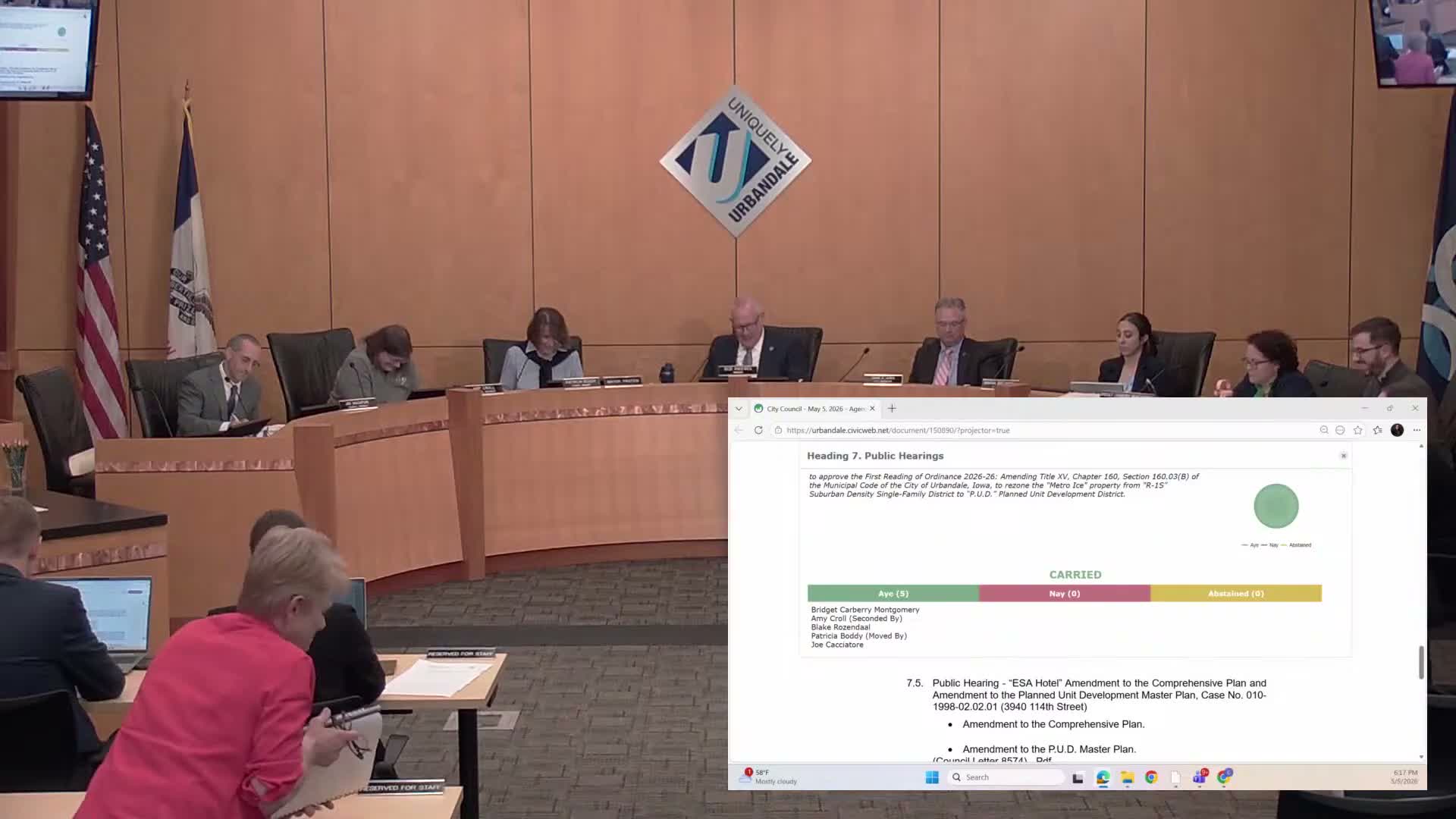
Urbandale’s City Council on a 5–0 vote approved a change to the city’s comprehensive plan that clears the way for a proposed conversion of an Extended Stay America hotel into permanent supportive housing, but stopped short of final zoning approval and asked staff to draft a detailed PUD ordinance before any rezoning occurs.
The amendment changes the future-land-use designation of the property near Douglas and 114th Street from office/business park to mixed residential. Emily Oswiler, CEO of Greater Des Moines Supportive Housing, told the council the project would convert the existing building into 104 studio units with on-site supportive services in a roughly 10,000-square-foot two‑story addition that would house case management, a pantry, classrooms and other wraparound supports. Oswiler said the model emphasizes on-site management, 24/7 staffing or security, a dry campus and background-screening criteria for residents. “We are not a shelter; we are permanent housing with supports,” she said.
Why it mattered: councilmembers said they were weighing an urgent regional shortage of permanent supportive housing against questions about site suitability and enforceable operational standards. Opponents, including representatives of nearby property owners and R and R Realty, argued the site lacks nearby transit, grocery and neighborhood amenities and warned that prior hotel conversions in the area had deteriorated. Adam Caduce of R and R Realty told the council that the PUD packet did not yet include binding operational requirements and urged the city to require enforceable standards in any ordinance.
Key facts: the applicant asked to (1) add multifamily supportive housing as a permitted use in the PUD, (2) reduce multi‑family parking to 0.5 spaces per unit (from the city’s reduced-staffing baseline), and (3) permit a small number of proposed units that fall below a 320‑sq‑ft minimum currently referenced in city code. Oswiler said roughly four of the project’s 104 studios are under 320 square feet and that the applicant’s operating plan anticipates few cars, bicycle parking and DART on‑demand service coverage beginning this fall.
Council action and next steps: the council approved the comprehensive-plan amendment (vote recorded as 5–0) and unanimously directed staff to draft a PUD ordinance that would implement and limit the requested changes. City staff and legal counsel advised the council that a formal PUD ordinance will require a separate public hearing and three readings; staff also noted a written protest petition had been filed that could raise the legal vote threshold for certain rezoning outcomes. Mayor Robert Andwig framed the council’s action as a legislative policy decision rather than final zoning, and councilmembers asked staff to return with draft ordinance language addressing parking (including deferred construction options), minimum unit size, landscaping/buffering, courtyard/open-space requirements, sidewalk connectivity and exterior lighting.
What proponents and opponents said: Oswiler pointed to a local precedent — a YMCA supportive-housing campus — and to regional studies identifying a shortage of supportive units in Polk County; she said the applicant has a $15 million acquisition/rehab estimate, a capital campaign under way, and an initial major philanthropic gift. Opponents, including Jeremy Shepherd and Adam Caduce of R and R Realty, emphasized site constraints and asked the council to require written, enforceable commitments (for example a development agreement) in addition to any PUD language. Legal counsel for an insurer representing nearby property owners also urged the council to ensure procedural completeness to avoid litigation risk.
Quotes: “We’re creating a healing space that fosters connections, purpose and wellness,” Oswiler said. Opponent Adam Caduce said the change would place residential uses into an area “not designed to have that kind of conflict between residential and commercial,” and urged enforceable standards in the ordinance.
The council did not take final action on a PUD rezoning request at the meeting; staff will return with a draft ordinance and timeline (staff estimated the public‑hearing/ordinance process will take weeks to a few months, depending on reading waivers and notice requirements). The council also discussed the possibility of a development agreement or conditional zoning to attach operational commitments to any approval.
The amendment changes the future-land-use designation of the property near Douglas and 114th Street from office/business park to mixed residential. Emily Oswiler, CEO of Greater Des Moines Supportive Housing, told the council the project would convert the existing building into 104 studio units with on-site supportive services in a roughly 10,000-square-foot two‑story addition that would house case management, a pantry, classrooms and other wraparound supports. Oswiler said the model emphasizes on-site management, 24/7 staffing or security, a dry campus and background-screening criteria for residents. “We are not a shelter; we are permanent housing with supports,” she said.
Why it mattered: councilmembers said they were weighing an urgent regional shortage of permanent supportive housing against questions about site suitability and enforceable operational standards. Opponents, including representatives of nearby property owners and R and R Realty, argued the site lacks nearby transit, grocery and neighborhood amenities and warned that prior hotel conversions in the area had deteriorated. Adam Caduce of R and R Realty told the council that the PUD packet did not yet include binding operational requirements and urged the city to require enforceable standards in any ordinance.
Key facts: the applicant asked to (1) add multifamily supportive housing as a permitted use in the PUD, (2) reduce multi‑family parking to 0.5 spaces per unit (from the city’s reduced-staffing baseline), and (3) permit a small number of proposed units that fall below a 320‑sq‑ft minimum currently referenced in city code. Oswiler said roughly four of the project’s 104 studios are under 320 square feet and that the applicant’s operating plan anticipates few cars, bicycle parking and DART on‑demand service coverage beginning this fall.
Council action and next steps: the council approved the comprehensive-plan amendment (vote recorded as 5–0) and unanimously directed staff to draft a PUD ordinance that would implement and limit the requested changes. City staff and legal counsel advised the council that a formal PUD ordinance will require a separate public hearing and three readings; staff also noted a written protest petition had been filed that could raise the legal vote threshold for certain rezoning outcomes. Mayor Robert Andwig framed the council’s action as a legislative policy decision rather than final zoning, and councilmembers asked staff to return with draft ordinance language addressing parking (including deferred construction options), minimum unit size, landscaping/buffering, courtyard/open-space requirements, sidewalk connectivity and exterior lighting.
What proponents and opponents said: Oswiler pointed to a local precedent — a YMCA supportive-housing campus — and to regional studies identifying a shortage of supportive units in Polk County; she said the applicant has a $15 million acquisition/rehab estimate, a capital campaign under way, and an initial major philanthropic gift. Opponents, including Jeremy Shepherd and Adam Caduce of R and R Realty, emphasized site constraints and asked the council to require written, enforceable commitments (for example a development agreement) in addition to any PUD language. Legal counsel for an insurer representing nearby property owners also urged the council to ensure procedural completeness to avoid litigation risk.
Quotes: “We’re creating a healing space that fosters connections, purpose and wellness,” Oswiler said. Opponent Adam Caduce said the change would place residential uses into an area “not designed to have that kind of conflict between residential and commercial,” and urged enforceable standards in the ordinance.
The council did not take final action on a PUD rezoning request at the meeting; staff will return with a draft ordinance and timeline (staff estimated the public‑hearing/ordinance process will take weeks to a few months, depending on reading waivers and notice requirements). The council also discussed the possibility of a development agreement or conditional zoning to attach operational commitments to any approval.
Don't Miss a Word: See the Full Meeting!
Go beyond summaries. Unlock every video, transcript, and key insight with a Founder Membership.
✓
Get instant access to full meeting videos
✓
Search and clip any phrase from complete transcripts
✓
Receive AI-powered summaries & custom alerts
✓
Enjoy lifetime, unrestricted access to government data
30-day money-back guarantee
