Acton approves TIF and zoning changes to support Insulet expansion in Nagog Park
May 06, 2026 | Acton-Boxborough Regional School District, School Boards, Massachusetts
This article was created by AI summarizing key points discussed. AI makes mistakes, so for full details and context, please refer to the video of the full meeting. Please report any errors so we can fix them. Report an error »
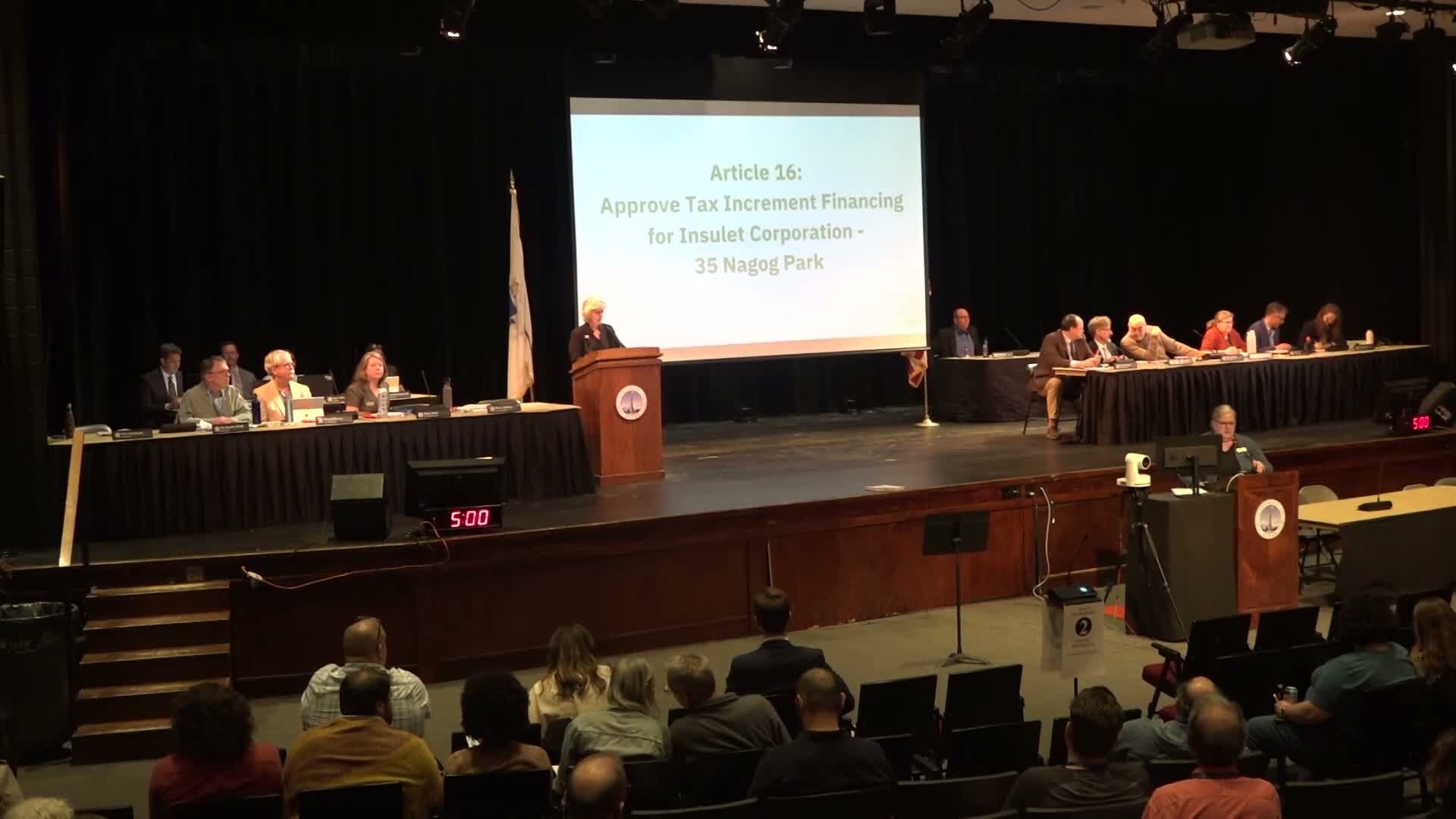
Town Meeting approved Article 16 to authorize the town to pursue a tax-increment financing agreement (TIF) for Insulet Corporation’s proposed expansion at 35 Nagog Park and separately approved Articles 17 and 18 to create a Nagog Park Innovation Overlay and enact several targeted zoning updates to ease reinvestment.
Fran Arsenault (speaker 9) summarized the TIF mechanism, noting that it applies only to new incremental value and follows a declining exemption schedule; she presented a 12‑year example and said the expansion could bring approximately 500 new jobs and $45–55 million in investment over the next two years. Arsenault and other committee speakers said the goal is to retain and grow a major local employer, renovate underperforming property and strengthen the commercial tax base.
Residents raised questions about the TIF’s cost to taxpayers, the time period of the exemption, whether Insulet truly needs the incentive, traffic impacts and the distribution of benefits between homeowners and commercial taxpayers. Supporters, including members of the finance and economic development committees, argued the incentive is temporary and performance-based and that shifting more tax burden to commercial property would relieve pressure on homeowners over time. The TIF authorization passed by majority vote; the overlay (Article 17) and related Article 18 zoning updates (signage, uses, permitting streamlining, Great Road changes) passed by the two‑thirds majorities required.
Article 17’s overlay removes a floor-area-ratio cap for opting properties, raises maximum height from 36 to 50 feet, reduces open-space requirement from 35% to 20% for opt-in projects and pairs flexibility with mandatory design, pedestrian, EV-charging and sustainability standards; Article 18 contains targeted bylaw updates to simplify approvals and expand allowed uses. Proponents stressed that use of the overlay is voluntary and that development must meet stronger design and environmental requirements.
Fran Arsenault (speaker 9) summarized the TIF mechanism, noting that it applies only to new incremental value and follows a declining exemption schedule; she presented a 12‑year example and said the expansion could bring approximately 500 new jobs and $45–55 million in investment over the next two years. Arsenault and other committee speakers said the goal is to retain and grow a major local employer, renovate underperforming property and strengthen the commercial tax base.
Residents raised questions about the TIF’s cost to taxpayers, the time period of the exemption, whether Insulet truly needs the incentive, traffic impacts and the distribution of benefits between homeowners and commercial taxpayers. Supporters, including members of the finance and economic development committees, argued the incentive is temporary and performance-based and that shifting more tax burden to commercial property would relieve pressure on homeowners over time. The TIF authorization passed by majority vote; the overlay (Article 17) and related Article 18 zoning updates (signage, uses, permitting streamlining, Great Road changes) passed by the two‑thirds majorities required.
Article 17’s overlay removes a floor-area-ratio cap for opting properties, raises maximum height from 36 to 50 feet, reduces open-space requirement from 35% to 20% for opt-in projects and pairs flexibility with mandatory design, pedestrian, EV-charging and sustainability standards; Article 18 contains targeted bylaw updates to simplify approvals and expand allowed uses. Proponents stressed that use of the overlay is voluntary and that development must meet stronger design and environmental requirements.
Don't Miss a Word: See the Full Meeting!
Go beyond summaries. Unlock every video, transcript, and key insight with a Founder Membership.
✓
Get instant access to full meeting videos
✓
Search and clip any phrase from complete transcripts
✓
Receive AI-powered summaries & custom alerts
✓
Enjoy lifetime, unrestricted access to government data
30-day money-back guarantee
