Ogden council reviews two-option managed parking plan amid concerns about data and small businesses
May 06, 2026 | Ogden City Council, Ogden, Weber County, Utah
This article was created by AI summarizing key points discussed. AI makes mistakes, so for full details and context, please refer to the video of the full meeting. Please report any errors so we can fix them. Report an error »
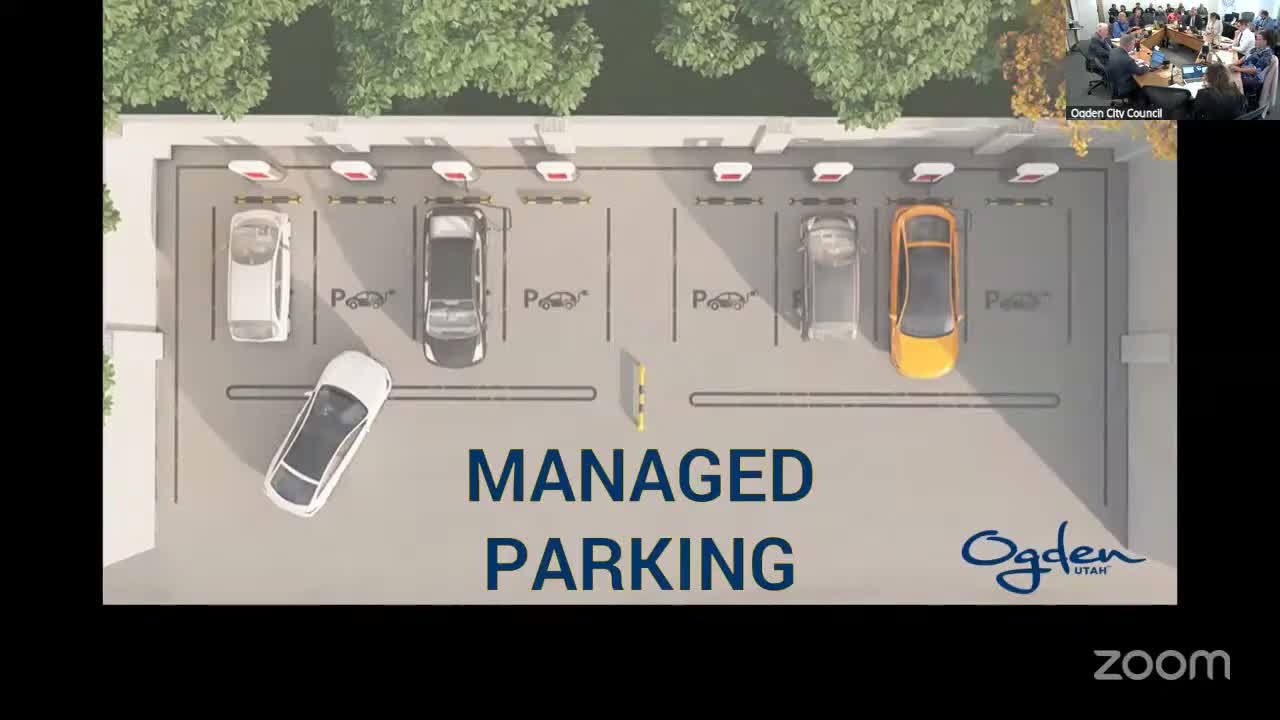
The Ogden City Council on May 5 reviewed a proposed managed parking ordinance that would establish paid and permitted parking in parts of downtown and set a framework for future expansions.
Robert Fair, a consultant with Kimley‑Horn, told the council that the ordinance should be tied to measurable performance indicators — notably block utilization, turnover, compliance and payment method adoption. "Once we get above 80% utilization on street, that's when you start hearing customer complaints," Fair said, recommending a 6‑ to 12‑month stabilization period after initial implementation to collect data and make adjustments.
Council members pressed staff and the consultant on two central questions: whether implementing paid parking would hurt downtown businesses and how much administrative authority to give the mayor to adjust rates and expand zones without returning to council. Fair said jurisdictions typically see an adjustment period followed by more predictable access that businesses often prefer. He added he could not point to a city where paid parking caused wholesale business failure: "There's an adjustment period, and then folks actually appreciate that they can find predictable access to parking spaces on street."
Council member Washington raised questions about the age and scope of the parking study underlying the recommendations, saying much of the data was collected over limited periods and that some imagery dated to 2017. "If the last numbers are from 2022 and it's 2026," Washington said, "why have we seen a shift in these numbers if we don't have current data?" Staff acknowledged the underlying study used varied dates and said they would double‑check the study citations; they also pointed to ongoing outreach and to new downtown housing that may change utilization.
Two ordinance options were presented. Option 1 authorizes a defined initial footprint and would require council approval for expansions beyond that area. Option 2 contains additional administrative findings and ranges so the administration could expand phases or adjust within floors and ceilings without returning to council, provided specified criteria are met. Staff said the code would still contain floors and ceilings for rates; expansions beyond those would require council action.
Staff summarized outreach dating back to 2020 and said there have been roughly 25–30 direct business meetings and multiple focus groups. Kelly, the staff member leading community engagement, told council there had been "a mixed bag of feelings," and described district‑level door‑to‑door business outreach and a business focus group created in 2025.
The council also discussed fee mechanics and small business mitigation. Staff described a business validation 'wallet' that would let participating businesses fund validation codes for customers through the Pathport app or kiosk system. Council members asked whether a portion of parking revenue could be directed to area improvements or short‑term assistance for small businesses; staff said case studies exist and that they would research mechanisms to return funds to affected areas.
Staff presented conservative revenue projections based on a smaller initial footprint; those models suggested operating costs for the parking program could be covered in some scenarios but would not fully service the bond debt in the near term unless utilization rose. Staff noted new downtown residential projects (the Wonder Block) could increase parking demand over time.
Next steps: staff said the council can pick an option, provide direction, or table the ordinance. If adopted, the administration would implement an introductory free period and collect six months of data for review before further phase expansions under Option 2 or before returning to council for expansions under Option 1.
Robert Fair, a consultant with Kimley‑Horn, told the council that the ordinance should be tied to measurable performance indicators — notably block utilization, turnover, compliance and payment method adoption. "Once we get above 80% utilization on street, that's when you start hearing customer complaints," Fair said, recommending a 6‑ to 12‑month stabilization period after initial implementation to collect data and make adjustments.
Council members pressed staff and the consultant on two central questions: whether implementing paid parking would hurt downtown businesses and how much administrative authority to give the mayor to adjust rates and expand zones without returning to council. Fair said jurisdictions typically see an adjustment period followed by more predictable access that businesses often prefer. He added he could not point to a city where paid parking caused wholesale business failure: "There's an adjustment period, and then folks actually appreciate that they can find predictable access to parking spaces on street."
Council member Washington raised questions about the age and scope of the parking study underlying the recommendations, saying much of the data was collected over limited periods and that some imagery dated to 2017. "If the last numbers are from 2022 and it's 2026," Washington said, "why have we seen a shift in these numbers if we don't have current data?" Staff acknowledged the underlying study used varied dates and said they would double‑check the study citations; they also pointed to ongoing outreach and to new downtown housing that may change utilization.
Two ordinance options were presented. Option 1 authorizes a defined initial footprint and would require council approval for expansions beyond that area. Option 2 contains additional administrative findings and ranges so the administration could expand phases or adjust within floors and ceilings without returning to council, provided specified criteria are met. Staff said the code would still contain floors and ceilings for rates; expansions beyond those would require council action.
Staff summarized outreach dating back to 2020 and said there have been roughly 25–30 direct business meetings and multiple focus groups. Kelly, the staff member leading community engagement, told council there had been "a mixed bag of feelings," and described district‑level door‑to‑door business outreach and a business focus group created in 2025.
The council also discussed fee mechanics and small business mitigation. Staff described a business validation 'wallet' that would let participating businesses fund validation codes for customers through the Pathport app or kiosk system. Council members asked whether a portion of parking revenue could be directed to area improvements or short‑term assistance for small businesses; staff said case studies exist and that they would research mechanisms to return funds to affected areas.
Staff presented conservative revenue projections based on a smaller initial footprint; those models suggested operating costs for the parking program could be covered in some scenarios but would not fully service the bond debt in the near term unless utilization rose. Staff noted new downtown residential projects (the Wonder Block) could increase parking demand over time.
Next steps: staff said the council can pick an option, provide direction, or table the ordinance. If adopted, the administration would implement an introductory free period and collect six months of data for review before further phase expansions under Option 2 or before returning to council for expansions under Option 1.
Don't Miss a Word: See the Full Meeting!
Go beyond summaries. Unlock every video, transcript, and key insight with a Founder Membership.
✓
Get instant access to full meeting videos
✓
Search and clip any phrase from complete transcripts
✓
Receive AI-powered summaries & custom alerts
✓
Enjoy lifetime, unrestricted access to government data
30-day money-back guarantee
