Ogden fire chief outlines wildfire season rules, restricted fireworks areas and enforcement plans
May 06, 2026 | Ogden City Council, Ogden, Weber County, Utah
This article was created by AI summarizing key points discussed. AI makes mistakes, so for full details and context, please refer to the video of the full meeting. Please report any errors so we can fix them. Report an error »
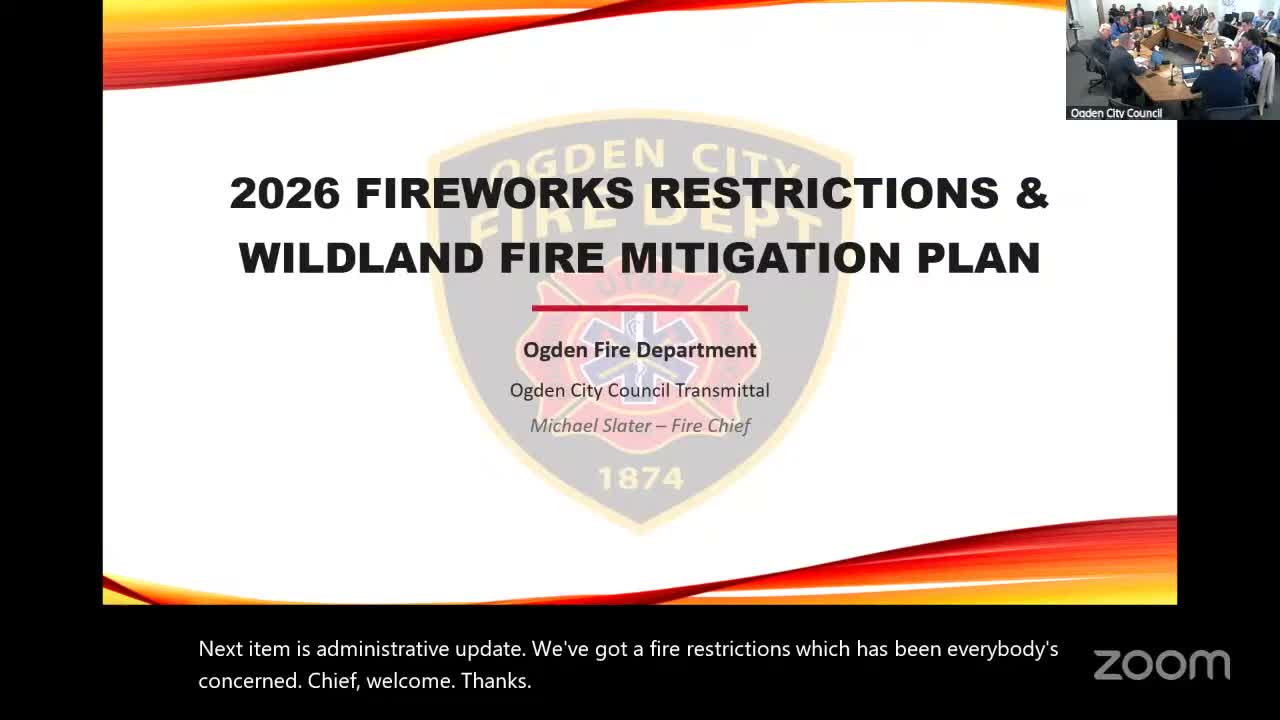
The Ogden Fire Department told the City Council on May 5 that it plans an aggressive outreach and enforcement campaign for the upcoming wildfire season, including targeted restrictions for discharging fireworks in historically hazardous areas.
The fire chief said the department has seen an uptick in grass‑fire activity in early 2025 and is preparing to use the statutory framework that allows cities to close specifically defined hazardous areas to fireworks. He explained there are three restriction levels under city code: yellow (lowest), orange (which bans open flames in restricted areas) and red (severe drought conditions). The department filed a hazardous‑area map with the state as required and intends to use that map as the basis for targeted enforcement east of Harrison Boulevard and other high‑risk parcels.
"I would outlaw fireworks," the fire chief said as a personal view, but he noted state law preempts a citywide ban and limits enforcement to historically hazardous areas. The chief said the fire marshal and local fire warden will monitor fuel moisture weekly and that the city will coordinate enforcement with police in restricted zones. Vendor tents will be required to display restriction maps at point of sale and the department will conduct vendor inspections for storage and permitting.
Staff anticipates declaring yellow restrictions by or before June 1 if hot, dry conditions persist and expects to move to orange by July 1 this year, ahead of the Independence Day fireworks window. The department emphasized a public education campaign that includes media releases, social media, mailers (water bills) and digital message signs (DMS) to notify residents when restriction levels change.
The council asked staff to verify and re‑upload the correct hazardous‑area map after council members flagged boundary differences from prior years; the chief agreed and said updated maps would be shared publicly.
Deputy Fire Chief Justin Green also described the Ready, Set, Go program, urging residents to prepare properties and defensible space and to sign up for the program's resources; staff said they will also deploy mitigation work in the wildland‑urban interface.
Next steps: staff will finalize and publish the hazardous‑area map, expand vendor notifications and provide a timeline for increased restrictions as weather warrants.
The fire chief said the department has seen an uptick in grass‑fire activity in early 2025 and is preparing to use the statutory framework that allows cities to close specifically defined hazardous areas to fireworks. He explained there are three restriction levels under city code: yellow (lowest), orange (which bans open flames in restricted areas) and red (severe drought conditions). The department filed a hazardous‑area map with the state as required and intends to use that map as the basis for targeted enforcement east of Harrison Boulevard and other high‑risk parcels.
"I would outlaw fireworks," the fire chief said as a personal view, but he noted state law preempts a citywide ban and limits enforcement to historically hazardous areas. The chief said the fire marshal and local fire warden will monitor fuel moisture weekly and that the city will coordinate enforcement with police in restricted zones. Vendor tents will be required to display restriction maps at point of sale and the department will conduct vendor inspections for storage and permitting.
Staff anticipates declaring yellow restrictions by or before June 1 if hot, dry conditions persist and expects to move to orange by July 1 this year, ahead of the Independence Day fireworks window. The department emphasized a public education campaign that includes media releases, social media, mailers (water bills) and digital message signs (DMS) to notify residents when restriction levels change.
The council asked staff to verify and re‑upload the correct hazardous‑area map after council members flagged boundary differences from prior years; the chief agreed and said updated maps would be shared publicly.
Deputy Fire Chief Justin Green also described the Ready, Set, Go program, urging residents to prepare properties and defensible space and to sign up for the program's resources; staff said they will also deploy mitigation work in the wildland‑urban interface.
Next steps: staff will finalize and publish the hazardous‑area map, expand vendor notifications and provide a timeline for increased restrictions as weather warrants.
Don't Miss a Word: See the Full Meeting!
Go beyond summaries. Unlock every video, transcript, and key insight with a Founder Membership.
✓
Get instant access to full meeting videos
✓
Search and clip any phrase from complete transcripts
✓
Receive AI-powered summaries & custom alerts
✓
Enjoy lifetime, unrestricted access to government data
30-day money-back guarantee
