Board adopts fee changes, approves one‑year RTB pilot with 30% soft cap on select planning fees
May 05, 2026 | San Luis Obispo County, California
This article was created by AI summarizing key points discussed. AI makes mistakes, so for full details and context, please refer to the video of the full meeting. Please report any errors so we can fix them. Report an error »
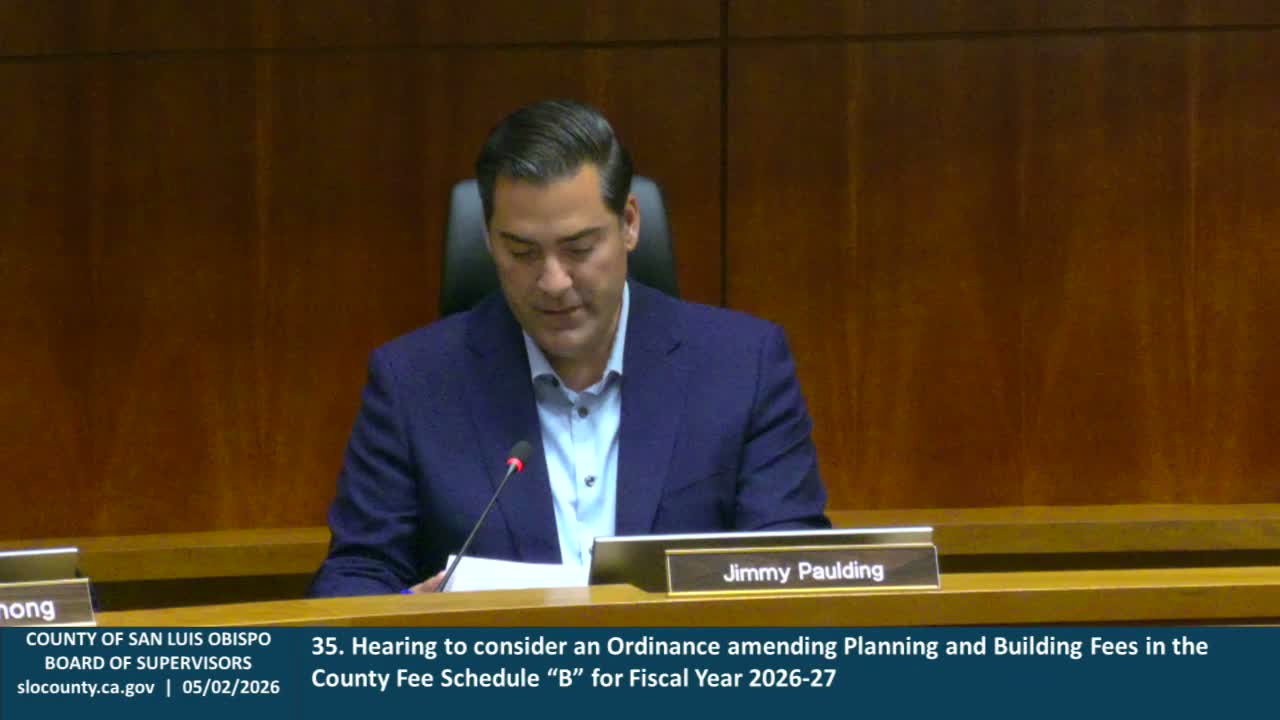
The San Luis Obispo County Board of Supervisors approved a package of Planning & Building fee adjustments on May 5 and directed a cautious rollout of real‑time billing (RTB) for certain permit types, adopting a one‑year pilot and asking staff to monitor outcomes and return with data.
Planning Director Trevor Keith and Administrative Manager Wes Reisdell briefed the board on roughly 16 fee changes derived from a recent cost study and a KPMG review; the department converted some land‑conservation fees to lower fixed fees, adjusted deposit levels and proposed RTB for more complex, resource‑intensive applications. Under RTB, applicants pay an up‑front deposit and staff invoice time spent processing the case; remaining deposits are refunded or additional costs billed at closeout.
Industry concerns and board response: Contractors and planning consultants, represented by Jamie Jones of Kirk Consulting and the Home Builders Association, said RTB improves transparency but raises applicant uncertainty without a fee cap. Jones proposed a hybrid: RTB with a capped buffer over the fee‑study estimate. Supervisor Bruce Gibson pressed for full cost recovery and cited a historically low dispute rate with previous RTB applications. Other supervisors advocated a compromise: a 12‑month pilot for RTB on selected fees with a 30% “soft cap” (a management threshold requiring early staff‑applicant conversations when invoices approach the cap) and improved dashboards to track processing touches and disputes.
Board action: The board approved the ordinance updates with staff direction to implement RTB for the identified fee categories under a one‑year pilot. Staff will treat the 30% buffer as a soft cap: when RTB invoices approach that level, Planning will notify applicants and review project status and causes for extra time; emergency or large discretionary projects (EIRs, conditional use or similar high‑complexity cases) will remain without a hard cap but will be subject to the RTB framework. The board also asked staff to report back after 12 months with dispute counts, categories of delays (applicant vs. county), and any suggested refinements.
Why it matters: The change aligns fees with the department’s stated cost‑recovery policy while attempting to reduce applicant uncertainty with a documented pilot and oversight mechanism. Planning staff said the pilot will be paired with new internal dashboards (per KPMG recommendations) to identify bottlenecks and keep dispute rates low.
Next steps: Planning & Building will implement the revised fee schedule effective July 1, 2026, and develop performance metrics for a 12‑month look‑back. Staff will continue to consult industry partners about deposit levels and RTB guardrails and return to the board with results and recommended adjustments.
Planning Director Trevor Keith and Administrative Manager Wes Reisdell briefed the board on roughly 16 fee changes derived from a recent cost study and a KPMG review; the department converted some land‑conservation fees to lower fixed fees, adjusted deposit levels and proposed RTB for more complex, resource‑intensive applications. Under RTB, applicants pay an up‑front deposit and staff invoice time spent processing the case; remaining deposits are refunded or additional costs billed at closeout.
Industry concerns and board response: Contractors and planning consultants, represented by Jamie Jones of Kirk Consulting and the Home Builders Association, said RTB improves transparency but raises applicant uncertainty without a fee cap. Jones proposed a hybrid: RTB with a capped buffer over the fee‑study estimate. Supervisor Bruce Gibson pressed for full cost recovery and cited a historically low dispute rate with previous RTB applications. Other supervisors advocated a compromise: a 12‑month pilot for RTB on selected fees with a 30% “soft cap” (a management threshold requiring early staff‑applicant conversations when invoices approach the cap) and improved dashboards to track processing touches and disputes.
Board action: The board approved the ordinance updates with staff direction to implement RTB for the identified fee categories under a one‑year pilot. Staff will treat the 30% buffer as a soft cap: when RTB invoices approach that level, Planning will notify applicants and review project status and causes for extra time; emergency or large discretionary projects (EIRs, conditional use or similar high‑complexity cases) will remain without a hard cap but will be subject to the RTB framework. The board also asked staff to report back after 12 months with dispute counts, categories of delays (applicant vs. county), and any suggested refinements.
Why it matters: The change aligns fees with the department’s stated cost‑recovery policy while attempting to reduce applicant uncertainty with a documented pilot and oversight mechanism. Planning staff said the pilot will be paired with new internal dashboards (per KPMG recommendations) to identify bottlenecks and keep dispute rates low.
Next steps: Planning & Building will implement the revised fee schedule effective July 1, 2026, and develop performance metrics for a 12‑month look‑back. Staff will continue to consult industry partners about deposit levels and RTB guardrails and return to the board with results and recommended adjustments.
Don't Miss a Word: See the Full Meeting!
Go beyond summaries. Unlock every video, transcript, and key insight with a Founder Membership.
✓
Get instant access to full meeting videos
✓
Search and clip any phrase from complete transcripts
✓
Receive AI-powered summaries & custom alerts
✓
Enjoy lifetime, unrestricted access to government data
30-day money-back guarantee
