Commission pauses overhaul of liquor ordinance after lengthy debate on transfers, gaming and definitions
May 06, 2026 | Villa Park, DuPage County, Illinois
This article was created by AI summarizing key points discussed. AI makes mistakes, so for full details and context, please refer to the video of the full meeting. Please report any errors so we can fix them. Report an error »
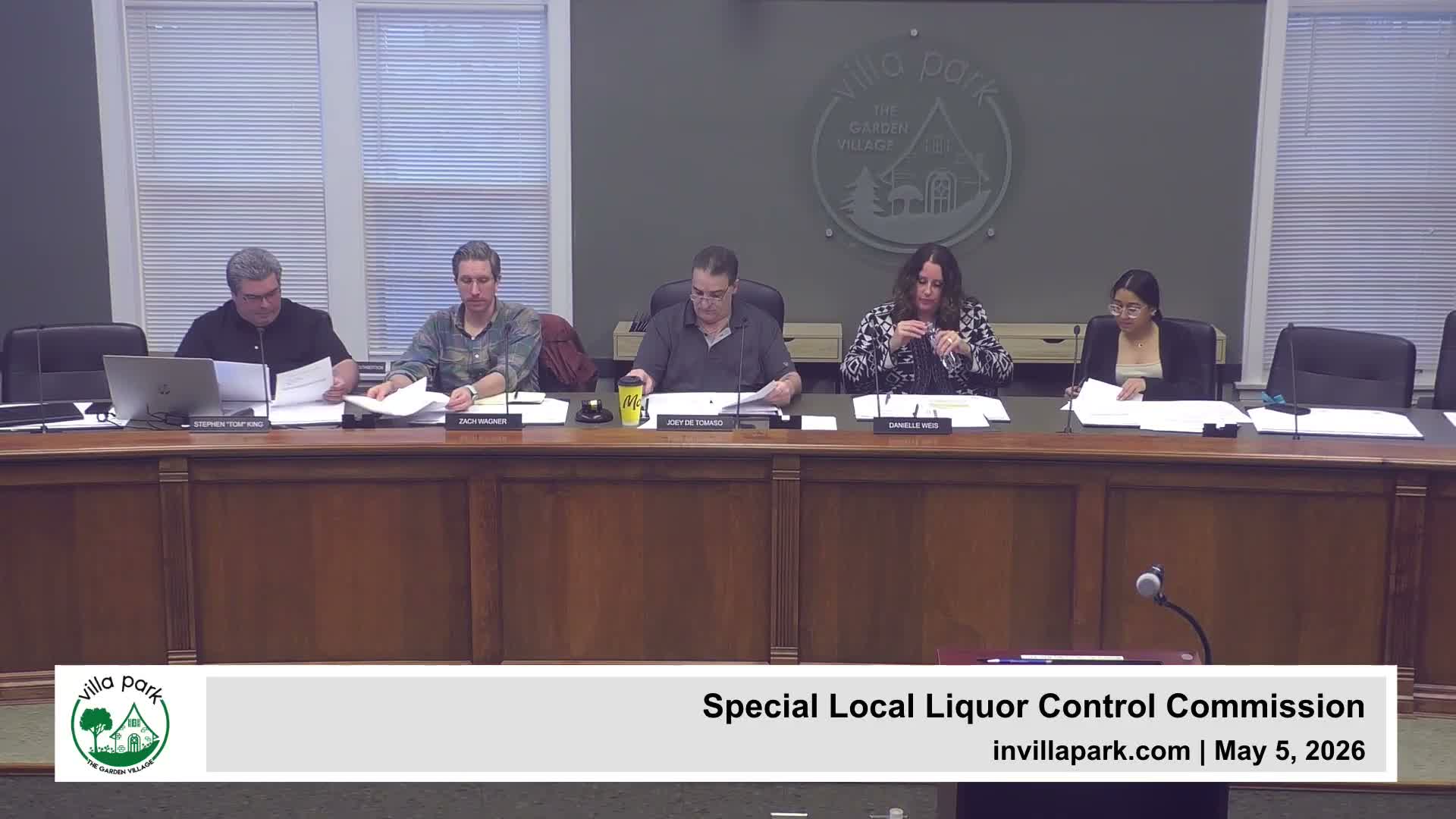
The Villa Park Liquor Control Commission spent much of its May 5 meeting vetting a broad package of proposed ordinance changes that would redefine license classes, create a new category for video gaming cafes, tighten transfer and renewal procedures, and add periodic background checks.
Trustee Consados, who presented the scenarios that prompted the review, asked the commission to clarify three common transfer situations — minor corporate share changes, an incoming owner who substantially replicates an existing business, and a licensed business that changes location — and recommended clearer language so applicants understand when a full new license is required.
"I gave these scenarios because being a business owner, these are the situations that usually arise," Trustee Consados said, urging clearer drafting for purchasers and transferees. Commissioners repeatedly debated whether a purchaser should file a full new application, whether transfers could be handled administratively if the business remained "substantially the same," and how to avoid a gap in operations while a transfer is processed.
Legal and practical constraints under the current code were raised: several speakers cited section 3‑3‑13 of the village code and explained that the Village Board controls the numeric allotment of licenses while the liquor commissioner (the village president) issues licenses within those allotments. One commissioner said the committee could draft a transfer ordinance allowing staff to transfer licenses when the business meets a defined "substantially the same" standard while requiring incoming owners to complete fingerprinting and background checks.
A large portion of the discussion focused on video gaming. Staff proposed a new Class G license for establishments where video gaming accounts for at least 60% of gross revenue, effectively classifying high‑gaming businesses as a distinct license type. Commissioners debated whether other license types (taverns, restaurants) should have caps on gaming revenue (suggested ranges included 30%–40%) and whether longstanding operators should be grandfathered.
Commissioners also discussed reintroducing a measurable restaurant test to ensure food remains the primary business: one draft would require that alcohol sales be less than food receipts on average over a year to qualify as a restaurant (excluding gaming revenue), with renewal applications collecting prior‑year food, alcohol and gaming revenue to enable assessment. The package also contains a proposed 18‑month rule before certain gaming privileges apply, and language that would require updated background checks on licensees every five years.
Members expressed concerns about enforceability, unintended business impacts, and fairness to prospective owners who must sign leases before knowing licensing outcomes. Several commissioners suggested creating advisory pre‑application meetings or provisional licenses to give prospective businesses guidance without obligating a full, fee‑based application.
After extensive debate and requests for legal follow‑up on grandfathering, allotment implications and drafting clarity (including recommended placement of definitions at the start of the chapter), the commission voted to table the ordinance package for further work and to return the item to the June meeting.
Trustee Consados, who presented the scenarios that prompted the review, asked the commission to clarify three common transfer situations — minor corporate share changes, an incoming owner who substantially replicates an existing business, and a licensed business that changes location — and recommended clearer language so applicants understand when a full new license is required.
"I gave these scenarios because being a business owner, these are the situations that usually arise," Trustee Consados said, urging clearer drafting for purchasers and transferees. Commissioners repeatedly debated whether a purchaser should file a full new application, whether transfers could be handled administratively if the business remained "substantially the same," and how to avoid a gap in operations while a transfer is processed.
Legal and practical constraints under the current code were raised: several speakers cited section 3‑3‑13 of the village code and explained that the Village Board controls the numeric allotment of licenses while the liquor commissioner (the village president) issues licenses within those allotments. One commissioner said the committee could draft a transfer ordinance allowing staff to transfer licenses when the business meets a defined "substantially the same" standard while requiring incoming owners to complete fingerprinting and background checks.
A large portion of the discussion focused on video gaming. Staff proposed a new Class G license for establishments where video gaming accounts for at least 60% of gross revenue, effectively classifying high‑gaming businesses as a distinct license type. Commissioners debated whether other license types (taverns, restaurants) should have caps on gaming revenue (suggested ranges included 30%–40%) and whether longstanding operators should be grandfathered.
Commissioners also discussed reintroducing a measurable restaurant test to ensure food remains the primary business: one draft would require that alcohol sales be less than food receipts on average over a year to qualify as a restaurant (excluding gaming revenue), with renewal applications collecting prior‑year food, alcohol and gaming revenue to enable assessment. The package also contains a proposed 18‑month rule before certain gaming privileges apply, and language that would require updated background checks on licensees every five years.
Members expressed concerns about enforceability, unintended business impacts, and fairness to prospective owners who must sign leases before knowing licensing outcomes. Several commissioners suggested creating advisory pre‑application meetings or provisional licenses to give prospective businesses guidance without obligating a full, fee‑based application.
After extensive debate and requests for legal follow‑up on grandfathering, allotment implications and drafting clarity (including recommended placement of definitions at the start of the chapter), the commission voted to table the ordinance package for further work and to return the item to the June meeting.
Don't Miss a Word: See the Full Meeting!
Go beyond summaries. Unlock every video, transcript, and key insight with a Founder Membership.
✓
Get instant access to full meeting videos
✓
Search and clip any phrase from complete transcripts
✓
Receive AI-powered summaries & custom alerts
✓
Enjoy lifetime, unrestricted access to government data
30-day money-back guarantee
