Austin staff urge replacement or major rehabilitation of aging bridges; Barton Springs project enters NEPA review
May 05, 2026 | Austin, Travis County, Texas
This article was created by AI summarizing key points discussed. AI makes mistakes, so for full details and context, please refer to the video of the full meeting. Please report any errors so we can fix them. Report an error »
City of Austin engineers told the Urban Transportation Commission on May 5 that several bond‑funded bridge projects will require major work and close coordination with regulators and the public.
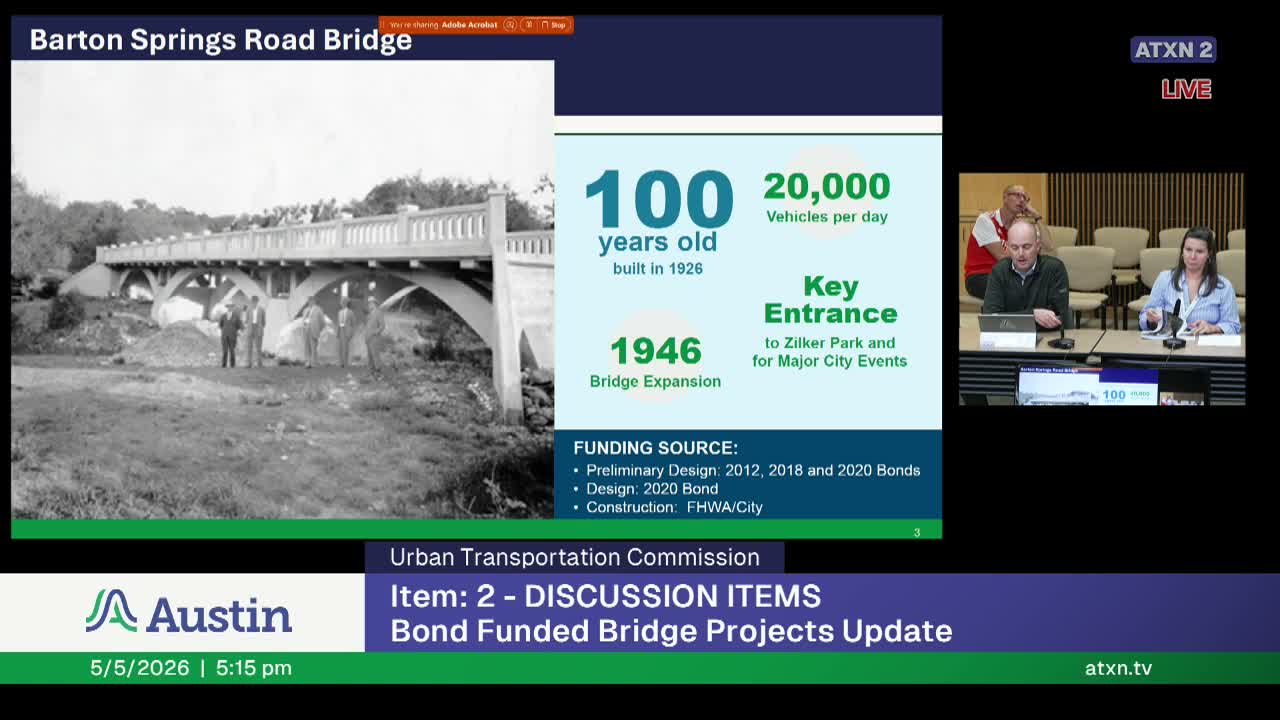
Eric Bailey, deputy director of Capital Delivery Services, said the Barton Springs Road Bridge — originally built about 100 years ago and carrying roughly 20,000 vehicles per day — is "functionally obsolete" and that the consulting engineer concluded "the structure needs to be replaced." Bailey said a 2023 structural evaluation found exposed steel, cracking and delamination, and estimated that, without significant work, "significant deterioration could progress to a point where increases in maintenance cost and repairs reach a significant level in 5 to 10 years." He said the project has substantial funding from the 2020 general obligation bond and a recently awarded $32,000,000 FHWA Bridge Improvement Program grant, but must complete National Environmental Policy Act (NEPA) clearance before the city can advertise the construction contract.
Bailey described five options the study considered — preserving the existing structure was eliminated — and said staff and consultants advanced three replacement alternatives and one rehabilitation option. He stressed the NEPA process will be administered by TxDOT in coordination with the Texas Historical Commission and the Army Corps, and noted an upcoming Landmarks Commission recommendation to planning commission on whether the existing bridge should be treated as a historic resource. Bailey said a historic designation "doesn't preclude the replacement option" but would change design requirements and permitting steps.
Commissioners pressed staff about pedestrian and bicycle facilities, whether a shared or separated path is appropriate near Zilker Park and how construction would affect the Zilker Eagle train. Bailey said designs are still preliminary and that the full replacement concepts include pedestrian and bike lanes on both sides and a right‑turn lane to improve circulation; he added that the bridge will likely remain open during construction with lane reductions because full closure would impede emergency access and bus service.
Janae Landry, assistant director for project delivery, briefed the commission on the Red Bud Trail Bridge, which she said is about 78 years old, carries utilities (including a corridor serving the Ulrich Water Treatment Plant) and was previously estimated at $130,000,000 with an unfunded need near $77,000,000 under an earlier full‑reconstruction scope. Landry said a recent structural assessment found rehabilitation could extend the life of structural elements (the team estimated extending steel beam life and that the structure has capacity to be widened several feet) and that staff are now refining a rehabilitation-plus‑widening scope that would provide safer bike and pedestrian access while minimizing impacts to the creek and aiming to fit within existing bond resources.
The commission also heard a retrospective on the Wishbone Bridge, a named 2020 bond project. Landry said the project — which replaced a constrained crossing and added the larger Unity Underpass — began design in 2021, received a construction permit in December 2023, and reached substantial completion in December 2025, six months early. The presentation highlighted strong public engagement, an Art in Public Places mosaic, and an opportunistic contractor‑built temporary dock that enabled earlier completion and is being turned into a public "skyline overlook." Commissioners praised the project as a model for effective public outreach and project delivery.
Why it matters: Barton Springs is a high‑use portal to Zilker Park and a sensitive environmental and cultural area; design and permitting will need to balance structural safety, access, park impacts and historic‑preservation concerns. Red Bud Trail is a critical access route with utilities and water‑plant access implications; a rehabilitation strategy could stretch bond dollars while improving safety. The Wishbone project demonstrates that early engagement and flexible contracting can reduce schedule and contingency use.
What’s next: Staff said NEPA work on Barton Springs is underway and targeted to wrap in late 2026 with the project ready to bid in 2027. Staff committed to continuing public engagement and to returning to the commission as design and permitting progress.
Eric Bailey, deputy director of Capital Delivery Services, said the Barton Springs Road Bridge — originally built about 100 years ago and carrying roughly 20,000 vehicles per day — is "functionally obsolete" and that the consulting engineer concluded "the structure needs to be replaced." Bailey said a 2023 structural evaluation found exposed steel, cracking and delamination, and estimated that, without significant work, "significant deterioration could progress to a point where increases in maintenance cost and repairs reach a significant level in 5 to 10 years." He said the project has substantial funding from the 2020 general obligation bond and a recently awarded $32,000,000 FHWA Bridge Improvement Program grant, but must complete National Environmental Policy Act (NEPA) clearance before the city can advertise the construction contract.
Bailey described five options the study considered — preserving the existing structure was eliminated — and said staff and consultants advanced three replacement alternatives and one rehabilitation option. He stressed the NEPA process will be administered by TxDOT in coordination with the Texas Historical Commission and the Army Corps, and noted an upcoming Landmarks Commission recommendation to planning commission on whether the existing bridge should be treated as a historic resource. Bailey said a historic designation "doesn't preclude the replacement option" but would change design requirements and permitting steps.
Commissioners pressed staff about pedestrian and bicycle facilities, whether a shared or separated path is appropriate near Zilker Park and how construction would affect the Zilker Eagle train. Bailey said designs are still preliminary and that the full replacement concepts include pedestrian and bike lanes on both sides and a right‑turn lane to improve circulation; he added that the bridge will likely remain open during construction with lane reductions because full closure would impede emergency access and bus service.
Janae Landry, assistant director for project delivery, briefed the commission on the Red Bud Trail Bridge, which she said is about 78 years old, carries utilities (including a corridor serving the Ulrich Water Treatment Plant) and was previously estimated at $130,000,000 with an unfunded need near $77,000,000 under an earlier full‑reconstruction scope. Landry said a recent structural assessment found rehabilitation could extend the life of structural elements (the team estimated extending steel beam life and that the structure has capacity to be widened several feet) and that staff are now refining a rehabilitation-plus‑widening scope that would provide safer bike and pedestrian access while minimizing impacts to the creek and aiming to fit within existing bond resources.
The commission also heard a retrospective on the Wishbone Bridge, a named 2020 bond project. Landry said the project — which replaced a constrained crossing and added the larger Unity Underpass — began design in 2021, received a construction permit in December 2023, and reached substantial completion in December 2025, six months early. The presentation highlighted strong public engagement, an Art in Public Places mosaic, and an opportunistic contractor‑built temporary dock that enabled earlier completion and is being turned into a public "skyline overlook." Commissioners praised the project as a model for effective public outreach and project delivery.
Why it matters: Barton Springs is a high‑use portal to Zilker Park and a sensitive environmental and cultural area; design and permitting will need to balance structural safety, access, park impacts and historic‑preservation concerns. Red Bud Trail is a critical access route with utilities and water‑plant access implications; a rehabilitation strategy could stretch bond dollars while improving safety. The Wishbone project demonstrates that early engagement and flexible contracting can reduce schedule and contingency use.
What’s next: Staff said NEPA work on Barton Springs is underway and targeted to wrap in late 2026 with the project ready to bid in 2027. Staff committed to continuing public engagement and to returning to the commission as design and permitting progress.
View the Full Meeting & All Its Details
This article offers just a summary. Unlock complete video, transcripts, and insights as a Founder Member.
✓
Watch full, unedited meeting videos
✓
Search every word spoken in unlimited transcripts
✓
AI summaries & real-time alerts (all government levels)
✓
Permanent access to expanding government content
30-day money-back guarantee
