City transportation staff explains when full traffic studies are required for zoning cases
May 05, 2026 | Austin, Travis County, Texas
This article was created by AI summarizing key points discussed. AI makes mistakes, so for full details and context, please refer to the video of the full meeting. Please report any errors so we can fix them. Report an error »
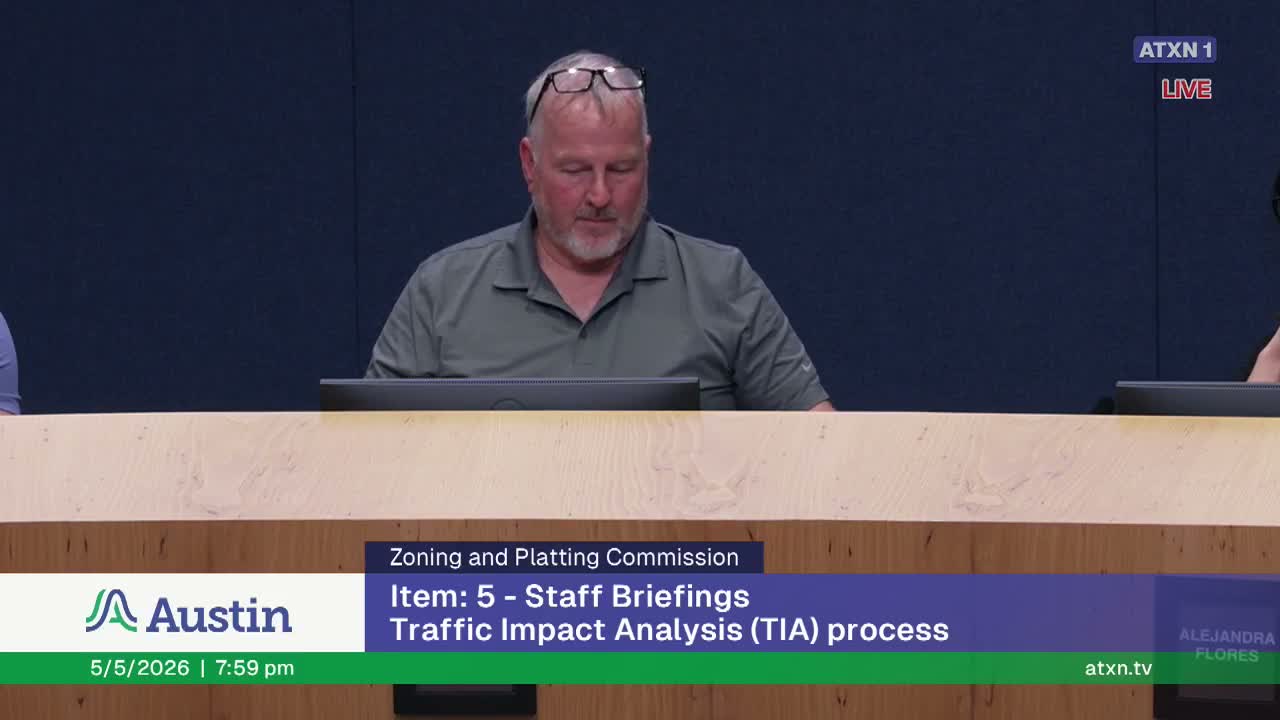
Curtis Spady, division manager for Transportation Development Services, briefed the Zoning and Planning Commission on May 5 about how Austin evaluates traffic impacts for rezoning and development.
Spady explained there are two primary analyses: a full Transportation Impact Analysis (TIA), usually required when a proposal generates more than roughly 2,000 vehicle trips per day, and a Neighborhood Traffic Analysis (NTA), which can be triggered when a residential block would receive more than about 300 additional daily vehicle trips and other block-specific criteria are met. "If a development exceeds 2,000 new vehicle trips a day, then a study can be conducted," Spady said, and added that the city uses the Institute of Transportation Engineers trip-generation manual to estimate expected trips.
He emphasized the limits of zoning-phase analyses: exact driveway locations, detailed site design and final intensities are typically unknown at zoning and are reviewed again at site plan, when the city can require specific mitigations (turn lanes, signals, pedestrian facilities) or tie commitments to a PUD ordinance. Spady also noted the city's recent adoption of the 12th edition of the ITE manual and described how changes in travel behavior (for example, greater remote work) can affect trip forecasts.
The briefing aimed to clarify why many residents asked for a more detailed traffic and school-safety review in the Circle C Tract 110 discussion and what additional analysis could be expected if Council approves zoning.
Spady explained there are two primary analyses: a full Transportation Impact Analysis (TIA), usually required when a proposal generates more than roughly 2,000 vehicle trips per day, and a Neighborhood Traffic Analysis (NTA), which can be triggered when a residential block would receive more than about 300 additional daily vehicle trips and other block-specific criteria are met. "If a development exceeds 2,000 new vehicle trips a day, then a study can be conducted," Spady said, and added that the city uses the Institute of Transportation Engineers trip-generation manual to estimate expected trips.
He emphasized the limits of zoning-phase analyses: exact driveway locations, detailed site design and final intensities are typically unknown at zoning and are reviewed again at site plan, when the city can require specific mitigations (turn lanes, signals, pedestrian facilities) or tie commitments to a PUD ordinance. Spady also noted the city's recent adoption of the 12th edition of the ITE manual and described how changes in travel behavior (for example, greater remote work) can affect trip forecasts.
The briefing aimed to clarify why many residents asked for a more detailed traffic and school-safety review in the Circle C Tract 110 discussion and what additional analysis could be expected if Council approves zoning.
Don't Miss a Word: See the Full Meeting!
Go beyond summaries. Unlock every video, transcript, and key insight with a Founder Membership.
✓
Get instant access to full meeting videos
✓
Search and clip any phrase from complete transcripts
✓
Receive AI-powered summaries & custom alerts
✓
Enjoy lifetime, unrestricted access to government data
30-day money-back guarantee
