Austin presents $47.8 million Climate Pollution Reduction Grant plans, including CTX Go app and commuter incentives
May 05, 2026 | Austin, Travis County, Texas
This article was created by AI summarizing key points discussed. AI makes mistakes, so for full details and context, please refer to the video of the full meeting. Please report any errors so we can fix them. Report an error »
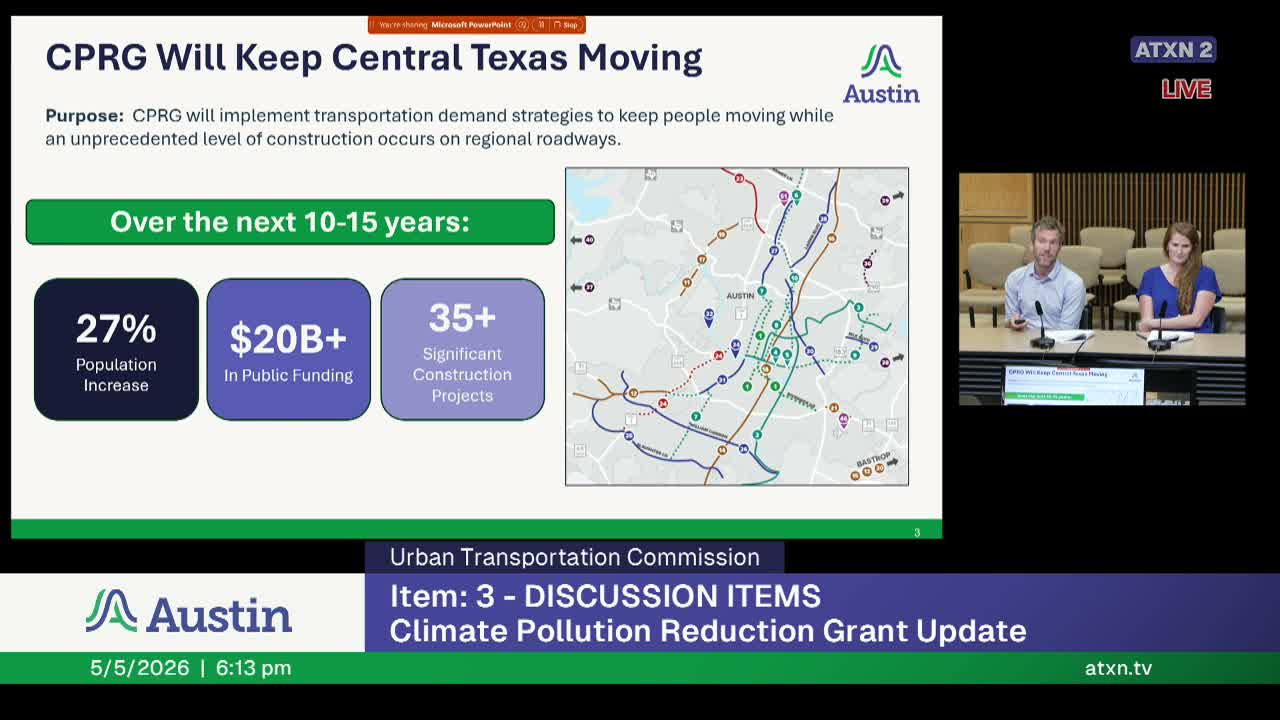
City transportation staff briefed the Urban Transportation Commission on May 5 about implementation of the federally funded Climate Pollution Reduction Grant (CPRG) and early program activity.
Jacob Barrett, transportation demand program manager, said the region received $47,800,000 in CPRG funding (award received January 2025) and that the grant runs through December 2029. Barrett said the program’s objective is to reduce vehicle miles traveled (VMT) in targeted construction‑impacted corridors by about 39,000,000 miles over five years, which Barrett framed as equivalent to roughly 820 people in the Central Texas region changing a daily drive‑alone trip to another mode on a typical day.
Staff described three measures: Measure 1 (service improvements), Measure 2 (TDM infrastructure) and Measure 3 (marketing, incentives and behavior change). Measure 1 examples include increased frequency on CapMetro lines and new CARTS regional routes (staff noted two CARTS routes launched March 2). Measure 2 covers 40 mobility hubs over the grant (10 planned in 2026), an expansion of the bicycle and pedestrian counter network (44 counters in place now with 50 more planned) and about 50 community PurpleAir sensors targeted to schools, libraries and civic facilities.
Measure 3 funds marketing and incentive programs. Shanna Riley, CPRG program manager, outlined a transportation wallet pilot to provide reloadable transit benefit cards to lower‑income participants (a 100‑person pilot moving toward a 700‑person target by 2029) and an incentive pilot that pays commuters up to $5 per day for 90 days via a partner platform (Tango). Barrett and Riley said CTX Go — a regional trip‑planning and incentive platform — is being built for a September launch with a mirror website and hotline; the app will draw on regional data feeds so it can coordinate messages when agencies (TxDOT, city, CapMetro) alter lanes or services.
Commissioners asked about VMT baselines and measurement. Staff said grant reporting uses CAMPO baselines and that the Texas A&M Transportation Institute is partnering to analyze impacts using ridership and other data to demonstrate grant‑level VMT reductions for EPA reporting. Commissioners sought city‑level data granularity, and staff said several data sources (StreetLight, signal systems, counters) are being evaluated for local metrics but CAMPO remains the grant baseline. Commissioners also discussed equity and regional balance: staff said the grant intentionally includes both CapMetro corridor investments and CARTS rural/suburban service to serve the wider five‑county area the grant covers.
Why it matters: The CPRG funding brings the largest infusion the city’s TDM program has received and aims to use service changes, small capital investments and behavior‑change incentives to reduce vehicle travel during a multi‑year period of heavy construction in the region. The CTX Go app and targeted incentives represent a new, coordinated regional approach to travel‑behavior programming.
What’s next: Staff are implementing early pilots (some incentives and service changes are active), expect CTX Go features to expand on May 8 and target a fuller September launch, and plan biannual reporting and an annual briefing to the commission with updated outcomes and metrics.
Jacob Barrett, transportation demand program manager, said the region received $47,800,000 in CPRG funding (award received January 2025) and that the grant runs through December 2029. Barrett said the program’s objective is to reduce vehicle miles traveled (VMT) in targeted construction‑impacted corridors by about 39,000,000 miles over five years, which Barrett framed as equivalent to roughly 820 people in the Central Texas region changing a daily drive‑alone trip to another mode on a typical day.
Staff described three measures: Measure 1 (service improvements), Measure 2 (TDM infrastructure) and Measure 3 (marketing, incentives and behavior change). Measure 1 examples include increased frequency on CapMetro lines and new CARTS regional routes (staff noted two CARTS routes launched March 2). Measure 2 covers 40 mobility hubs over the grant (10 planned in 2026), an expansion of the bicycle and pedestrian counter network (44 counters in place now with 50 more planned) and about 50 community PurpleAir sensors targeted to schools, libraries and civic facilities.
Measure 3 funds marketing and incentive programs. Shanna Riley, CPRG program manager, outlined a transportation wallet pilot to provide reloadable transit benefit cards to lower‑income participants (a 100‑person pilot moving toward a 700‑person target by 2029) and an incentive pilot that pays commuters up to $5 per day for 90 days via a partner platform (Tango). Barrett and Riley said CTX Go — a regional trip‑planning and incentive platform — is being built for a September launch with a mirror website and hotline; the app will draw on regional data feeds so it can coordinate messages when agencies (TxDOT, city, CapMetro) alter lanes or services.
Commissioners asked about VMT baselines and measurement. Staff said grant reporting uses CAMPO baselines and that the Texas A&M Transportation Institute is partnering to analyze impacts using ridership and other data to demonstrate grant‑level VMT reductions for EPA reporting. Commissioners sought city‑level data granularity, and staff said several data sources (StreetLight, signal systems, counters) are being evaluated for local metrics but CAMPO remains the grant baseline. Commissioners also discussed equity and regional balance: staff said the grant intentionally includes both CapMetro corridor investments and CARTS rural/suburban service to serve the wider five‑county area the grant covers.
Why it matters: The CPRG funding brings the largest infusion the city’s TDM program has received and aims to use service changes, small capital investments and behavior‑change incentives to reduce vehicle travel during a multi‑year period of heavy construction in the region. The CTX Go app and targeted incentives represent a new, coordinated regional approach to travel‑behavior programming.
What’s next: Staff are implementing early pilots (some incentives and service changes are active), expect CTX Go features to expand on May 8 and target a fuller September launch, and plan biannual reporting and an annual briefing to the commission with updated outcomes and metrics.
Don't Miss a Word: See the Full Meeting!
Go beyond summaries. Unlock every video, transcript, and key insight with a Founder Membership.
✓
Get instant access to full meeting videos
✓
Search and clip any phrase from complete transcripts
✓
Receive AI-powered summaries & custom alerts
✓
Enjoy lifetime, unrestricted access to government data
30-day money-back guarantee
