Residents challenge proposed water and wastewater rate changes and enterprise-fund subsidies
May 05, 2026 | Worcester County, Maryland
This article was created by AI summarizing key points discussed. AI makes mistakes, so for full details and context, please refer to the video of the full meeting. Please report any errors so we can fix them. Report an error »
Several Worcester County residents used the May 5 public hearing to press county officials for clearer explanations of proposed water and wastewater fee changes and to report sudden bill increases and high hookup costs.
"It went up $55 at once," Barbara Connor told commissioners, describing a single-month bill increase of $55.38. Other residents described being forced from private septic systems onto county sewer lines with one caller saying she paid roughly $18,000 to connect after regulations changed. "I had to pay the county their expenses, and then this catch up fee," a resident said, urging standardized, equitable connect fees and longer-term financing options.
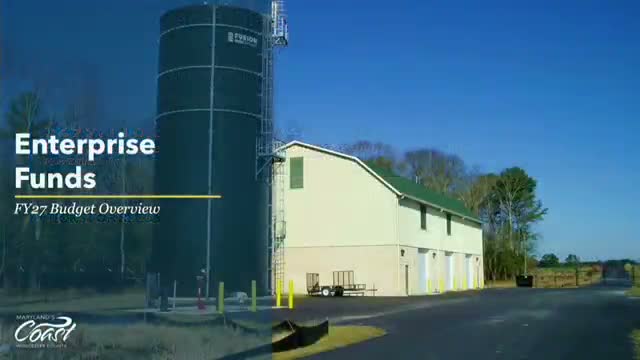
County CAO Weston Young's presentation explained that the combined water/wastewater proposed FY27 budget totals $22,348,447, with $1,148,419 in general-fund support requested for some smaller service areas. Young cited rising chemical and energy costs, capital requests and reserve transfers as drivers for rate pressure and described proposed EDU (equivalent dwelling unit) adjustments that would scale usage tiers by the number of EDUs a customer holds. He also outlined varied service-area situations: Ocean Pines (the largest area) carries debt and proposals to reduce a portion of the existing debt-service charge; Mystic Harbor and others face shortfalls proposed to be covered from reserves.
Residents asked whether some service areas effectively subsidize others and whether enterprise funds were being used as stopgap measures rather than long-term planning. Robin Jenks Vanderlip, speaking for the Baywise program and Master Gardeners, urged the county to assemble a long-term water management plan rather than relying on short-term fixes.
County staff offered to have enterprise fund personnel follow up offline to explain billing drivers in greater detail, including which neighborhoods pay for treatment of others and the effects of commodity and energy inflation on treatment costs.
Next steps: staff indicated enterprise-fund staff would reach out to residents individually; commissioners will review enterprise fund proposals during upcoming budget sessions.
"It went up $55 at once," Barbara Connor told commissioners, describing a single-month bill increase of $55.38. Other residents described being forced from private septic systems onto county sewer lines with one caller saying she paid roughly $18,000 to connect after regulations changed. "I had to pay the county their expenses, and then this catch up fee," a resident said, urging standardized, equitable connect fees and longer-term financing options.
County CAO Weston Young's presentation explained that the combined water/wastewater proposed FY27 budget totals $22,348,447, with $1,148,419 in general-fund support requested for some smaller service areas. Young cited rising chemical and energy costs, capital requests and reserve transfers as drivers for rate pressure and described proposed EDU (equivalent dwelling unit) adjustments that would scale usage tiers by the number of EDUs a customer holds. He also outlined varied service-area situations: Ocean Pines (the largest area) carries debt and proposals to reduce a portion of the existing debt-service charge; Mystic Harbor and others face shortfalls proposed to be covered from reserves.
Residents asked whether some service areas effectively subsidize others and whether enterprise funds were being used as stopgap measures rather than long-term planning. Robin Jenks Vanderlip, speaking for the Baywise program and Master Gardeners, urged the county to assemble a long-term water management plan rather than relying on short-term fixes.
County staff offered to have enterprise fund personnel follow up offline to explain billing drivers in greater detail, including which neighborhoods pay for treatment of others and the effects of commodity and energy inflation on treatment costs.
Next steps: staff indicated enterprise-fund staff would reach out to residents individually; commissioners will review enterprise fund proposals during upcoming budget sessions.
Don't Miss a Word: See the Full Meeting!
Go beyond summaries. Unlock every video, transcript, and key insight with a Founder Membership.
✓
Get instant access to full meeting videos
✓
Search and clip any phrase from complete transcripts
✓
Receive AI-powered summaries & custom alerts
✓
Enjoy lifetime, unrestricted access to government data
30-day money-back guarantee
