Commission denies Cook Foods' 5‑acre solar array after residents raise visual and precedent concerns
May 06, 2026 | Harris County, Georgia
This article was created by AI summarizing key points discussed. AI makes mistakes, so for full details and context, please refer to the video of the full meeting. Please report any errors so we can fix them. Report an error »
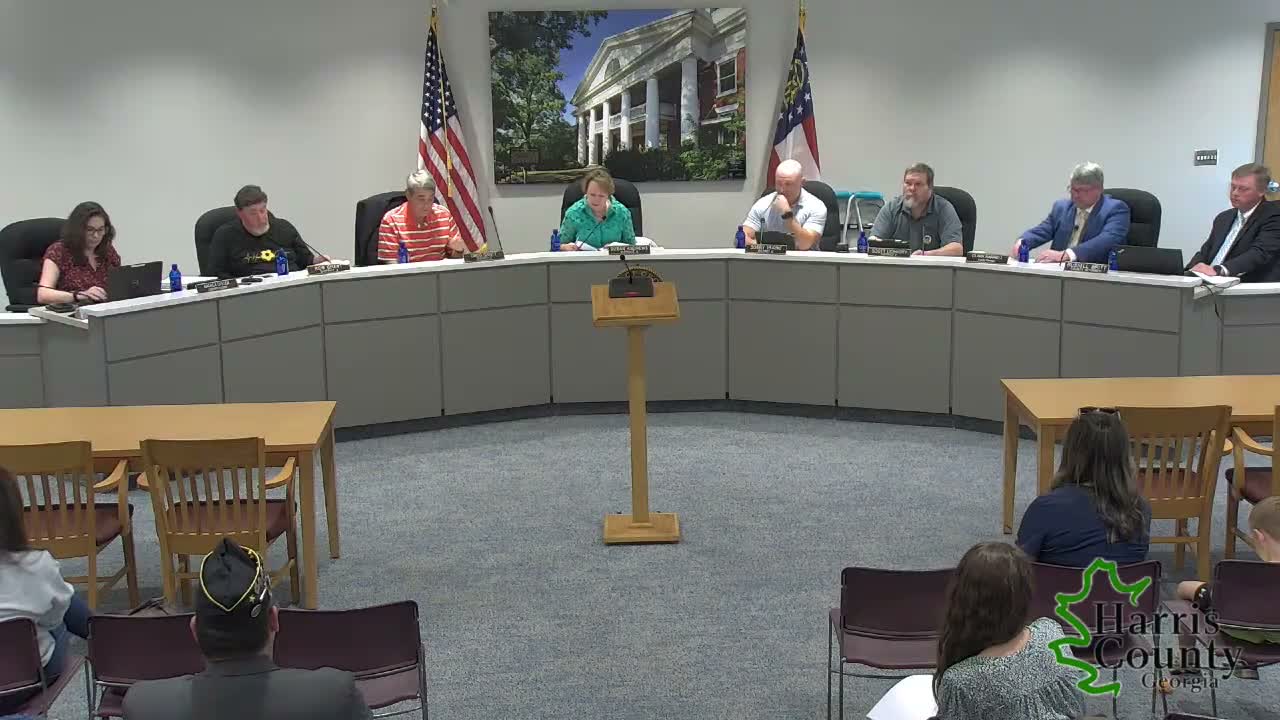
Clay Gardner, representing Radiant Solar as general contractor and stating he works with Georgia Power, presented a request by Cook Foods for a special‑use permit to build a roughly 5‑acre photovoltaic array in a former spray field behind the plant. Gardner said the array would disturb less than one acre, have buried electrical runs back to Cook Foods, include a roughly 50‑foot tree buffer and be sized only to offset a portion of Cook Foods' electric purchases. He said Cook Foods would fund the project entirely and that constraints in the local distribution infrastructure limit any practical near‑term expansion.
Dozens of nearby residents and community representatives spoke in opposition during the public hearing. Speakers cited concerns that even a small array is an “eyesore” for Pine Mountain Valley, could depress property values, and would set a precedent allowing incremental expansion of solar footprint on private industrial parcels. Several speakers also asked whether decommissioning costs were secured upfront, questioned long‑term maintenance and whether the county or ratepayers would bear indirect costs.
Gardner replied that panels contain no liquids and that damaged modules are recycled following industry and company guidelines; he said arrays typically have a planned useful life of about 30 years and that Cook Foods would contract for removal and recycling at decommissioning. He emphasized the limited scale of this array compared with utility‑scale projects and reiterated that Cook Foods is the project funder, not Georgia Power.
After discussion, a board member moved to deny the special‑use permit for the solar installation, and the motion carried. The chair announced the motion carried and the application was denied; commissioners indicated concerns about community impacts and precedent weighed heavily in their decision.
Dozens of nearby residents and community representatives spoke in opposition during the public hearing. Speakers cited concerns that even a small array is an “eyesore” for Pine Mountain Valley, could depress property values, and would set a precedent allowing incremental expansion of solar footprint on private industrial parcels. Several speakers also asked whether decommissioning costs were secured upfront, questioned long‑term maintenance and whether the county or ratepayers would bear indirect costs.
Gardner replied that panels contain no liquids and that damaged modules are recycled following industry and company guidelines; he said arrays typically have a planned useful life of about 30 years and that Cook Foods would contract for removal and recycling at decommissioning. He emphasized the limited scale of this array compared with utility‑scale projects and reiterated that Cook Foods is the project funder, not Georgia Power.
After discussion, a board member moved to deny the special‑use permit for the solar installation, and the motion carried. The chair announced the motion carried and the application was denied; commissioners indicated concerns about community impacts and precedent weighed heavily in their decision.
View the Full Meeting & All Its Details
This article offers just a summary. Unlock complete video, transcripts, and insights as a Founder Member.
✓
Watch full, unedited meeting videos
✓
Search every word spoken in unlimited transcripts
✓
AI summaries & real-time alerts (all government levels)
✓
Permanent access to expanding government content
30-day money-back guarantee
