Fire commission approves move toward skills-based HMA tests and expands online testing access
May 06, 2026 | Commerce & Insurance, Deparments in Office of the Governor, Organizations, Executive, Tennessee
This article was created by AI summarizing key points discussed. AI makes mistakes, so for full details and context, please refer to the video of the full meeting. Please report any errors so we can fix them. Report an error »
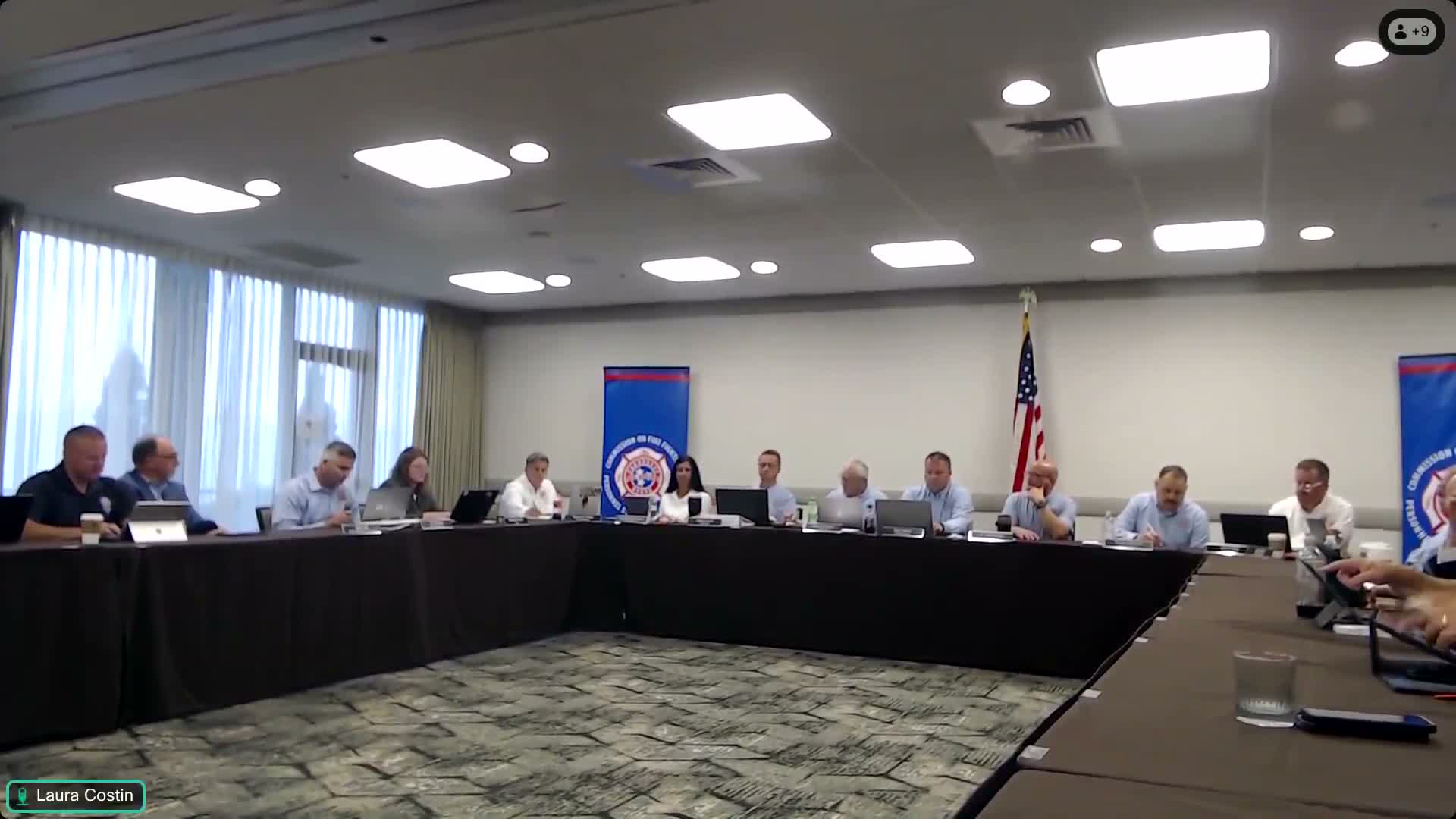
The Tennessee Fire Commission on May 16 reviewed testing data showing a high failure rate on the HMA portion of certification and directed staff to move toward skills-based assessments and wider, proctored online testing.
Commission staff reported HMA pass rates around 52% (48% failure) and HMO pass rates near 66% (34% failure) and said some failures stem from mismatch between the editions instructors use and the edition used for testing. Commissioner Henry (first referenced during the discussion) said staff had validated the HMA test and that commission accreditation managers would verify which edition is being used statewide; if the fourth edition remains listed it will be removed in favor of the validated fifth-edition combined book. "We validated an HMA test," the commissioner said, noting multiple agencies participated in validation.
Staff and Director Jason Sparks described plans to eliminate the written test for certain certifications and instead adopt fully skills-based evaluations for HMA and plans-examiner tracks, incorporating job-performance requirements (JPRs) into those assessments. Director Sparks also reported that the academy intends to update textbooks and test banks tied to the 1010 standard, with new materials expected to be presented to the commission after the summer.
To expand access to proctored testing across departments that lack secure computer labs, the commission described purchasing iPads for mobile proctors. Staff said they bought devices that allow proctors to bring secure, individual testing stations to a department: "Instead of being handed a written test, they're going to be handed an iPad," staff explained, with each candidate receiving a unique 16-digit code to log in and take the exam.
Commissioners discussed the practical implications for volunteer and career departments, and staff said audits and accreditation oversight would continue as an integrity check under the new approach. No formal rule adoption occurred at the meeting; staff said rule changes and related test-bank edits will follow the commission's standard process, including additional review and formal approval steps.
The commission noted that materials and process changes are being coordinated with the accreditation manager and legal staff; the item will return for follow-up and a presentation once the updated materials and validation checks are complete.
Commission staff reported HMA pass rates around 52% (48% failure) and HMO pass rates near 66% (34% failure) and said some failures stem from mismatch between the editions instructors use and the edition used for testing. Commissioner Henry (first referenced during the discussion) said staff had validated the HMA test and that commission accreditation managers would verify which edition is being used statewide; if the fourth edition remains listed it will be removed in favor of the validated fifth-edition combined book. "We validated an HMA test," the commissioner said, noting multiple agencies participated in validation.
Staff and Director Jason Sparks described plans to eliminate the written test for certain certifications and instead adopt fully skills-based evaluations for HMA and plans-examiner tracks, incorporating job-performance requirements (JPRs) into those assessments. Director Sparks also reported that the academy intends to update textbooks and test banks tied to the 1010 standard, with new materials expected to be presented to the commission after the summer.
To expand access to proctored testing across departments that lack secure computer labs, the commission described purchasing iPads for mobile proctors. Staff said they bought devices that allow proctors to bring secure, individual testing stations to a department: "Instead of being handed a written test, they're going to be handed an iPad," staff explained, with each candidate receiving a unique 16-digit code to log in and take the exam.
Commissioners discussed the practical implications for volunteer and career departments, and staff said audits and accreditation oversight would continue as an integrity check under the new approach. No formal rule adoption occurred at the meeting; staff said rule changes and related test-bank edits will follow the commission's standard process, including additional review and formal approval steps.
The commission noted that materials and process changes are being coordinated with the accreditation manager and legal staff; the item will return for follow-up and a presentation once the updated materials and validation checks are complete.
Don't Miss a Word: See the Full Meeting!
Go beyond summaries. Unlock every video, transcript, and key insight with a Founder Membership.
✓
Get instant access to full meeting videos
✓
Search and clip any phrase from complete transcripts
✓
Receive AI-powered summaries & custom alerts
✓
Enjoy lifetime, unrestricted access to government data
30-day money-back guarantee
