Irvine council orders 90‑day deep dive into projected budget shortfall after mid‑cycle briefing
May 05, 2026 | Irvine , Orange County, California
This article was created by AI summarizing key points discussed. AI makes mistakes, so for full details and context, please refer to the video of the full meeting. Please report any errors so we can fix them. Report an error »
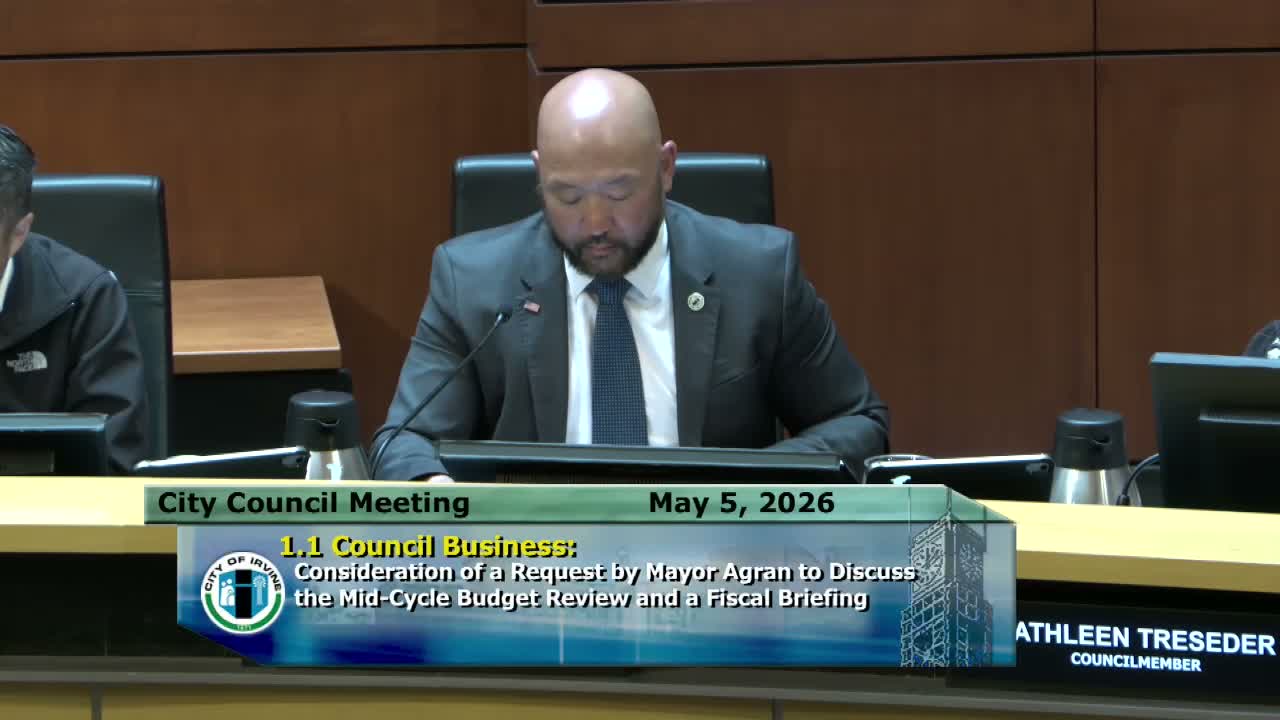
Irvine — The Irvine City Council voted 5–2 on May 5 to direct the city manager and finance staff to return within 90 days with a detailed report and plan to address a projected structural budget deficit.
City staff told the council in a mid‑cycle fiscal briefing that Irvine remains in a strong fiscal position overall — citing an investment portfolio of $1,700,000,000 and more than $130,000,000 in reserves — but faces near‑term deficits driven by rising costs and slower growth in some revenue categories. "We have $1,700,000,000 in investment portfolio and over $130,000,000 in reserves," Director of Administrative Services Dale Bullisong said during the presentation. Staff reported a projected $6,000,000 shortfall in fiscal year 2025–26 (about 2 percent) and a $9,000,000 shortfall projected for fiscal year 2026–27 (about 3 percent).
The staff presentation outlined a package of balancing measures to close the near‑term gap, including deferring fleet vehicle replacements ($2.6 million), holding vacant positions and other department cost reductions ($3.5 million), increasing solid‑waste revenue ($1.9 million) and adjusting user fees ($1.0 million). Bullisong said those measures, together with use of the asset management plan fund as a one‑time bridge, would balance the current and next fiscal year while staff works on longer‑term changes.
Councilmember James White moved the resolution directing staff to prepare an expansive report that would diagnose structural deficits, account for one‑time funds used in prior years, inventory discretionary spending and propose three specific balancing plans with dollar amounts. White’s motion called for the full staff report and supporting materials to be released publicly at least 14 days before the special meeting. White said the measure was intended to ensure the council and public can see the numerical drivers behind the city’s projections.
Councilmember White: "I move that the city council direct the city manager and staff to return within 60 days ... devoted exclusively to the general fund structural deficit, 5‑year forecast, and long term budget balancing options," (motion later amended to 90 days).
The motion was amended on the floor to extend the original 60‑day deadline to 90 days and then passed on a roll call vote: Carroll yes; Goh yes; Liu no; Martinez Franco yes; Tresider yes; Vice Mayor Mei yes; Mayor Agren no.
Public commenters at the meeting urged detailed transparency and several called for an independent or targeted audit of specific items, including past use of federal relief funds, spending on city hall renovations, and the library transition. Former Mayor Suki Kang told the council, "Every dollar we save within city hall is a dollar we don't have to take from our residents," urging fiscal discipline before asking residents for new revenues.
Other speakers raised concerns about a proposed Oak Creek development and whether council actions tied to development deals had been sufficiently disclosed; one commenter asked whether parts of the budget looked like a "backroom deal." City staff and the mayor reiterated that formal audits and regular external audits are part of the city’s oversight and said more detail would be made available to the finance commission and the council.
Several council members said they supported the thorough review but stressed limits: multiple members said they would not support layoffs of sworn public safety personnel and emphasized that reopening labor contracts is not currently planned. Staff told the council that bargaining agreements expire in 2029 and that any negotiations would normally start before expiration; staff said there was no plan to reopen agreements immediately.
The staff presentation also addressed the Great Park budget and cost allocations. Bullisong said the city will "right size" allocations to the Great Park — moving an average staff allocation from 8 percent of citywide staff cost to 6 percent to better reflect actual work charged directly to park projects — and staff confirmed the city is conducting a parking analysis for the park.
Next steps: the council’s direction requires staff to compile and publish a detailed, numerical staff report that includes a structural deficit diagnosis, a one‑time funds audit back to fiscal year 2017, fund balance schedules, staffing and labor cost scenarios, a catalog of discretionary spending and high‑cost contracts, deferred maintenance impacts, and three actionable balancing plans with department‑level dollar impacts. Staff said it will return to the council within the amended 90‑day timeframe and that additional community workshops are scheduled over the summer as part of the biennial budget process.
The council adjourned after the vote; staff and the finance commission will continue to review and refine the materials ahead of the June budget meeting.
City staff told the council in a mid‑cycle fiscal briefing that Irvine remains in a strong fiscal position overall — citing an investment portfolio of $1,700,000,000 and more than $130,000,000 in reserves — but faces near‑term deficits driven by rising costs and slower growth in some revenue categories. "We have $1,700,000,000 in investment portfolio and over $130,000,000 in reserves," Director of Administrative Services Dale Bullisong said during the presentation. Staff reported a projected $6,000,000 shortfall in fiscal year 2025–26 (about 2 percent) and a $9,000,000 shortfall projected for fiscal year 2026–27 (about 3 percent).
The staff presentation outlined a package of balancing measures to close the near‑term gap, including deferring fleet vehicle replacements ($2.6 million), holding vacant positions and other department cost reductions ($3.5 million), increasing solid‑waste revenue ($1.9 million) and adjusting user fees ($1.0 million). Bullisong said those measures, together with use of the asset management plan fund as a one‑time bridge, would balance the current and next fiscal year while staff works on longer‑term changes.
Councilmember James White moved the resolution directing staff to prepare an expansive report that would diagnose structural deficits, account for one‑time funds used in prior years, inventory discretionary spending and propose three specific balancing plans with dollar amounts. White’s motion called for the full staff report and supporting materials to be released publicly at least 14 days before the special meeting. White said the measure was intended to ensure the council and public can see the numerical drivers behind the city’s projections.
Councilmember White: "I move that the city council direct the city manager and staff to return within 60 days ... devoted exclusively to the general fund structural deficit, 5‑year forecast, and long term budget balancing options," (motion later amended to 90 days).
The motion was amended on the floor to extend the original 60‑day deadline to 90 days and then passed on a roll call vote: Carroll yes; Goh yes; Liu no; Martinez Franco yes; Tresider yes; Vice Mayor Mei yes; Mayor Agren no.
Public commenters at the meeting urged detailed transparency and several called for an independent or targeted audit of specific items, including past use of federal relief funds, spending on city hall renovations, and the library transition. Former Mayor Suki Kang told the council, "Every dollar we save within city hall is a dollar we don't have to take from our residents," urging fiscal discipline before asking residents for new revenues.
Other speakers raised concerns about a proposed Oak Creek development and whether council actions tied to development deals had been sufficiently disclosed; one commenter asked whether parts of the budget looked like a "backroom deal." City staff and the mayor reiterated that formal audits and regular external audits are part of the city’s oversight and said more detail would be made available to the finance commission and the council.
Several council members said they supported the thorough review but stressed limits: multiple members said they would not support layoffs of sworn public safety personnel and emphasized that reopening labor contracts is not currently planned. Staff told the council that bargaining agreements expire in 2029 and that any negotiations would normally start before expiration; staff said there was no plan to reopen agreements immediately.
The staff presentation also addressed the Great Park budget and cost allocations. Bullisong said the city will "right size" allocations to the Great Park — moving an average staff allocation from 8 percent of citywide staff cost to 6 percent to better reflect actual work charged directly to park projects — and staff confirmed the city is conducting a parking analysis for the park.
Next steps: the council’s direction requires staff to compile and publish a detailed, numerical staff report that includes a structural deficit diagnosis, a one‑time funds audit back to fiscal year 2017, fund balance schedules, staffing and labor cost scenarios, a catalog of discretionary spending and high‑cost contracts, deferred maintenance impacts, and three actionable balancing plans with department‑level dollar impacts. Staff said it will return to the council within the amended 90‑day timeframe and that additional community workshops are scheduled over the summer as part of the biennial budget process.
The council adjourned after the vote; staff and the finance commission will continue to review and refine the materials ahead of the June budget meeting.
Don't Miss a Word: See the Full Meeting!
Go beyond summaries. Unlock every video, transcript, and key insight with a Founder Membership.
✓
Get instant access to full meeting videos
✓
Search and clip any phrase from complete transcripts
✓
Receive AI-powered summaries & custom alerts
✓
Enjoy lifetime, unrestricted access to government data
30-day money-back guarantee
