Council backs staff preference for resilience hubs, not reservoir-based distribution; questions viability of filtration trailers
May 06, 2026 | Tigard, Washington County, Oregon
This article was created by AI summarizing key points discussed. AI makes mistakes, so for full details and context, please refer to the video of the full meeting. Please report any errors so we can fix them. Report an error »
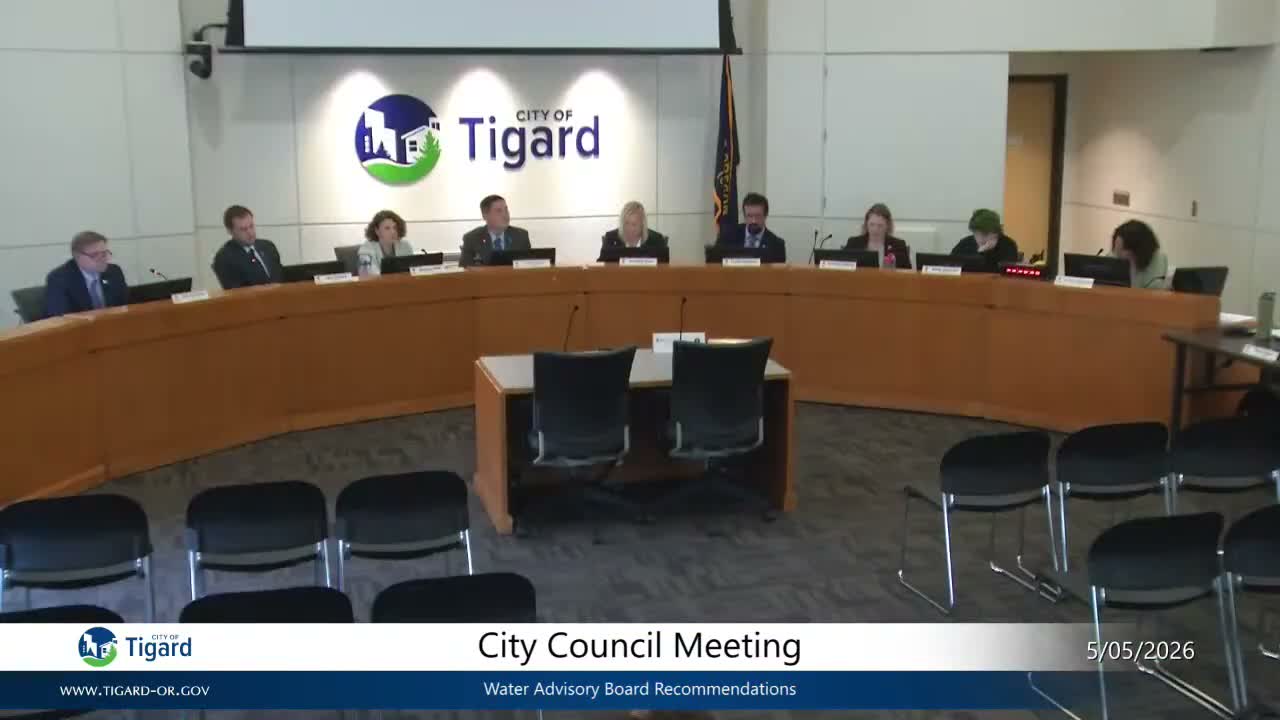
Staff presented three recommendations related to Tigard Water District proposals: (1) do not use reservoir sites as volunteer-run emergency water-distribution manifolds; (2) be cautious about using large filtration trailers for early disaster response, and (3) pursue smaller portable filtration units and coordination with CERT for volunteer training and staging at resilience hubs/CPODs.
Acting city manager and public works director Brian Rager said reservoir sites are not appropriate for immediate emergency distribution because the city's emergency plan centers on commodity points of distribution and potential resilience hubs. He described smaller portable filtration units as promising because they are more portable and could be deployed to CPOD locations or staged at permanent resilience hubs.
Several councilors voiced support for staff recommendations, while asking practical questions about liability, realistic implementation and the best use of donated funds. Councilor Robbins asked who would operate a filtration trailer and whether volunteers could run it; staff and other councilors responded that some filtration systems require state-certified operators and that smaller units would be simpler to train volunteers to use. One councilor said an engineering study on using a reservoir for distribution could be wasteful if the system could not be staffed or operated as proposed.
Why it matters: The decision shapes how Tigard prepares for and responds to water-system failures in major emergencies. Choices about equipment, staffing and staging affect response time and community resilience.
Next steps: Council supported staff recommendations to pursue resilience-hub planning and smaller portable units, and asked staff to work with the Tigard Water District and the Water Advisory Board to refine implementable options and training pathways (CERT).
Acting city manager and public works director Brian Rager said reservoir sites are not appropriate for immediate emergency distribution because the city's emergency plan centers on commodity points of distribution and potential resilience hubs. He described smaller portable filtration units as promising because they are more portable and could be deployed to CPOD locations or staged at permanent resilience hubs.
Several councilors voiced support for staff recommendations, while asking practical questions about liability, realistic implementation and the best use of donated funds. Councilor Robbins asked who would operate a filtration trailer and whether volunteers could run it; staff and other councilors responded that some filtration systems require state-certified operators and that smaller units would be simpler to train volunteers to use. One councilor said an engineering study on using a reservoir for distribution could be wasteful if the system could not be staffed or operated as proposed.
Why it matters: The decision shapes how Tigard prepares for and responds to water-system failures in major emergencies. Choices about equipment, staffing and staging affect response time and community resilience.
Next steps: Council supported staff recommendations to pursue resilience-hub planning and smaller portable units, and asked staff to work with the Tigard Water District and the Water Advisory Board to refine implementable options and training pathways (CERT).
Don't Miss a Word: See the Full Meeting!
Go beyond summaries. Unlock every video, transcript, and key insight with a Founder Membership.
✓
Get instant access to full meeting videos
✓
Search and clip any phrase from complete transcripts
✓
Receive AI-powered summaries & custom alerts
✓
Enjoy lifetime, unrestricted access to government data
30-day money-back guarantee
