Tigard council unanimously adopts two ordinances: repeals outdated 'soundtracks' code and updates election filing rules
May 06, 2026 | Tigard, Washington County, Oregon
This article was created by AI summarizing key points discussed. AI makes mistakes, so for full details and context, please refer to the video of the full meeting. Please report any errors so we can fix them. Report an error »
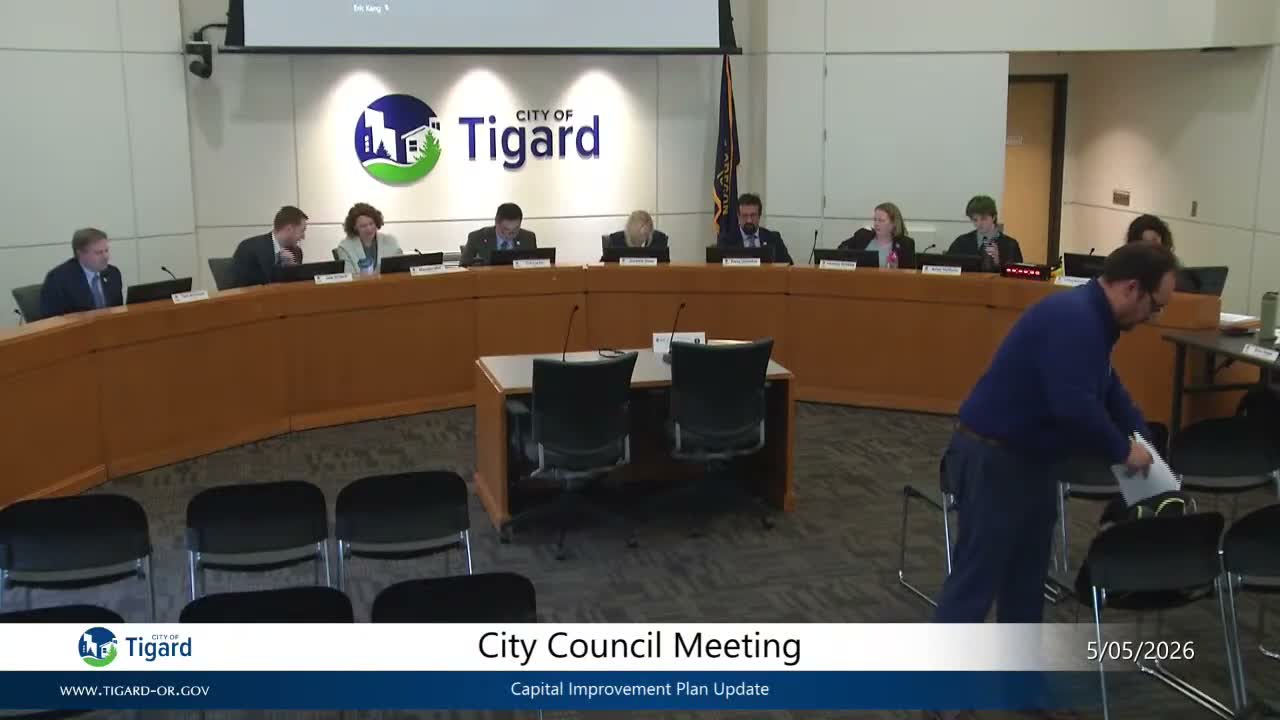
The Tigard City Council held two legislative public hearings and adopted both ordinances by unanimous vote.
Ordinance No. 26-10 repealed Tigard Municipal Code chapter 5.16 (soundtracks). The city attorney said the section had no registrations in more than 40 years, is likely unconstitutional under current case law, and its repeal does not alter existing noise regulation or vehicle-sound statutes. No members of the public testified on the item; the ordinance was moved, seconded and adopted unanimously.
Ordinance No. 26-11 amends Tigard Municipal Code chapter 2.4 regarding election filing procedures. Staff described the changes as clarifications and updates to reflect the new city charter and a state-law change that affects filing deadlines for incumbents and candidates. The amendment removes an older requirement that a seated councilor resign to run for mayor (now addressed by the charter) and aligns filing deadlines with state law. There were no public comments on this item; council moved, seconded and adopted the ordinance unanimously.
Votes at a glance:
- Consent agenda (two resolutions: opportunity zone nomination; Safe Streets and Roads for All grant application) — motion to approve carried unanimously.
- Ordinance 26-10 (repeal of TMC 5.16) — adopted unanimously.
- Ordinance 26-11 (amend TMC 2.4) — adopted unanimously.
Why it matters: The repeal removes an obsolete code section that staff said could be constitutionally vulnerable; the election-code amendments align municipal code with the city charter and state law, reducing procedural confusion for candidates and election officers.
Next steps: Both ordinances take effect per municipal procedures; staff will continue routine implementation and public notification.
Ordinance No. 26-10 repealed Tigard Municipal Code chapter 5.16 (soundtracks). The city attorney said the section had no registrations in more than 40 years, is likely unconstitutional under current case law, and its repeal does not alter existing noise regulation or vehicle-sound statutes. No members of the public testified on the item; the ordinance was moved, seconded and adopted unanimously.
Ordinance No. 26-11 amends Tigard Municipal Code chapter 2.4 regarding election filing procedures. Staff described the changes as clarifications and updates to reflect the new city charter and a state-law change that affects filing deadlines for incumbents and candidates. The amendment removes an older requirement that a seated councilor resign to run for mayor (now addressed by the charter) and aligns filing deadlines with state law. There were no public comments on this item; council moved, seconded and adopted the ordinance unanimously.
Votes at a glance:
- Consent agenda (two resolutions: opportunity zone nomination; Safe Streets and Roads for All grant application) — motion to approve carried unanimously.
- Ordinance 26-10 (repeal of TMC 5.16) — adopted unanimously.
- Ordinance 26-11 (amend TMC 2.4) — adopted unanimously.
Why it matters: The repeal removes an obsolete code section that staff said could be constitutionally vulnerable; the election-code amendments align municipal code with the city charter and state law, reducing procedural confusion for candidates and election officers.
Next steps: Both ordinances take effect per municipal procedures; staff will continue routine implementation and public notification.
Don't Miss a Word: See the Full Meeting!
Go beyond summaries. Unlock every video, transcript, and key insight with a Founder Membership.
✓
Get instant access to full meeting videos
✓
Search and clip any phrase from complete transcripts
✓
Receive AI-powered summaries & custom alerts
✓
Enjoy lifetime, unrestricted access to government data
30-day money-back guarantee
