House Finance Committee hears proposal to raise bulk fuel loan cap amid sharp price and supply pressures
May 05, 2026 | 2026 Legislature Alaska, Alaska
This article was created by AI summarizing key points discussed. AI makes mistakes, so for full details and context, please refer to the video of the full meeting. Please report any errors so we can fix them. Report an error »
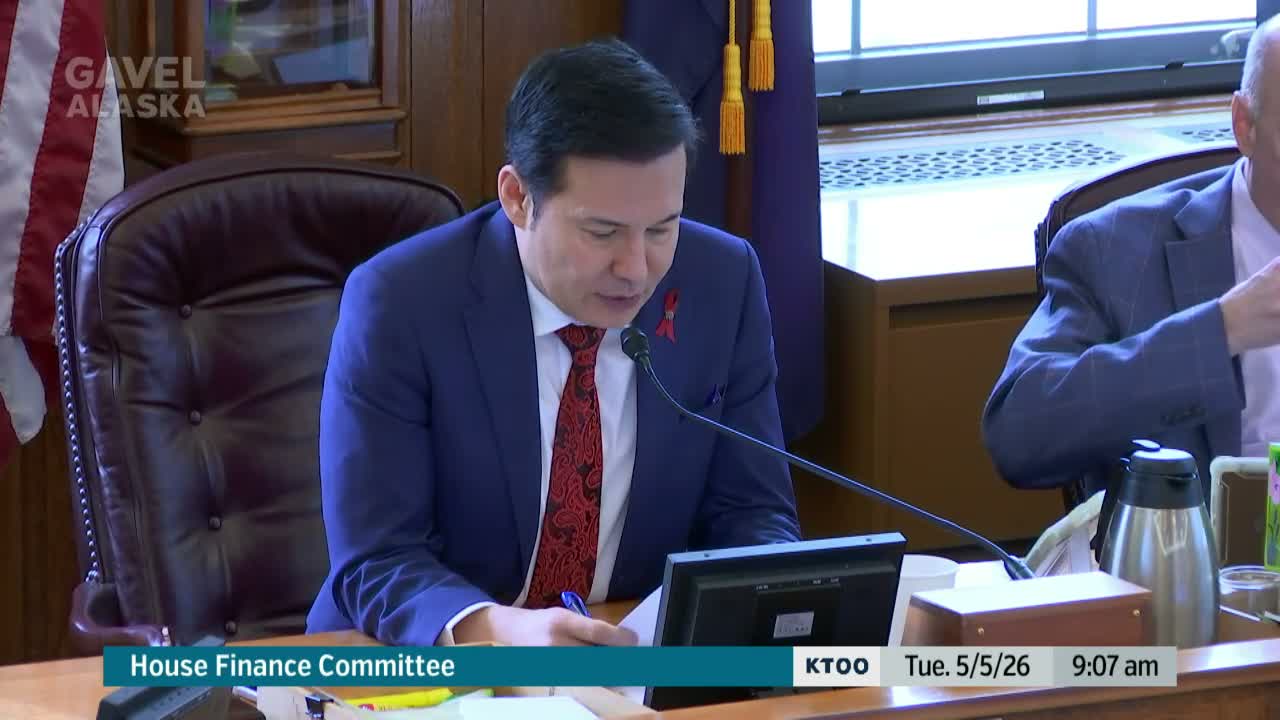
The Alaska House Finance Committee on May 5 heard introductions and invited testimony on House Bill 388, a proposal to raise the state's bulk fuel revolving loan cap from $750,000 to $1,500,000 and to eliminate an alternative minimum cap for pooled loans that could limit larger, multi-community borrowings.
Paul Labold, staff to Co-chair Foster, said the bill would double the upper limit for individual loans and remove a $1.8 million alternative minimum so the allowable loan amount for pooled borrowers would instead be the per-community cap multiplied by the number of participating communities.
Sandra Muller, director of the Division of Community and Regional Affairs, told the committee that rising market prices and constrained supply have made bulk purchases more expensive and less certain this season. "We currently think it's in that $3 range," Muller said, describing a roughly $3-per-gallon market increase used in DCRA's modeling. She summarized DCRA's recent survey reporting average retail gasoline at $6.63 and heating fuel at $6.32 per gallon and noted wide regional variation (as low as about $4.40 and, in northern interior communities, reported highs near $15 per gallon).
DCRA described the program as a revolving loan fund used primarily by off-road-system communities that purchase seasonal bulk fuel. Muller said the fund typically supports one or two deliveries per year for borrowers, that the program's collection performance historically has been strong (DCRA cited collection rates near 99.5%), and that the agency currently has roughly $22,000,000 in the fund balance.
Committee members pressed for precise fiscal assumptions. Representative Schrage asked how DCRA modeled Scenario B, which projects fund needs if borrowers increase the amounts they borrow. Muller said the fiscal-note Scenario B applied a 100% increase to the average current loan (DCRA's stated average was about $350,000), and that under that modeling the fund would require an additional roughly $25,000,000 (a projected total fund balance of about $47,000,000) to cover the higher borrowing level.
Mike Poston, director of sales for VITAS, corroborated suppliers' inputs to the committee, reporting constrained supply and higher transportation costs. "The $3 to $4 a gallon increase ... is what we're seeing in the marketplace," Poston said, adding that more entities are likely to need state loan referrals because higher prices will push orders above the existing cap.
Caitlin Conway of the Alaska Municipal League said AML "fully supports this bill," arguing that without a higher borrowing ceiling some communities could under-order fuel and risk running short before the next delivery season. AML urged lawmakers to consider additional capitalization, expanded eligibility for select applicants such as school districts, targeted interest-rate concessions for first-time borrowers, and more state technical assistance to help communities navigate purchases and price risk.
Representative Allard raised a policy concern about sovereign immunity, saying the current program requires Alaska Native villages to waive sovereign immunity as a condition of borrowing, and cautioned that raising loan caps increases the legal and financial stakes for those borrowers. Committee members indicated they would return to that point in forthcoming discussions.
The committee set HB 388 aside for additional questions and scheduled public testimony on the bill at its next meeting (1:30 p.m. the same day). No formal action or vote was taken at the May 5 session.
What happens next: Committee staff and DCRA will refine fiscal projections and respond to member questions; the committee will accept public testimony and resume consideration on the next scheduled meeting.
Paul Labold, staff to Co-chair Foster, said the bill would double the upper limit for individual loans and remove a $1.8 million alternative minimum so the allowable loan amount for pooled borrowers would instead be the per-community cap multiplied by the number of participating communities.
Sandra Muller, director of the Division of Community and Regional Affairs, told the committee that rising market prices and constrained supply have made bulk purchases more expensive and less certain this season. "We currently think it's in that $3 range," Muller said, describing a roughly $3-per-gallon market increase used in DCRA's modeling. She summarized DCRA's recent survey reporting average retail gasoline at $6.63 and heating fuel at $6.32 per gallon and noted wide regional variation (as low as about $4.40 and, in northern interior communities, reported highs near $15 per gallon).
DCRA described the program as a revolving loan fund used primarily by off-road-system communities that purchase seasonal bulk fuel. Muller said the fund typically supports one or two deliveries per year for borrowers, that the program's collection performance historically has been strong (DCRA cited collection rates near 99.5%), and that the agency currently has roughly $22,000,000 in the fund balance.
Committee members pressed for precise fiscal assumptions. Representative Schrage asked how DCRA modeled Scenario B, which projects fund needs if borrowers increase the amounts they borrow. Muller said the fiscal-note Scenario B applied a 100% increase to the average current loan (DCRA's stated average was about $350,000), and that under that modeling the fund would require an additional roughly $25,000,000 (a projected total fund balance of about $47,000,000) to cover the higher borrowing level.
Mike Poston, director of sales for VITAS, corroborated suppliers' inputs to the committee, reporting constrained supply and higher transportation costs. "The $3 to $4 a gallon increase ... is what we're seeing in the marketplace," Poston said, adding that more entities are likely to need state loan referrals because higher prices will push orders above the existing cap.
Caitlin Conway of the Alaska Municipal League said AML "fully supports this bill," arguing that without a higher borrowing ceiling some communities could under-order fuel and risk running short before the next delivery season. AML urged lawmakers to consider additional capitalization, expanded eligibility for select applicants such as school districts, targeted interest-rate concessions for first-time borrowers, and more state technical assistance to help communities navigate purchases and price risk.
Representative Allard raised a policy concern about sovereign immunity, saying the current program requires Alaska Native villages to waive sovereign immunity as a condition of borrowing, and cautioned that raising loan caps increases the legal and financial stakes for those borrowers. Committee members indicated they would return to that point in forthcoming discussions.
The committee set HB 388 aside for additional questions and scheduled public testimony on the bill at its next meeting (1:30 p.m. the same day). No formal action or vote was taken at the May 5 session.
What happens next: Committee staff and DCRA will refine fiscal projections and respond to member questions; the committee will accept public testimony and resume consideration on the next scheduled meeting.
Don't Miss a Word: See the Full Meeting!
Go beyond summaries. Unlock every video, transcript, and key insight with a Founder Membership.
✓
Get instant access to full meeting videos
✓
Search and clip any phrase from complete transcripts
✓
Receive AI-powered summaries & custom alerts
✓
Enjoy lifetime, unrestricted access to government data
30-day money-back guarantee
