Committee hears SB 29 to codify executive administrator for Big Game Commercial Services Board
May 05, 2026 | 2026 Legislature Alaska, Alaska
This article was created by AI summarizing key points discussed. AI makes mistakes, so for full details and context, please refer to the video of the full meeting. Please report any errors so we can fix them. Report an error »
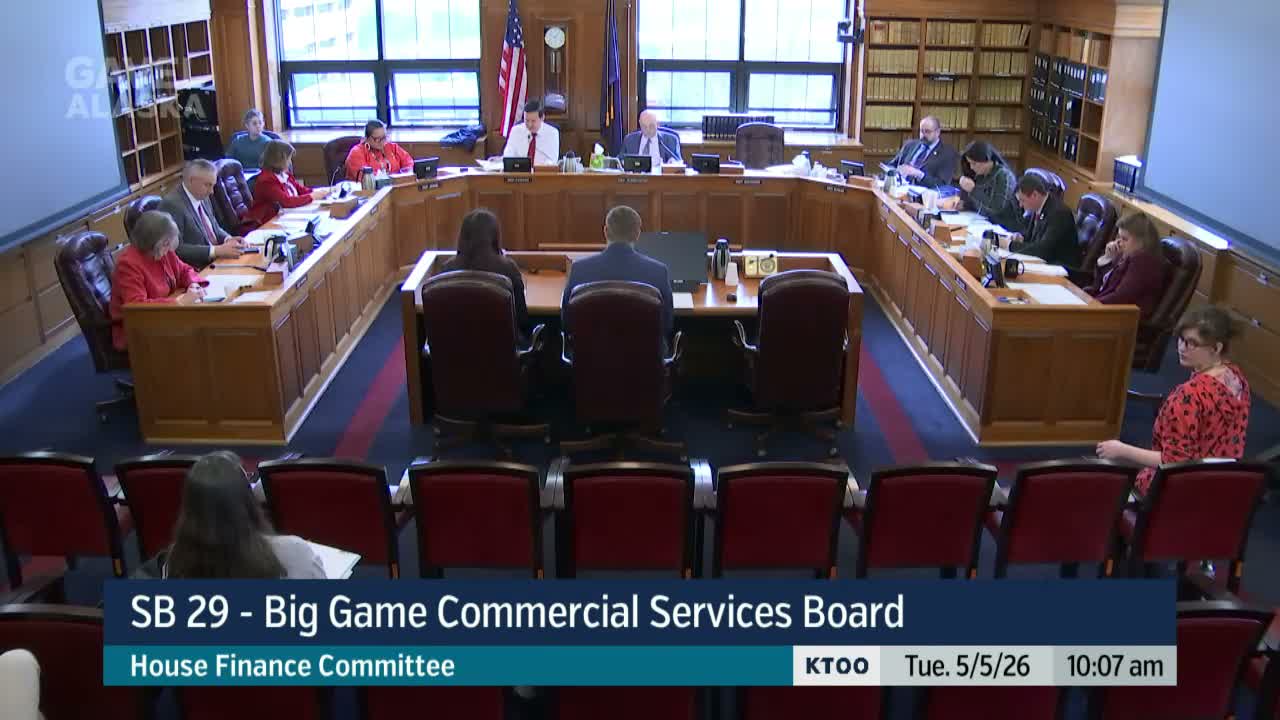
Senate Bill 29 was introduced to the House Finance Committee on May 5 as a measure to codify and set the statutory range for an executive administrator for the Big Game Commercial Services Board.
Senator Jesse Bjorkman (sponsor) told the committee the board oversees licensing and regulation for big-game guides and outfitters across different regions and manages a complex set of exams and reporting requirements. "Codifying this executive administrator position in statute will improve efficiency and help retain institutional knowledge," Bjorkman said, adding that the position has been funded for two fiscal years by designated license-fee receipts, not by general-fund appropriations.
Keegan McCarthy, chair of the Big Game Commercial Services Board, described the workload the board handles, including 29 different guide examinations, licensing, investigative support and frequent regulatory updates. McCarthy said the temporary executive-administrator position (created in the FY2024 and FY2025 budgets and filled October 2024) has helped sustain operations and that making it permanent would ensure continuity when board members are in the field.
Representative Allard expressed concern about the bill's stated pay range, worrying the description in the draft could appear clerical while the fiscal note showed a significant salary range. "I can't wrap my head around this particular range," Allard said, asking for a clearer job description and evidence that the pay range reflects the duties. Senator Bjorkman replied that the position is technical and specialized and not a "run of the mill, secretarial position." Sylvan Robb, director of the Division of Corporations, Business and Professional Licensing, told the committee that six licensing boards already have executive administrators created in statute and that those positions are typically paid at range 23 or higher; in three cases the statute also specifies the range.
Committee members asked for licensee counts and workload context; Robb provided FY25 numbers: roughly 1,004 assistant guides, 442 master guides and registered outfitters, and 147 transporters. Members pressed on whether the board's complexity warranted the statutory designation; sponsors said the board's regional regulatory differences, multiple exam sets and investigatory work justify a dedicated administrator.
No action was taken; the bill was introduced and discussed and will proceed through regular committee consideration.
What happens next: Committee staff will review statutory language and fiscal notes; members requested additional documentation about pay-range norms, job duties and precedent for statutory executive-administrator positions.
Senator Jesse Bjorkman (sponsor) told the committee the board oversees licensing and regulation for big-game guides and outfitters across different regions and manages a complex set of exams and reporting requirements. "Codifying this executive administrator position in statute will improve efficiency and help retain institutional knowledge," Bjorkman said, adding that the position has been funded for two fiscal years by designated license-fee receipts, not by general-fund appropriations.
Keegan McCarthy, chair of the Big Game Commercial Services Board, described the workload the board handles, including 29 different guide examinations, licensing, investigative support and frequent regulatory updates. McCarthy said the temporary executive-administrator position (created in the FY2024 and FY2025 budgets and filled October 2024) has helped sustain operations and that making it permanent would ensure continuity when board members are in the field.
Representative Allard expressed concern about the bill's stated pay range, worrying the description in the draft could appear clerical while the fiscal note showed a significant salary range. "I can't wrap my head around this particular range," Allard said, asking for a clearer job description and evidence that the pay range reflects the duties. Senator Bjorkman replied that the position is technical and specialized and not a "run of the mill, secretarial position." Sylvan Robb, director of the Division of Corporations, Business and Professional Licensing, told the committee that six licensing boards already have executive administrators created in statute and that those positions are typically paid at range 23 or higher; in three cases the statute also specifies the range.
Committee members asked for licensee counts and workload context; Robb provided FY25 numbers: roughly 1,004 assistant guides, 442 master guides and registered outfitters, and 147 transporters. Members pressed on whether the board's complexity warranted the statutory designation; sponsors said the board's regional regulatory differences, multiple exam sets and investigatory work justify a dedicated administrator.
No action was taken; the bill was introduced and discussed and will proceed through regular committee consideration.
What happens next: Committee staff will review statutory language and fiscal notes; members requested additional documentation about pay-range norms, job duties and precedent for statutory executive-administrator positions.
View the Full Meeting & All Its Details
This article offers just a summary. Unlock complete video, transcripts, and insights as a Founder Member.
✓
Watch full, unedited meeting videos
✓
Search every word spoken in unlimited transcripts
✓
AI summaries & real-time alerts (all government levels)
✓
Permanent access to expanding government content
30-day money-back guarantee
