Franklin council debates tightening citizen comment rules; residents warn of chilling effect
May 06, 2026 | Franklin City, Milwaukee County, Wisconsin
This article was created by AI summarizing key points discussed. AI makes mistakes, so for full details and context, please refer to the video of the full meeting. Please report any errors so we can fix them. Report an error »
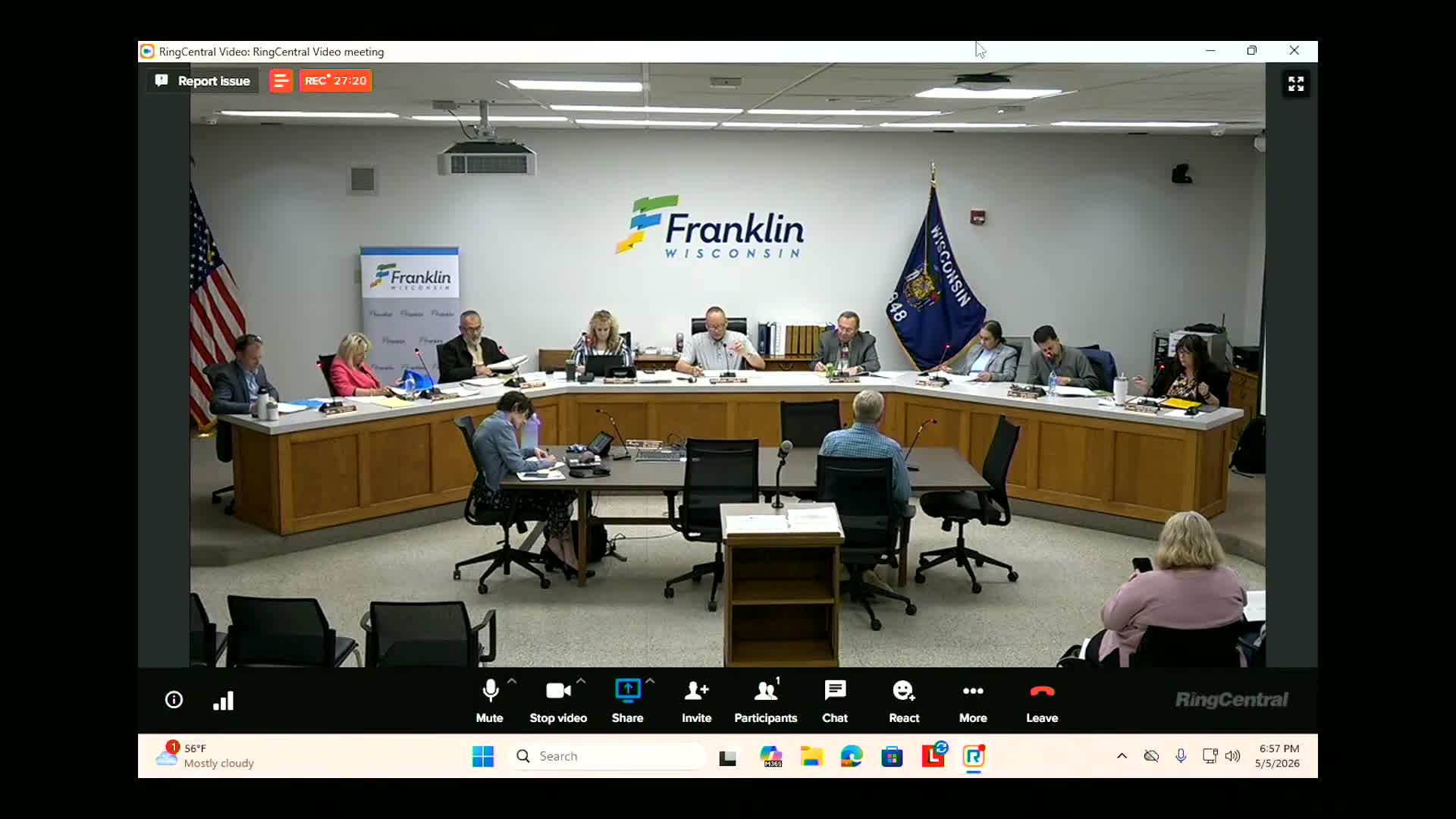
Residents and councilors spent the bulk of Tuesday’s meeting debating proposed changes to municipal code 19‑2(b), the section that governs how citizen comment periods are run at Common Council meetings.
Linda Mathewig, who spoke during public comment, told the council she opposed the draft ordinance (agenda item G5). "This ordinance goes beyond decorum…It creates a process that makes public comment easier to limit, easier to manage, and easier to cut off," Mathewig said. "Public comment is not wasted time. It is democracy in its most basic form."
Mayor Nelson opened the council discussion by saying the matter is for the council to decide and emphasizing the stated intent is not to silence residents but to consider improvements. He asked the council to think through specifics such as whether a neighborhood representative should be required to file annually and what additional time, if any, a representative would receive.
Council members raised practical and legal questions. One councilor argued the ordinance should be enforced to match the existing text (no one should speak longer than three minutes without unanimous consent). Another councilor said the council has historically been lenient and suggested returning to strict three‑minute enforcement. Others warned that terms in the draft such as "repetitive," "irrelevant," and "disruptive" are subjective and might be applied unevenly depending on who is presiding.
Councilors also discussed logistics: whether to require people to register if they claim to represent a neighborhood, how often registration should be updated, and whether to limit total public comment time (options mentioned included 30, 60 or 90 minutes). The city attorney explained that a supermajority requirement for changes could be drafted (for example, three‑quarters or two‑thirds of the council) if the council chose that path.
No ordinance was adopted Tuesday. Councilors directed staff and the city attorney to clarify definitions and drafting options so the council can consider a refined proposal at a future meeting.
Next steps: the city attorney will prepare clearer language on registration, representative status and objective standards for decorum so the council can revisit the ordinance draft.
Linda Mathewig, who spoke during public comment, told the council she opposed the draft ordinance (agenda item G5). "This ordinance goes beyond decorum…It creates a process that makes public comment easier to limit, easier to manage, and easier to cut off," Mathewig said. "Public comment is not wasted time. It is democracy in its most basic form."
Mayor Nelson opened the council discussion by saying the matter is for the council to decide and emphasizing the stated intent is not to silence residents but to consider improvements. He asked the council to think through specifics such as whether a neighborhood representative should be required to file annually and what additional time, if any, a representative would receive.
Council members raised practical and legal questions. One councilor argued the ordinance should be enforced to match the existing text (no one should speak longer than three minutes without unanimous consent). Another councilor said the council has historically been lenient and suggested returning to strict three‑minute enforcement. Others warned that terms in the draft such as "repetitive," "irrelevant," and "disruptive" are subjective and might be applied unevenly depending on who is presiding.
Councilors also discussed logistics: whether to require people to register if they claim to represent a neighborhood, how often registration should be updated, and whether to limit total public comment time (options mentioned included 30, 60 or 90 minutes). The city attorney explained that a supermajority requirement for changes could be drafted (for example, three‑quarters or two‑thirds of the council) if the council chose that path.
No ordinance was adopted Tuesday. Councilors directed staff and the city attorney to clarify definitions and drafting options so the council can consider a refined proposal at a future meeting.
Next steps: the city attorney will prepare clearer language on registration, representative status and objective standards for decorum so the council can revisit the ordinance draft.
Don't Miss a Word: See the Full Meeting!
Go beyond summaries. Unlock every video, transcript, and key insight with a Founder Membership.
✓
Get instant access to full meeting videos
✓
Search and clip any phrase from complete transcripts
✓
Receive AI-powered summaries & custom alerts
✓
Enjoy lifetime, unrestricted access to government data
30-day money-back guarantee
