Albany City planning board approves four development applications, sets conditions on larger River Boulevard project
May 06, 2026 | Albany City, Albany County, New York
This article was created by AI summarizing key points discussed. AI makes mistakes, so for full details and context, please refer to the video of the full meeting. Please report any errors so we can fix them. Report an error »
The Albany City Planning Board on Monday approved multiple development applications, voting to grant conditional use permits for two small apartment conversions and to move forward with conditional approvals for larger redevelopment projects subject to technical conditions.
Chair speaker (speaker 5) opened the meeting and introduced agenda items including CUP-2026-1 at 434 Elk Street and CP-2026-13 at 39 Timber Place. Daniel Sanders, identified in the record as the applicants’ architect, presented the 434 Elk Street application and described two units planned in the existing structure. "1st Floor, 2 bedroom, 2nd Floor, 1 bedroom," Sanders said, summarizing the unit layout. Planning staff reported the proposal met R-2 zoning criteria, that on-site parking and refuse arrangements were adequate for the added unit, and recommended approval. The board moved and approved the conditional use permit by voice vote.
The board then considered CP-2026-13 at 39 Timber Place. Sanders also presented that project, describing a two‑unit conversion that preserves the building’s storefront character and retains front and rear windows. Neighbors asked whether the adjacent lawn and parking would be maintained; Kevin Boucher, who identified himself as a resident at 18 Temperer Place, asked whether the parcel included the lawn to the left of the building and whether it would be kept. Sanders and staff said the area would be used for parking and that additional documentation (a deck plan and other clarifications) would be provided. The board voted to approve the permit unanimously.
The meeting’s lengthiest discussion focused on DPR-2025-28, a plan to add units at 315 River Boulevard (an extension of the former Livingston School/’Livingston Apartments’). Applicant representative Daniel Hershberg presented a site plan that would add approximately 97 units by building into a vacant area to the northeast of the existing structure and tying into utilities on Manning Boulevard. Hershberg said the design would match the school’s architecture, preserve an identified historic tree and provide a mix of surface and garage parking totaling about 43 spaces. "We think it makes a nice building," he said, adding that the project "provides some needed housing." Planning staff summarized referrals and coordination: the project was referred to Albany County Planning, to agencies linked to public funding and to historic‑resource reviewers; CHaP/SHPO coordination concluded there would be no adverse effect to historic resources for the current scope of work, staff said.
Board members and residents pressed the applicant on traffic and parking, expressing concerns about cut‑through traffic and congestion during school pickup and drop-off times. Staff and the applicant discussed possible mitigations including signage, a designated onsite monitor during busy hours, and cameras; the board agreed to check with the Albany Police Department about enforcement options. Staff noted outstanding technical reviews (water, sewer, traffic engineering) and required conditions tied to those reviews.
On motions the board overruled an Albany County Planning Board recommendation that would have expanded outside agency review, voted to adopt a SEQR negative declaration for DPR-2025-28, and granted conditional approval of the development plan review. Conditions listed on the record included final approval from the Department of Water (water department sign‑off), consolidation or lot modification before issuance of a certificate of occupancy, and an access agreement to maintain parking and rear access in perpetuity. The board recorded the motions as passed by voice vote.
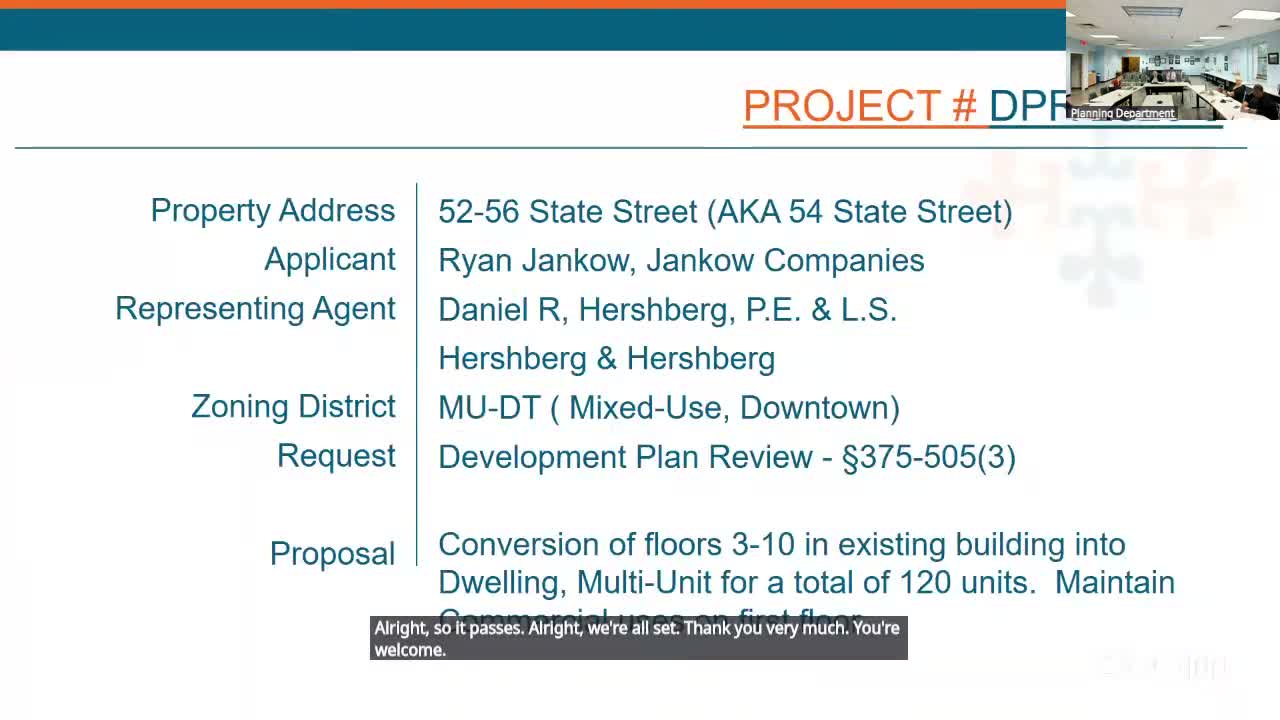
The board also heard a large downtown conversion at 52 State Street (DPR-2026-5). Hershberg described a conversion of an office building into roughly 120 residential units with commercial ground-floor uses, internal trash rooms on each floor and permitted access to a rear parking garage. Planning staff recommended standard conditions including submission of a final site plan by a New York‑licensed engineer, final water‑department approval, lot consolidation prior to certificate of occupancy and an approved affordable‑housing compliance plan (or payment under alternate compliance). The board moved and seconded the conditional approval; the motion passed.
The meeting adjourned at approximately 7:00 p.m.
Votes at a glance
- CUP-2026-1 (434 Elk Street): motion to approve conditional use permit — passed by voice vote (recorded as in favor; no roll‑call tally provided).
- CP-2026-13 (39 Timber Place): motion to approve conditional use permit — passed unanimously by voice vote.
- DPR-2025-28 (315 River Boulevard): motion to overrule Albany County recommendation — passed by voice vote; motion to declare SEQR negative declaration — passed by voice vote; motion for conditional approval with conditions (water sign‑off, lot modification prior to CO, access agreement, other site conditions) — passed by voice vote.
- DPR-2026-5 (52 State Street): motion for conditional approval with conditions (engineer site plan, water approval, lot consolidation, affordable-housing compliance or payment) — passed by voice vote.
What happens next
Applicants were instructed to supply additional drawings or documentation where requested (deck details for egress, signage plans, final engineered site plans) and to obtain final technical approvals from the Department of Water and other reviewing agencies before building permits or certificates of occupancy are issued.
Chair speaker (speaker 5) opened the meeting and introduced agenda items including CUP-2026-1 at 434 Elk Street and CP-2026-13 at 39 Timber Place. Daniel Sanders, identified in the record as the applicants’ architect, presented the 434 Elk Street application and described two units planned in the existing structure. "1st Floor, 2 bedroom, 2nd Floor, 1 bedroom," Sanders said, summarizing the unit layout. Planning staff reported the proposal met R-2 zoning criteria, that on-site parking and refuse arrangements were adequate for the added unit, and recommended approval. The board moved and approved the conditional use permit by voice vote.
The board then considered CP-2026-13 at 39 Timber Place. Sanders also presented that project, describing a two‑unit conversion that preserves the building’s storefront character and retains front and rear windows. Neighbors asked whether the adjacent lawn and parking would be maintained; Kevin Boucher, who identified himself as a resident at 18 Temperer Place, asked whether the parcel included the lawn to the left of the building and whether it would be kept. Sanders and staff said the area would be used for parking and that additional documentation (a deck plan and other clarifications) would be provided. The board voted to approve the permit unanimously.
The meeting’s lengthiest discussion focused on DPR-2025-28, a plan to add units at 315 River Boulevard (an extension of the former Livingston School/’Livingston Apartments’). Applicant representative Daniel Hershberg presented a site plan that would add approximately 97 units by building into a vacant area to the northeast of the existing structure and tying into utilities on Manning Boulevard. Hershberg said the design would match the school’s architecture, preserve an identified historic tree and provide a mix of surface and garage parking totaling about 43 spaces. "We think it makes a nice building," he said, adding that the project "provides some needed housing." Planning staff summarized referrals and coordination: the project was referred to Albany County Planning, to agencies linked to public funding and to historic‑resource reviewers; CHaP/SHPO coordination concluded there would be no adverse effect to historic resources for the current scope of work, staff said.
Board members and residents pressed the applicant on traffic and parking, expressing concerns about cut‑through traffic and congestion during school pickup and drop-off times. Staff and the applicant discussed possible mitigations including signage, a designated onsite monitor during busy hours, and cameras; the board agreed to check with the Albany Police Department about enforcement options. Staff noted outstanding technical reviews (water, sewer, traffic engineering) and required conditions tied to those reviews.
On motions the board overruled an Albany County Planning Board recommendation that would have expanded outside agency review, voted to adopt a SEQR negative declaration for DPR-2025-28, and granted conditional approval of the development plan review. Conditions listed on the record included final approval from the Department of Water (water department sign‑off), consolidation or lot modification before issuance of a certificate of occupancy, and an access agreement to maintain parking and rear access in perpetuity. The board recorded the motions as passed by voice vote.
The board also heard a large downtown conversion at 52 State Street (DPR-2026-5). Hershberg described a conversion of an office building into roughly 120 residential units with commercial ground-floor uses, internal trash rooms on each floor and permitted access to a rear parking garage. Planning staff recommended standard conditions including submission of a final site plan by a New York‑licensed engineer, final water‑department approval, lot consolidation prior to certificate of occupancy and an approved affordable‑housing compliance plan (or payment under alternate compliance). The board moved and seconded the conditional approval; the motion passed.
The meeting adjourned at approximately 7:00 p.m.
Votes at a glance
- CUP-2026-1 (434 Elk Street): motion to approve conditional use permit — passed by voice vote (recorded as in favor; no roll‑call tally provided).
- CP-2026-13 (39 Timber Place): motion to approve conditional use permit — passed unanimously by voice vote.
- DPR-2025-28 (315 River Boulevard): motion to overrule Albany County recommendation — passed by voice vote; motion to declare SEQR negative declaration — passed by voice vote; motion for conditional approval with conditions (water sign‑off, lot modification prior to CO, access agreement, other site conditions) — passed by voice vote.
- DPR-2026-5 (52 State Street): motion for conditional approval with conditions (engineer site plan, water approval, lot consolidation, affordable-housing compliance or payment) — passed by voice vote.
What happens next
Applicants were instructed to supply additional drawings or documentation where requested (deck details for egress, signage plans, final engineered site plans) and to obtain final technical approvals from the Department of Water and other reviewing agencies before building permits or certificates of occupancy are issued.
Don't Miss a Word: See the Full Meeting!
Go beyond summaries. Unlock every video, transcript, and key insight with a Founder Membership.
✓
Get instant access to full meeting videos
✓
Search and clip any phrase from complete transcripts
✓
Receive AI-powered summaries & custom alerts
✓
Enjoy lifetime, unrestricted access to government data
30-day money-back guarantee
