Planning commission approves The Grove at Brentwood, clears conditional use permit for alcohol sales and community events
May 06, 2026 | Brentwood, Contra Costa County, California
This article was created by AI summarizing key points discussed. AI makes mistakes, so for full details and context, please refer to the video of the full meeting. Please report any errors so we can fix them. Report an error »
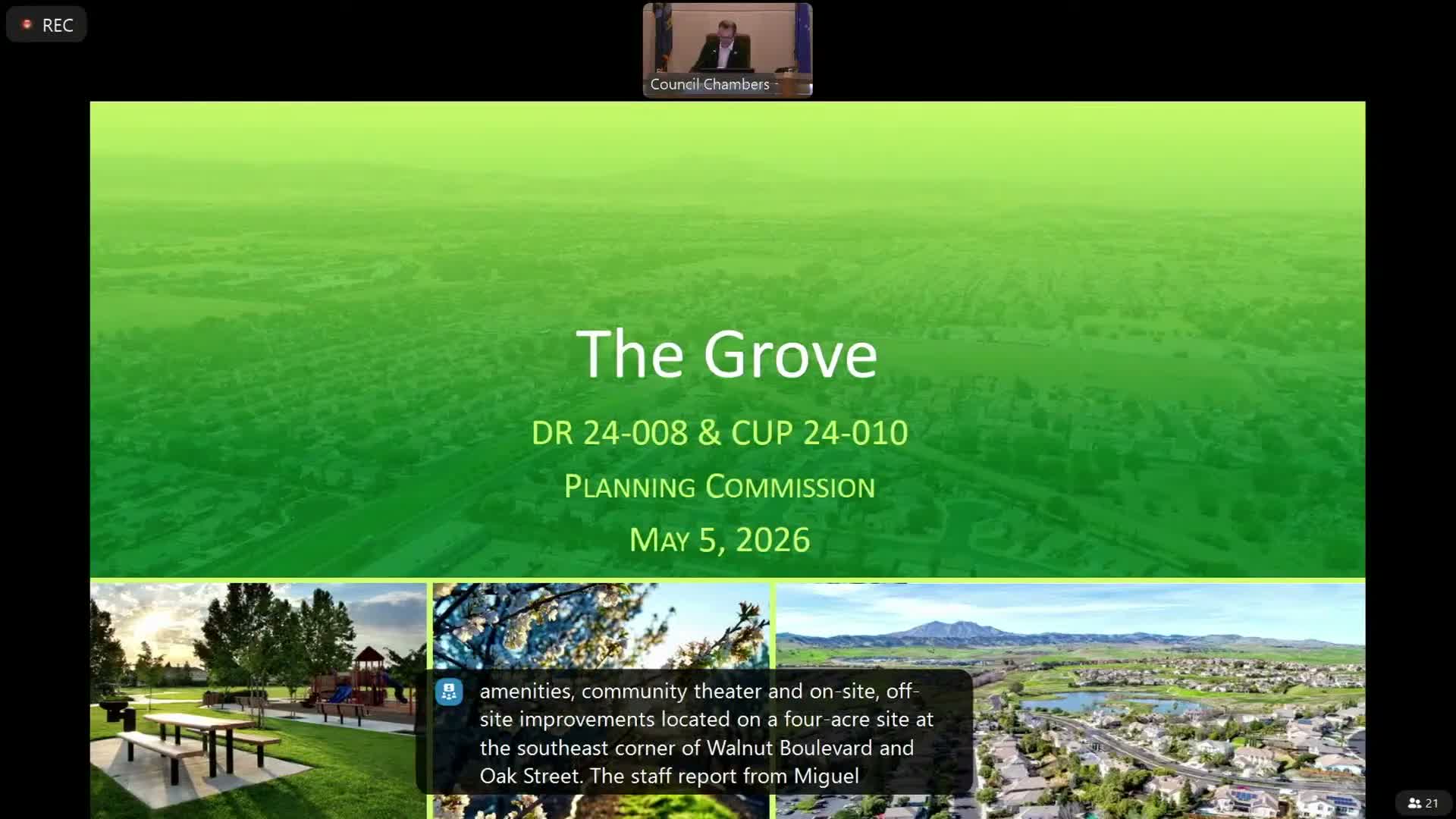
The Brentwood Planning Commission voted May 5 to approve design review and a conditional use permit for The Grove at Brentwood, a proposed two‑story, multi‑tenant commercial development at the southeast corner of Walnut Boulevard and Oak Street that will include shops, cafes, a community theater and about 24,000 square feet of outdoor seating.
Miguel, the city planner who presented the staff report, said the project—design review application 24‑008 and conditional use permit 24‑010—would build a roughly 35,690‑square‑foot shell building on a 4‑acre site, provide approximately 144 parking spaces, and include a small community amphitheater with lighting and sound. He said the project is consistent with the downtown specific plan and is statutorily exempt from CEQA under the Class 32 infill exemption. "The draft conditions of approval would require adherence by the applicant and all tenants to ABC regulations and recommendations," Miguel said.
The application requests both on‑site and off‑site alcohol sales and consumption; staff noted the ABC license types the project could pursue and that tenant alcohol sales would be limited to between 6 a.m. and 12 a.m. The applicant proposed that the community theater operate between 10 a.m. and 10 p.m., and staff said the project must meet the city's existing noise standards.
During the public comment period the commission heard sustained support from local business leaders and residents. "The Grove would bring in over 30,000 square feet of commercial space to the Walnut and Oak corridor," Denise Cosgrove, president of the Brentwood Chamber of Commerce, told the commission, saying the project would create local jobs and support small businesses. Architect Lance Cornell of SDG said the building was designed to echo downtown architecture and that the two tower elements were intended as visual landmarks aligned with Walnut Boulevard.
Commissioners focused questions on parking, circulation, noise from events and the height of an architectural projection that staff had flagged as exceeding a stated plan limit in parts of the packet. Commissioner Roberts said she appreciated community turnout and asked about solar and delivery circulation; Lance Cornell said solar is being evaluated under CalGreen requirements and described a separate shipping/receiving area intended to keep deliveries out of customer circulation.
There was also discussion about hours of alcohol service. Some commissioners urged limiting late‑night hours to reduce potential neighborhood impacts; others cautioned that strict curfews could constrain tenant mix and the project's economic viability. Staff told the commission the downtown specific plan is silent for this particular zoning district on alcohol hours, so authority over later hours rests with a CUP.
On a motion that included a friendly amendment to remove the draft condition requiring the middle tower projection to be reduced, the commission adopted Resolution No. 26‑010 approving Design Review No. 25‑008. The commission then adopted Resolution No. 26‑011, approving Conditional Use Permit No. 25‑010. Chair Brand congratulated the applicant, and the commission closed the public hearing.
Next steps: the approvals are subject to the written findings and conditions contained in the adopted resolutions; any appeal of commission action must be filed with the city clerk within 10 days.
Miguel, the city planner who presented the staff report, said the project—design review application 24‑008 and conditional use permit 24‑010—would build a roughly 35,690‑square‑foot shell building on a 4‑acre site, provide approximately 144 parking spaces, and include a small community amphitheater with lighting and sound. He said the project is consistent with the downtown specific plan and is statutorily exempt from CEQA under the Class 32 infill exemption. "The draft conditions of approval would require adherence by the applicant and all tenants to ABC regulations and recommendations," Miguel said.
The application requests both on‑site and off‑site alcohol sales and consumption; staff noted the ABC license types the project could pursue and that tenant alcohol sales would be limited to between 6 a.m. and 12 a.m. The applicant proposed that the community theater operate between 10 a.m. and 10 p.m., and staff said the project must meet the city's existing noise standards.
During the public comment period the commission heard sustained support from local business leaders and residents. "The Grove would bring in over 30,000 square feet of commercial space to the Walnut and Oak corridor," Denise Cosgrove, president of the Brentwood Chamber of Commerce, told the commission, saying the project would create local jobs and support small businesses. Architect Lance Cornell of SDG said the building was designed to echo downtown architecture and that the two tower elements were intended as visual landmarks aligned with Walnut Boulevard.
Commissioners focused questions on parking, circulation, noise from events and the height of an architectural projection that staff had flagged as exceeding a stated plan limit in parts of the packet. Commissioner Roberts said she appreciated community turnout and asked about solar and delivery circulation; Lance Cornell said solar is being evaluated under CalGreen requirements and described a separate shipping/receiving area intended to keep deliveries out of customer circulation.
There was also discussion about hours of alcohol service. Some commissioners urged limiting late‑night hours to reduce potential neighborhood impacts; others cautioned that strict curfews could constrain tenant mix and the project's economic viability. Staff told the commission the downtown specific plan is silent for this particular zoning district on alcohol hours, so authority over later hours rests with a CUP.
On a motion that included a friendly amendment to remove the draft condition requiring the middle tower projection to be reduced, the commission adopted Resolution No. 26‑010 approving Design Review No. 25‑008. The commission then adopted Resolution No. 26‑011, approving Conditional Use Permit No. 25‑010. Chair Brand congratulated the applicant, and the commission closed the public hearing.
Next steps: the approvals are subject to the written findings and conditions contained in the adopted resolutions; any appeal of commission action must be filed with the city clerk within 10 days.
Don't Miss a Word: See the Full Meeting!
Go beyond summaries. Unlock every video, transcript, and key insight with a Founder Membership.
✓
Get instant access to full meeting videos
✓
Search and clip any phrase from complete transcripts
✓
Receive AI-powered summaries & custom alerts
✓
Enjoy lifetime, unrestricted access to government data
30-day money-back guarantee
