Health officials report rising COVID cases, racial disparities and caution about reopening; sheriff and fire chiefs give status reports
May 06, 2026 | Alameda County, California
This article was created by AI summarizing key points discussed. AI makes mistakes, so for full details and context, please refer to the video of the full meeting. Please report any errors so we can fix them. Report an error »
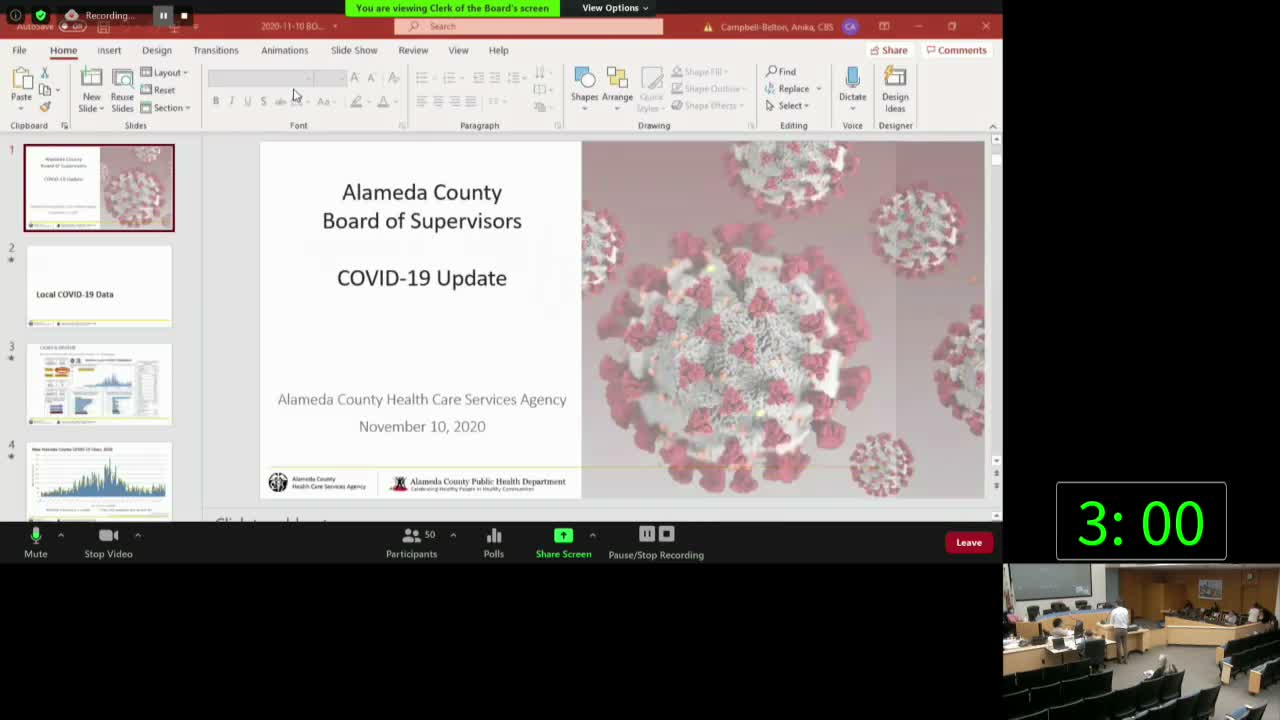
County health officials told the Alameda County Board of Supervisors the county is seeing an increase in COVID‑19 case rates and hospitalizations and reiterated that racial and neighborhood disparities persist.
"Alameda County, this is yesterday's data: 24,851 total cases...475 total deaths," Dr. Moss said, noting a recent uptick in daily case rates and that the county remained in the state's orange tier but could move to red if increases continue.
Dr. Moss highlighted disparities: cumulative cases and rates are highest among Latinx residents and mortality is highest among Black residents. He noted data limits — roughly 20% of case reports lack race/ethnicity information — and said staff will track how new increases distribute across populations and neighborhoods.
On capacity and operations, Dr. Moss said testing remains a county priority, hospitalizations have risen modestly, and the county is pausing reopening while monitoring trends. "We are going to be guided by the state's system...but COVID moves fast and the state system moves slowly," he said.
Fire Chief Willie McDonald reported that November incident volumes exceeded November 2019 and that the department had 18 confirmed COVID‑positive firefighters and 84 employees quarantined since March; currently there were two active positives and three employees in quarantine.
Undersheriff Lucia reported 2,152 inmates in custody and described testing and release practices: 5,310 tests had been administered in custody, of which the transcript records 269 positive tests and 78 pending results; the department has two hospitalizations and no in‑custody deaths since the pandemic began. Lucia said the jail population fell early in the pandemic due to releases authorized by courts and has climbed back as arrests resumed; about 140 inmates who are sentenced to state prison remain in custody because state facilities are not accepting transfers.
Board members asked how released positive inmates are supported; public‑health staff described procedures to isolate released positives, provide instructions and follow up to identify contacts and ensure isolation. On shelters and homeless hotels the board heard staff say the county will phase down hotel usage and work individually with roughly 1,100 people then housed in hotels to find more stable housing and rental assistance.
Next steps: health staff will continue to share dashboard updates, neighborhood and race/ethnicity breakdowns, and will monitor the state tier status to inform reopening decisions.
"Alameda County, this is yesterday's data: 24,851 total cases...475 total deaths," Dr. Moss said, noting a recent uptick in daily case rates and that the county remained in the state's orange tier but could move to red if increases continue.
Dr. Moss highlighted disparities: cumulative cases and rates are highest among Latinx residents and mortality is highest among Black residents. He noted data limits — roughly 20% of case reports lack race/ethnicity information — and said staff will track how new increases distribute across populations and neighborhoods.
On capacity and operations, Dr. Moss said testing remains a county priority, hospitalizations have risen modestly, and the county is pausing reopening while monitoring trends. "We are going to be guided by the state's system...but COVID moves fast and the state system moves slowly," he said.
Fire Chief Willie McDonald reported that November incident volumes exceeded November 2019 and that the department had 18 confirmed COVID‑positive firefighters and 84 employees quarantined since March; currently there were two active positives and three employees in quarantine.
Undersheriff Lucia reported 2,152 inmates in custody and described testing and release practices: 5,310 tests had been administered in custody, of which the transcript records 269 positive tests and 78 pending results; the department has two hospitalizations and no in‑custody deaths since the pandemic began. Lucia said the jail population fell early in the pandemic due to releases authorized by courts and has climbed back as arrests resumed; about 140 inmates who are sentenced to state prison remain in custody because state facilities are not accepting transfers.
Board members asked how released positive inmates are supported; public‑health staff described procedures to isolate released positives, provide instructions and follow up to identify contacts and ensure isolation. On shelters and homeless hotels the board heard staff say the county will phase down hotel usage and work individually with roughly 1,100 people then housed in hotels to find more stable housing and rental assistance.
Next steps: health staff will continue to share dashboard updates, neighborhood and race/ethnicity breakdowns, and will monitor the state tier status to inform reopening decisions.
View the Full Meeting & All Its Details
This article offers just a summary. Unlock complete video, transcripts, and insights as a Founder Member.
✓
Watch full, unedited meeting videos
✓
Search every word spoken in unlimited transcripts
✓
AI summaries & real-time alerts (all government levels)
✓
Permanent access to expanding government content
30-day money-back guarantee
