Residents urge Kent council to disclose Flock/ALPR camera locations and tighten safeguards
May 06, 2026 | Kent, King County, Washington
This article was created by AI summarizing key points discussed. AI makes mistakes, so for full details and context, please refer to the video of the full meeting. Please report any errors so we can fix them. Report an error »
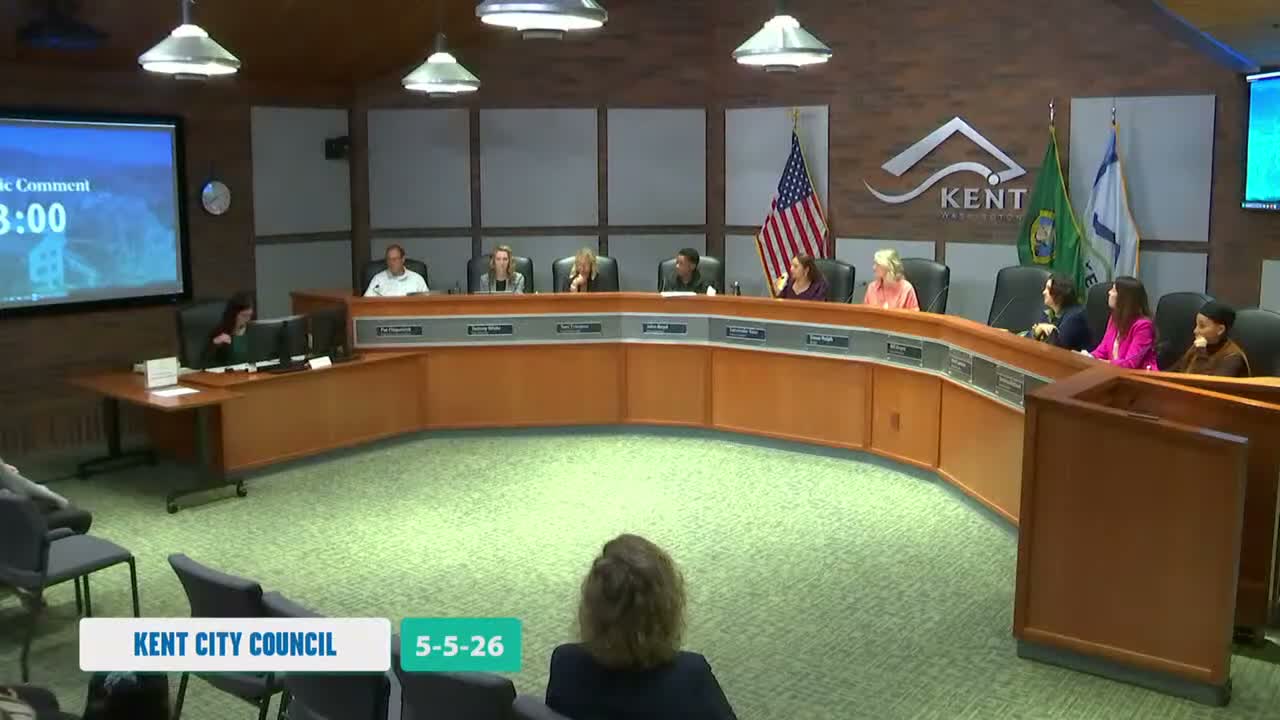
Kent — Multiple public commenters at Tuesdayvening's Kent City Council meeting urged the city to pause its ALPR (automatic license plate reader) and Flock Safety camera program, disclose camera locations and strengthen contractual safeguards to limit data sharing with federal agencies.
"Where are the cameras? Are they by a church, a school, a food bank, a sensitive area stated in the new law that needs to be removed or turned off?" asked Barbara Clements, who also questioned the master service agreement and whether the vendor could share data without a warrant. Clements noted other local councils had restricted or turned off cameras and urged interactive community outreach to address resident concerns.
Leslie Bidlak of Kent Indivisible said she had found cameras watching routine errands and warned that the technology, and potential drone uses, risked creating a "surveillance state." "We are hurtling very fast into a dystopian world where '1984' is not fiction," Bidlak said.
Kara Haney, a Kent East Hill resident, asked the council to go beyond the minimum required by ESSB 6002 and hold a well-publicized public hearing showing camera locations and compliance steps. She said families in Kent are living in fear and asked the council to "be brave" and adopt stronger protections for residents whose immigration status or livelihoods could be affected by broad data collection.
Council members did not take action during the public comment period. Mayor Dana Ralph reminded speakers of the public comment rules and the three-minute time limit and said the council would continue to process items on the published agenda.
Speakers asked for specific clarifications including: a public map of camera locations, a copy of the master service agreement and whom the city will notify when an outside agency requests data. Several commenters referenced recent state guidance and decisions by other cities (Tukwila and Renton) to reduce or suspend camera operations.
The city did not present a staff report on ALPR policy during the meeting; callers asked that staff and council schedule a dedicated public hearing and publish any applicable policy and procedural safeguards online.
"Where are the cameras? Are they by a church, a school, a food bank, a sensitive area stated in the new law that needs to be removed or turned off?" asked Barbara Clements, who also questioned the master service agreement and whether the vendor could share data without a warrant. Clements noted other local councils had restricted or turned off cameras and urged interactive community outreach to address resident concerns.
Leslie Bidlak of Kent Indivisible said she had found cameras watching routine errands and warned that the technology, and potential drone uses, risked creating a "surveillance state." "We are hurtling very fast into a dystopian world where '1984' is not fiction," Bidlak said.
Kara Haney, a Kent East Hill resident, asked the council to go beyond the minimum required by ESSB 6002 and hold a well-publicized public hearing showing camera locations and compliance steps. She said families in Kent are living in fear and asked the council to "be brave" and adopt stronger protections for residents whose immigration status or livelihoods could be affected by broad data collection.
Council members did not take action during the public comment period. Mayor Dana Ralph reminded speakers of the public comment rules and the three-minute time limit and said the council would continue to process items on the published agenda.
Speakers asked for specific clarifications including: a public map of camera locations, a copy of the master service agreement and whom the city will notify when an outside agency requests data. Several commenters referenced recent state guidance and decisions by other cities (Tukwila and Renton) to reduce or suspend camera operations.
The city did not present a staff report on ALPR policy during the meeting; callers asked that staff and council schedule a dedicated public hearing and publish any applicable policy and procedural safeguards online.
Don't Miss a Word: See the Full Meeting!
Go beyond summaries. Unlock every video, transcript, and key insight with a Founder Membership.
✓
Get instant access to full meeting videos
✓
Search and clip any phrase from complete transcripts
✓
Receive AI-powered summaries & custom alerts
✓
Enjoy lifetime, unrestricted access to government data
30-day money-back guarantee
