Panel reviews OE‑3 revisions: expands sustainability language, sets renovation reporting and facility benchmarks
May 05, 2026 | Racine Unified School District, School Districts, Wisconsin
This article was created by AI summarizing key points discussed. AI makes mistakes, so for full details and context, please refer to the video of the full meeting. Please report any errors so we can fix them. Report an error »
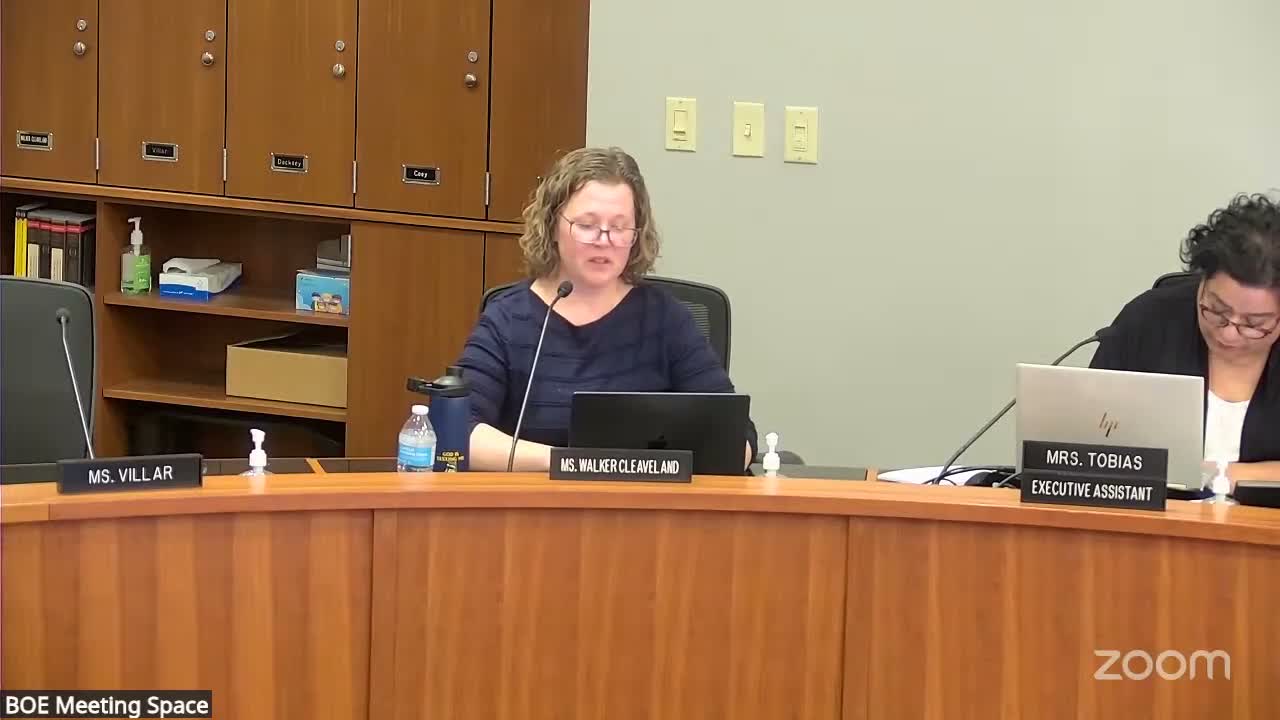
At the May 4, 2026 governance meeting of the Racine Unified School Board, Mr. Reynolds presented recommended revisions to the district's OE‑3 interpretations and performance indicators aimed at clarifying assumptions, broadening sustainability language beyond strict LEED compliance, and adjusting facility benchmarks.
"And they are relatively, minor," Reynolds said at the start of his presentation, describing the edits as refinements to make expectations clearer for staff and contractors. He proposed changing interpretation language in 3.1(e) so that documents identify assumptions used in planning — including enrollment or growth patterns and the financial and staffing impact of projects — rather than requiring a separate, formalized analysis in every instance.
Reynolds also recommended replacing references to "LEED compliance" with broader "environmental sustainability considerations, including LEED or comparable measures," saying the change was intended to avoid excluding other appropriate sustainability approaches when LEED is not used. He said the indicator text was likewise adjusted to "environmental sustainability considerations, including LEED or comparable measures." The presentation added a reporting requirement that renovation projects in excess of $1,000,000 present information in a consistent, standardized format aligned to administrative procedures.
On facility standards, Reynolds said the board's earlier 95% cleanliness benchmark had proven hard to meet during periods of construction and recommended a 90% benchmark as more attainable while still meaningful. He also noted that procedural concerns raised by facility users should be addressed within five business days and staff recommended a 95% responsiveness benchmark for practicality.
Committee members asked whether the policy would cover school closures; Reynolds replied that closing a school would necessitate attendance‑boundary changes and therefore fall under the policy's requirement that the superintendent recommend such changes to the board and obtain board approval prior to implementation. Reynolds noted the district maintains a prioritized five‑year capital maintenance plan and said he believes a long‑range plan is required by state administrative code.
Members discussed where particular items belong in policy documents (facilities vs. governance) and noted some edits to BoardDocs posted that afternoon; Reynolds acknowledged the timing and that not all members' versions would reflect the most recent revisions. He summarized current grade-configuration examples for the district (PK–5; 4K–8; PK–8; 6–12; 9–12) and asked the committee for any additional changes.
The chair said the OE‑3 item will appear on the consent agenda at the full board business meeting unless a member requests it be pulled, and the committee adjourned. No formal vote on the OE‑3 revisions was recorded at this session.
"And they are relatively, minor," Reynolds said at the start of his presentation, describing the edits as refinements to make expectations clearer for staff and contractors. He proposed changing interpretation language in 3.1(e) so that documents identify assumptions used in planning — including enrollment or growth patterns and the financial and staffing impact of projects — rather than requiring a separate, formalized analysis in every instance.
Reynolds also recommended replacing references to "LEED compliance" with broader "environmental sustainability considerations, including LEED or comparable measures," saying the change was intended to avoid excluding other appropriate sustainability approaches when LEED is not used. He said the indicator text was likewise adjusted to "environmental sustainability considerations, including LEED or comparable measures." The presentation added a reporting requirement that renovation projects in excess of $1,000,000 present information in a consistent, standardized format aligned to administrative procedures.
On facility standards, Reynolds said the board's earlier 95% cleanliness benchmark had proven hard to meet during periods of construction and recommended a 90% benchmark as more attainable while still meaningful. He also noted that procedural concerns raised by facility users should be addressed within five business days and staff recommended a 95% responsiveness benchmark for practicality.
Committee members asked whether the policy would cover school closures; Reynolds replied that closing a school would necessitate attendance‑boundary changes and therefore fall under the policy's requirement that the superintendent recommend such changes to the board and obtain board approval prior to implementation. Reynolds noted the district maintains a prioritized five‑year capital maintenance plan and said he believes a long‑range plan is required by state administrative code.
Members discussed where particular items belong in policy documents (facilities vs. governance) and noted some edits to BoardDocs posted that afternoon; Reynolds acknowledged the timing and that not all members' versions would reflect the most recent revisions. He summarized current grade-configuration examples for the district (PK–5; 4K–8; PK–8; 6–12; 9–12) and asked the committee for any additional changes.
The chair said the OE‑3 item will appear on the consent agenda at the full board business meeting unless a member requests it be pulled, and the committee adjourned. No formal vote on the OE‑3 revisions was recorded at this session.
Don't Miss a Word: See the Full Meeting!
Go beyond summaries. Unlock every video, transcript, and key insight with a Founder Membership.
✓
Get instant access to full meeting videos
✓
Search and clip any phrase from complete transcripts
✓
Receive AI-powered summaries & custom alerts
✓
Enjoy lifetime, unrestricted access to government data
30-day money-back guarantee
