Finance committee approves two fund transfers, debates shifting money toward sidewalks, parks and contingency
May 06, 2026 | Annapolis, Anne Arundel County, Maryland
This article was created by AI summarizing key points discussed. AI makes mistakes, so for full details and context, please refer to the video of the full meeting. Please report any errors so we can fix them. Report an error »
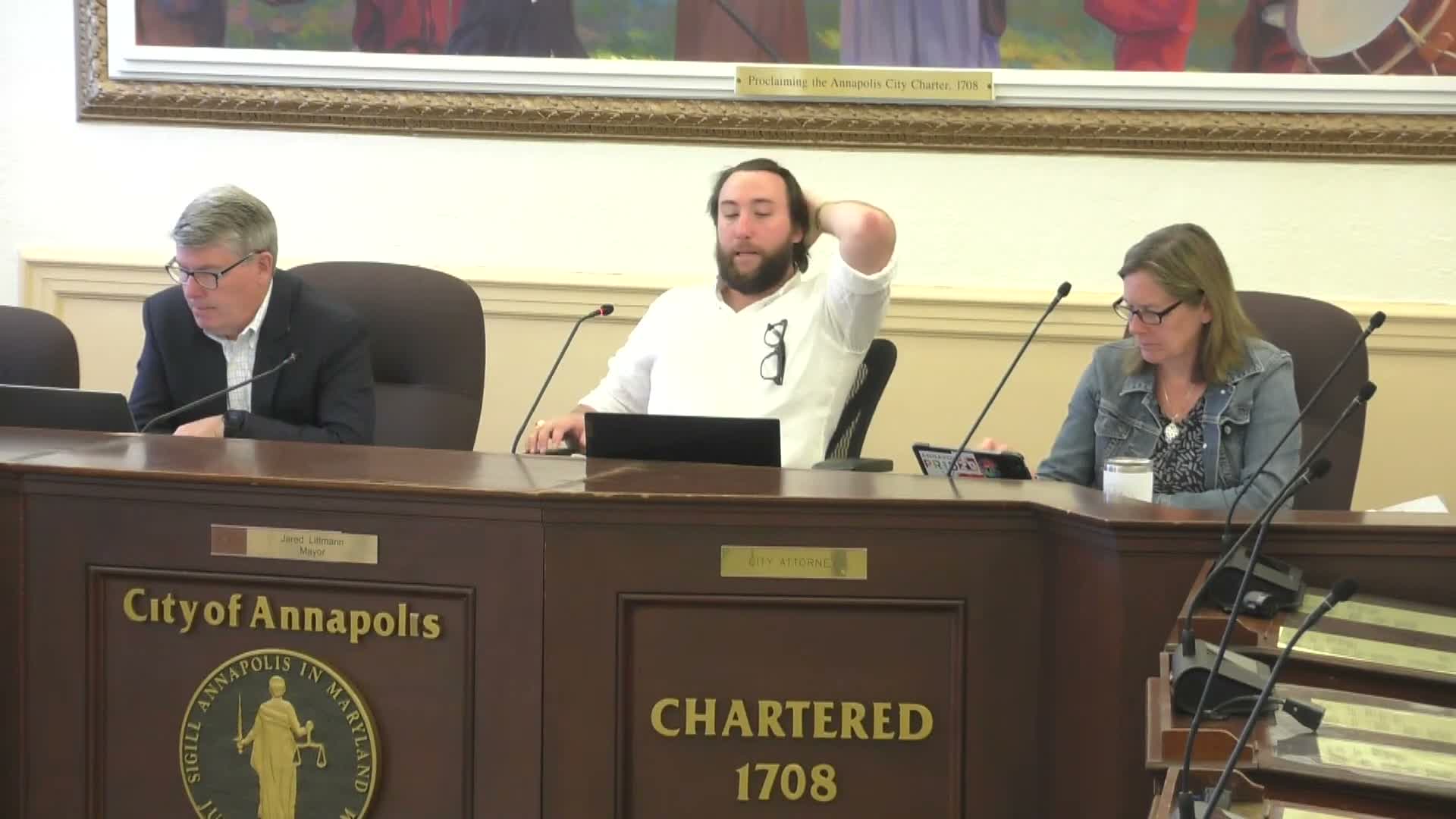
The Annapolis Finance Committee on May 5 approved two fund-transfer items and spent the rest of its meeting debating how to reframe the city budget to emphasize visible services such as sidewalks and parks.
The committee gave a favorable recommendation to FT1126, which staff said moves the stormwater obligation for the Cedar Park Sidewalk project into the city's MS4 stormwater account so required water-quality treatment can occur elsewhere in the same sub-watershed after on-site treatment proved impractical. "There was a stormwater management requirement for that project...it wasn't practical to install the stormwater on-site," said Director Vogel, who explained site constraints and the plan to treat the same volume elsewhere in the watershed.
Members also approved FT1226, a finance-department budget revision that reallocates money from non-allocated debt service and vacancy savings into contractual services to maintain ongoing consulting agreements. Finance staff said the change covers existing consulting needs while the department "scrubs" schedules and verifies debt-service assumptions.
The larger portion of the hearing was a wide-ranging budget discussion about priorities and trade-offs ahead of the committee's report. Chair framed the conversation around near-term deadlines and asked members to focus on where they might shift resources in the coming year. "We have a couple different deadlines...directors must respond by the end of day tomorrow," the Chair said.
Alderman O'Neil urged the committee to reconsider the community-grants allocations to make room for a lone local LGBTQ services provider and suggested swapping contract funding for recurring staff where feasible. "I want us to take a look at parks and rec...it's revenue generating and we can make changes in how funds are allocated," O'Neil said, arguing for converting seasonal parks workers to full-time to improve maintenance.
Alderman Thorpe and other members pressed for more funding and clearer plans for sidewalks and streets, saying residents want visible improvements. Thorpe said the council should "get to 9" on productivity and capacity, meaning the city should provide noticeably better maintenance and infrastructure delivery.
Committee members also debated the new Central Services consolidation. Some supported adding a risk-management specialist to oversee insurance and safety functions; others questioned whether that role or security-guard spending at City Hall was the best use of limited funds. "We have no way of knowing if this is saving 1 life or 100 lives or 0 lives," the Chair said of the security expense, calling for comparison to alternatives such as traffic-calming work that directly affects public safety.
On centralization, budget staff and the acting director said some savings from consolidated contracts (for example, citywide electricity or software licenses) are expected but likely to appear in FY28 when contracts come up for renegotiation. Miss Turner, the budget analyst, told the committee the centralization effort is aligning budgets now so savings can be captured later.
Members discussed technical proposals to recognize vacancy savings more systematically across large departments and to increase contingency reserves. The Chair proposed a conservative algorithm (an "Olympic average" of past vacancy rates) to free one-time funds for contingency or tax relief, coupled with a requirement that half of any realized savings go to contingency.
Several revenue options were floated as potential "pay-fors": bifurcated fees for nonresident use of parks and boat ramps, revisiting short-term-rental fees, and updating liquor-license fees after confirming whether those fees currently fund enforcement positions. Members agreed not to raise liquor-license fees without first verifying how enforcement and inspection costs are currently covered.
The committee scheduled further questions to directors and planned to reconvene for additional deliberations and a closed session the following day. With the clock approaching members' hard stops, the committee adjourned after moving a final motion to end the meeting.
Votes at a glance
FT1126 — Transfer stormwater obligation to MS4 account (Cedar Park sidewalk phase 1): motion moved and seconded; approved by voice vote.
FT1226 — Move unneeded debt service and vacancy savings to contractual services (finance): motion moved and seconded; approved by voice vote.
Next steps
Committee members will submit questions to department directors by the end of the day; directors must reply by the following day. The finance committee's report is due Monday, and members expect further amendment and deliberation before final council votes.
The committee gave a favorable recommendation to FT1126, which staff said moves the stormwater obligation for the Cedar Park Sidewalk project into the city's MS4 stormwater account so required water-quality treatment can occur elsewhere in the same sub-watershed after on-site treatment proved impractical. "There was a stormwater management requirement for that project...it wasn't practical to install the stormwater on-site," said Director Vogel, who explained site constraints and the plan to treat the same volume elsewhere in the watershed.
Members also approved FT1226, a finance-department budget revision that reallocates money from non-allocated debt service and vacancy savings into contractual services to maintain ongoing consulting agreements. Finance staff said the change covers existing consulting needs while the department "scrubs" schedules and verifies debt-service assumptions.
The larger portion of the hearing was a wide-ranging budget discussion about priorities and trade-offs ahead of the committee's report. Chair framed the conversation around near-term deadlines and asked members to focus on where they might shift resources in the coming year. "We have a couple different deadlines...directors must respond by the end of day tomorrow," the Chair said.
Alderman O'Neil urged the committee to reconsider the community-grants allocations to make room for a lone local LGBTQ services provider and suggested swapping contract funding for recurring staff where feasible. "I want us to take a look at parks and rec...it's revenue generating and we can make changes in how funds are allocated," O'Neil said, arguing for converting seasonal parks workers to full-time to improve maintenance.
Alderman Thorpe and other members pressed for more funding and clearer plans for sidewalks and streets, saying residents want visible improvements. Thorpe said the council should "get to 9" on productivity and capacity, meaning the city should provide noticeably better maintenance and infrastructure delivery.
Committee members also debated the new Central Services consolidation. Some supported adding a risk-management specialist to oversee insurance and safety functions; others questioned whether that role or security-guard spending at City Hall was the best use of limited funds. "We have no way of knowing if this is saving 1 life or 100 lives or 0 lives," the Chair said of the security expense, calling for comparison to alternatives such as traffic-calming work that directly affects public safety.
On centralization, budget staff and the acting director said some savings from consolidated contracts (for example, citywide electricity or software licenses) are expected but likely to appear in FY28 when contracts come up for renegotiation. Miss Turner, the budget analyst, told the committee the centralization effort is aligning budgets now so savings can be captured later.
Members discussed technical proposals to recognize vacancy savings more systematically across large departments and to increase contingency reserves. The Chair proposed a conservative algorithm (an "Olympic average" of past vacancy rates) to free one-time funds for contingency or tax relief, coupled with a requirement that half of any realized savings go to contingency.
Several revenue options were floated as potential "pay-fors": bifurcated fees for nonresident use of parks and boat ramps, revisiting short-term-rental fees, and updating liquor-license fees after confirming whether those fees currently fund enforcement positions. Members agreed not to raise liquor-license fees without first verifying how enforcement and inspection costs are currently covered.
The committee scheduled further questions to directors and planned to reconvene for additional deliberations and a closed session the following day. With the clock approaching members' hard stops, the committee adjourned after moving a final motion to end the meeting.
Votes at a glance
FT1126 — Transfer stormwater obligation to MS4 account (Cedar Park sidewalk phase 1): motion moved and seconded; approved by voice vote.
FT1226 — Move unneeded debt service and vacancy savings to contractual services (finance): motion moved and seconded; approved by voice vote.
Next steps
Committee members will submit questions to department directors by the end of the day; directors must reply by the following day. The finance committee's report is due Monday, and members expect further amendment and deliberation before final council votes.
Don't Miss a Word: See the Full Meeting!
Go beyond summaries. Unlock every video, transcript, and key insight with a Founder Membership.
✓
Get instant access to full meeting videos
✓
Search and clip any phrase from complete transcripts
✓
Receive AI-powered summaries & custom alerts
✓
Enjoy lifetime, unrestricted access to government data
30-day money-back guarantee
