National City approves West Air permit for 30,000‑gallon propane tank after safety debate
May 05, 2026 | National City, San Diego County, California
This article was created by AI summarizing key points discussed. AI makes mistakes, so for full details and context, please refer to the video of the full meeting. Please report any errors so we can fix them. Report an error »
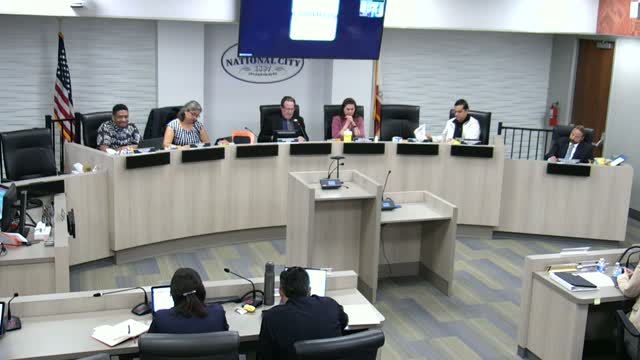
The National City Council on May 5 approved a conditional use permit allowing West Air to install a 30,000‑gallon aboveground liquefied petroleum gas (LPG) storage vessel at 2100 Halfley Avenue, concluding a months‑long planning process that drew heavy public comment about safety and cumulative pollution on the West Side.
Community Development Director Martin Reeder told the council the facility is proposed at an existing industrial site and would require a coastal development permit because the CUP is discretionary. The project, as presented to the council, would include a large horizontal storage tank, automated cylinder‑filling equipment, and one bobtail delivery about every two weeks. Reeder said the site has an existing remediation system from past underground tank leaks and that the planning commission recommended approval by a 3–2 vote.
Why it matters: West Side residents urged delay or denial, saying the neighborhood already bears a disproportionate share of industrial uses and diesel traffic. Council members and staff focused on whether the city’s permitting process and local emergency response plans would adequately mitigate risk if an incident occurred.
Sheila Rogan, a principal environmental health and safety consultant working with West Air, described the equipment and regulatory oversight. “The tank and associated piping will be protected from vehicle impact by the concrete bollards,” Rogan said, and she added that operators will receive “initial and ongoing safety training.” She told the council West Air has other 30,000‑gallon tanks in Oceanside and Garden Grove and, she said, “Westair takes safety very seriously and has not had any incidents resulting in fires or explosions.”
Residents and community organizers pressed a different point: several speakers asked the council to pause new West Side industrial approvals until the city completes a local coastal program update or conducts new air‑quality monitoring. Cynthia Fuller Quinones, for the Healthy Culturas Coalition, urged a short moratorium and a community‑driven assessment, saying a pause would allow the city to study cumulative harms and public health impacts.
Council discussion focused on the safety record, operator training, separation distances required by code, the Fire Department’s review, and the effect of a pending update to the city’s local coastal program. Reeder confirmed that vessels are typically filled to about 80% of capacity to allow for thermal expansion and that the proposed tank would meet NFPA 58 standards and local fire‑code requirements.
Councilmember comments reflected a balance of concerns. One councilmember said they were persuaded by the Fire Department’s participation and the layers of required plans and inspections. Another emphasized the need for continued engagement with community groups on West Side land‑use priorities.
The council voted 4–1 to approve certification of the negative declaration and the conditional use permit, attaching the staff‑recommended conditions addressing fire safety, monitoring and tribal‑resource protections. Councilmember Rodriguez cast the lone dissenting vote, citing lingering community safety and cumulative pollution concerns.
What happens next: Conditions of approval require West Air to submit a hazardous‑materials business plan and coordinate emergency response and training with the National City Fire Department and San Diego County CUPA (Certified Unified Program Agency). The approvals are subject to any further permits required by regional or state agencies.
Authorities and key technical details: the project was evaluated under CEQA initial study/negative declaration standards; design and operation will follow NFPA 58 and applicable Cal‑OSHA and Cal‑Fire rules; the San Diego County Department of Environmental Health (CUPA) will review the hazardous materials business plan. The applicant estimated deliveries about once every two weeks and noted typical vessel fill levels are roughly 80% of capacity.
The council’s approval allows West Air to proceed with building and fire‑permit submittals required before installation and operation.
Community Development Director Martin Reeder told the council the facility is proposed at an existing industrial site and would require a coastal development permit because the CUP is discretionary. The project, as presented to the council, would include a large horizontal storage tank, automated cylinder‑filling equipment, and one bobtail delivery about every two weeks. Reeder said the site has an existing remediation system from past underground tank leaks and that the planning commission recommended approval by a 3–2 vote.
Why it matters: West Side residents urged delay or denial, saying the neighborhood already bears a disproportionate share of industrial uses and diesel traffic. Council members and staff focused on whether the city’s permitting process and local emergency response plans would adequately mitigate risk if an incident occurred.
Sheila Rogan, a principal environmental health and safety consultant working with West Air, described the equipment and regulatory oversight. “The tank and associated piping will be protected from vehicle impact by the concrete bollards,” Rogan said, and she added that operators will receive “initial and ongoing safety training.” She told the council West Air has other 30,000‑gallon tanks in Oceanside and Garden Grove and, she said, “Westair takes safety very seriously and has not had any incidents resulting in fires or explosions.”
Residents and community organizers pressed a different point: several speakers asked the council to pause new West Side industrial approvals until the city completes a local coastal program update or conducts new air‑quality monitoring. Cynthia Fuller Quinones, for the Healthy Culturas Coalition, urged a short moratorium and a community‑driven assessment, saying a pause would allow the city to study cumulative harms and public health impacts.
Council discussion focused on the safety record, operator training, separation distances required by code, the Fire Department’s review, and the effect of a pending update to the city’s local coastal program. Reeder confirmed that vessels are typically filled to about 80% of capacity to allow for thermal expansion and that the proposed tank would meet NFPA 58 standards and local fire‑code requirements.
Councilmember comments reflected a balance of concerns. One councilmember said they were persuaded by the Fire Department’s participation and the layers of required plans and inspections. Another emphasized the need for continued engagement with community groups on West Side land‑use priorities.
The council voted 4–1 to approve certification of the negative declaration and the conditional use permit, attaching the staff‑recommended conditions addressing fire safety, monitoring and tribal‑resource protections. Councilmember Rodriguez cast the lone dissenting vote, citing lingering community safety and cumulative pollution concerns.
What happens next: Conditions of approval require West Air to submit a hazardous‑materials business plan and coordinate emergency response and training with the National City Fire Department and San Diego County CUPA (Certified Unified Program Agency). The approvals are subject to any further permits required by regional or state agencies.
Authorities and key technical details: the project was evaluated under CEQA initial study/negative declaration standards; design and operation will follow NFPA 58 and applicable Cal‑OSHA and Cal‑Fire rules; the San Diego County Department of Environmental Health (CUPA) will review the hazardous materials business plan. The applicant estimated deliveries about once every two weeks and noted typical vessel fill levels are roughly 80% of capacity.
The council’s approval allows West Air to proceed with building and fire‑permit submittals required before installation and operation.
Don't Miss a Word: See the Full Meeting!
Go beyond summaries. Unlock every video, transcript, and key insight with a Founder Membership.
✓
Get instant access to full meeting videos
✓
Search and clip any phrase from complete transcripts
✓
Receive AI-powered summaries & custom alerts
✓
Enjoy lifetime, unrestricted access to government data
30-day money-back guarantee
