Assembly hearing spotlights predatory NIL contracts and calls for standardized financial literacy for student athletes
May 05, 2026 | California State Assembly, House, Legislative, California
This article was created by AI summarizing key points discussed. AI makes mistakes, so for full details and context, please refer to the video of the full meeting. Please report any errors so we can fix them. Report an error »
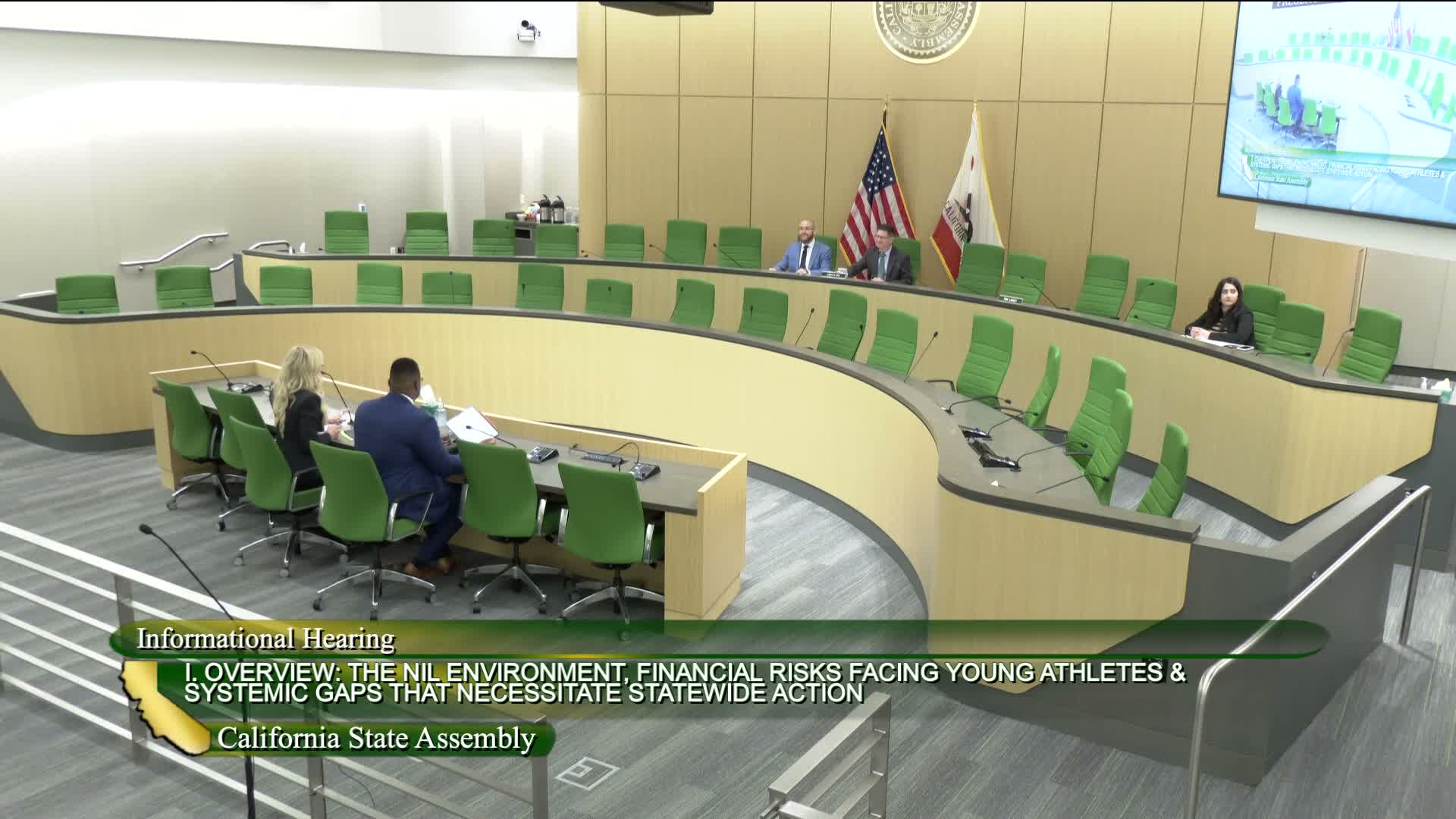
SACRAMENTO, Calif. — Lawmakers, student athletes and university officials told a California State Assembly informational hearing May 5 that the rapid rise of name, image and likeness (NIL) deals has created opportunities for college and high-school athletes — and a new marketplace vulnerable to predatory advances, opaque contracts and wide variation in institutional protections.
Chairman Ward opened the session of the Assembly Committee on Arts, Entertainment, Sports, and Tourism by noting California’s early role in shaping NIL laws and saying the committee wanted to know whether student athletes are receiving sufficient financial education to navigate new offers and contracts.
"NIL created opportunity, but it has also created a new and unregulated financial marketplace," financial educator Tyree Dillingham testified, describing gaps in budgeting, tax literacy and contract comprehension among many athletes and calling for standardized, ongoing coursework rather than occasional workshops.
Several witnesses described contracts that functioned like predatory advances. An Oaktree Solutions consultant who reviewed a high-profile case told the committee that the firm in question advanced $150,000 to a young athlete and received exclusive rights to his NIL, required unpaid public appearances and retained a large share of future revenues while having no contractual obligation to secure deals for the athlete.
"They had attorneys, experience, and a contract designed to benefit them," student athlete Mikey Williams told the committee, describing how he signed an agreement without legal counsel that later contributed to lost endorsements, a lost scholarship, foreclosure on a home and heavy legal fees. "I signed that contract without a lawyer," Williams said. "They own the piece of my greatest asset, which is my NIL."
Brandon Copeland, executive director of athletes.org, urged policymakers to consider formal structures to represent student athletes and set minimum standards for contracts and adviser conduct. "This system was built on multibillion-dollar media deals, and we don't call that chaos. We call that business," Copeland said, arguing a players' association and clearer guardrails could prevent exploitation.
University officials described practical limits on what campuses can do. Adam Shore, athletics director at the University of the Pacific, said institutions increasingly negotiate revenue-sharing arrangements and must balance student protection against liability concerns for giving personalized financial advice. San Diego State representatives described a mandatory, four-year life-skills class that integrates financial literacy, internship placement and branding workshops; a current SDSU student credited those sessions with improving her budgeting and preparation for life after college.
Panelists urged several policy responses currently under consideration: a statewide standard for multi-year financial-literacy instruction, mandatory access to legal review before students sign NIL contracts, adapting or expanding sports-agent registration and licensing rules to the college space, and advocacy for a national solution so differing state rules do not simply shift predatory activity across borders.
No committee votes were held; the hearing was informational. Chairman Ward closed the session by thanking witnesses and saying the committee will consider next steps and possible legislative options.
The committee heard firsthand accounts, institutional models and legal concerns that lawmakers said will inform future policy work on NIL safeguards and financial education for student athletes.
Chairman Ward opened the session of the Assembly Committee on Arts, Entertainment, Sports, and Tourism by noting California’s early role in shaping NIL laws and saying the committee wanted to know whether student athletes are receiving sufficient financial education to navigate new offers and contracts.
"NIL created opportunity, but it has also created a new and unregulated financial marketplace," financial educator Tyree Dillingham testified, describing gaps in budgeting, tax literacy and contract comprehension among many athletes and calling for standardized, ongoing coursework rather than occasional workshops.
Several witnesses described contracts that functioned like predatory advances. An Oaktree Solutions consultant who reviewed a high-profile case told the committee that the firm in question advanced $150,000 to a young athlete and received exclusive rights to his NIL, required unpaid public appearances and retained a large share of future revenues while having no contractual obligation to secure deals for the athlete.
"They had attorneys, experience, and a contract designed to benefit them," student athlete Mikey Williams told the committee, describing how he signed an agreement without legal counsel that later contributed to lost endorsements, a lost scholarship, foreclosure on a home and heavy legal fees. "I signed that contract without a lawyer," Williams said. "They own the piece of my greatest asset, which is my NIL."
Brandon Copeland, executive director of athletes.org, urged policymakers to consider formal structures to represent student athletes and set minimum standards for contracts and adviser conduct. "This system was built on multibillion-dollar media deals, and we don't call that chaos. We call that business," Copeland said, arguing a players' association and clearer guardrails could prevent exploitation.
University officials described practical limits on what campuses can do. Adam Shore, athletics director at the University of the Pacific, said institutions increasingly negotiate revenue-sharing arrangements and must balance student protection against liability concerns for giving personalized financial advice. San Diego State representatives described a mandatory, four-year life-skills class that integrates financial literacy, internship placement and branding workshops; a current SDSU student credited those sessions with improving her budgeting and preparation for life after college.
Panelists urged several policy responses currently under consideration: a statewide standard for multi-year financial-literacy instruction, mandatory access to legal review before students sign NIL contracts, adapting or expanding sports-agent registration and licensing rules to the college space, and advocacy for a national solution so differing state rules do not simply shift predatory activity across borders.
No committee votes were held; the hearing was informational. Chairman Ward closed the session by thanking witnesses and saying the committee will consider next steps and possible legislative options.
The committee heard firsthand accounts, institutional models and legal concerns that lawmakers said will inform future policy work on NIL safeguards and financial education for student athletes.
View the Full Meeting & All Its Details
This article offers just a summary. Unlock complete video, transcripts, and insights as a Founder Member.
✓
Watch full, unedited meeting videos
✓
Search every word spoken in unlimited transcripts
✓
AI summaries & real-time alerts (all government levels)
✓
Permanent access to expanding government content
30-day money-back guarantee
