La Paz County supervisors give staff direction on FY2027 tentative budget, weighing solar lease revenue for one‑time projects
May 04, 2026 | La Paz County, Arizona
This article was created by AI summarizing key points discussed. AI makes mistakes, so for full details and context, please refer to the video of the full meeting. Please report any errors so we can fix them. Report an error »
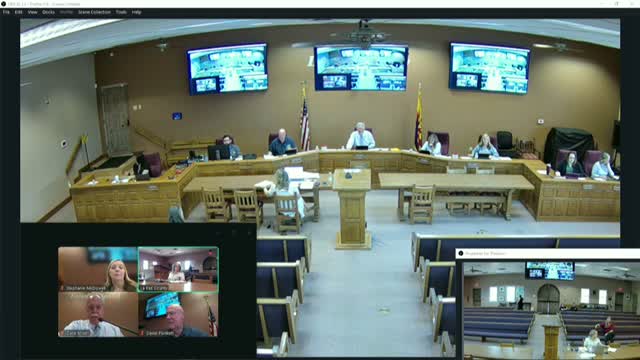
La Paz County Board of Supervisors members on May 4 directed staff to prepare a tentative FY2027 budget that follows the county administrator's recommendations while debating whether to use solar lease revenues for one‑time projects or ongoing costs.
"We're looking for direction today as we prepare the tentative budget for May 18," County Administrator Stephanie said as she opened the work session. Finance staff presented modeling that split potential solar lease income in a $6 million scenario into transfers for landfill, operating and contingency; staff said their recommendation used a lower percentage than the sample model.
Board members pressed staff on which portions of solar revenue would be safe to transfer into the general fund. Karen Ziegler, who walked the board through the levy and five‑year forecast, showed a scenario that included $900,000 from solar lease revenue moved to general operating, $450,000 from landfill and contingency figures that together would bring roughly $2.4 million in transfers to the general fund in the FY27 model. Staff cautioned that committing one‑time solar money to recurring items such as annual COLAs could create deficits in later years.
"If you're going to want to continue with a contingency budget of all of these things, you don't have general fund revenues to support that," Ziegler said, arguing the board must weigh the risk of using one‑time lease dollars for ongoing obligations.
Supervisor Plunkett, advocating for immediate safety projects, urged the board to restore small, one‑time safety and vehicle requests in the capital plan rather than delay them. "Our employee security ... are number 1. Let's get their security right there with it," Plunkett said, pressing for security improvements for assessor and recorder offices.
Board members also debated giving pay increases now: staff estimated a 2.5% COLA and a merit program would cost about $370,000 in FY27 plus roughly $100,000 for employer related expenses; the board was warned those are ongoing costs that must be funded in later budgets. Finance staff noted that a modeled 6% annual growth in expenditures without corresponding sustainable revenue would cause fund‑balance strain by 2031.
Staff summarized the recommended approach as: include the county administrator's recommended departmental funding, phase major capital costs (such as a financial and HR system) across fiscal years where feasible, and prioritize security as funding allows. The board recorded a motion to accept the administrator's recommendations during the session; the transcript records the motion being made but does not show a second or a recorded vote.
Next steps: staff will prepare a tentative FY2027 budget reflecting the board's direction and return it to the board on May 18 for formal consideration.
"We're looking for direction today as we prepare the tentative budget for May 18," County Administrator Stephanie said as she opened the work session. Finance staff presented modeling that split potential solar lease income in a $6 million scenario into transfers for landfill, operating and contingency; staff said their recommendation used a lower percentage than the sample model.
Board members pressed staff on which portions of solar revenue would be safe to transfer into the general fund. Karen Ziegler, who walked the board through the levy and five‑year forecast, showed a scenario that included $900,000 from solar lease revenue moved to general operating, $450,000 from landfill and contingency figures that together would bring roughly $2.4 million in transfers to the general fund in the FY27 model. Staff cautioned that committing one‑time solar money to recurring items such as annual COLAs could create deficits in later years.
"If you're going to want to continue with a contingency budget of all of these things, you don't have general fund revenues to support that," Ziegler said, arguing the board must weigh the risk of using one‑time lease dollars for ongoing obligations.
Supervisor Plunkett, advocating for immediate safety projects, urged the board to restore small, one‑time safety and vehicle requests in the capital plan rather than delay them. "Our employee security ... are number 1. Let's get their security right there with it," Plunkett said, pressing for security improvements for assessor and recorder offices.
Board members also debated giving pay increases now: staff estimated a 2.5% COLA and a merit program would cost about $370,000 in FY27 plus roughly $100,000 for employer related expenses; the board was warned those are ongoing costs that must be funded in later budgets. Finance staff noted that a modeled 6% annual growth in expenditures without corresponding sustainable revenue would cause fund‑balance strain by 2031.
Staff summarized the recommended approach as: include the county administrator's recommended departmental funding, phase major capital costs (such as a financial and HR system) across fiscal years where feasible, and prioritize security as funding allows. The board recorded a motion to accept the administrator's recommendations during the session; the transcript records the motion being made but does not show a second or a recorded vote.
Next steps: staff will prepare a tentative FY2027 budget reflecting the board's direction and return it to the board on May 18 for formal consideration.
Don't Miss a Word: See the Full Meeting!
Go beyond summaries. Unlock every video, transcript, and key insight with a Founder Membership.
✓
Get instant access to full meeting videos
✓
Search and clip any phrase from complete transcripts
✓
Receive AI-powered summaries & custom alerts
✓
Enjoy lifetime, unrestricted access to government data
30-day money-back guarantee
